


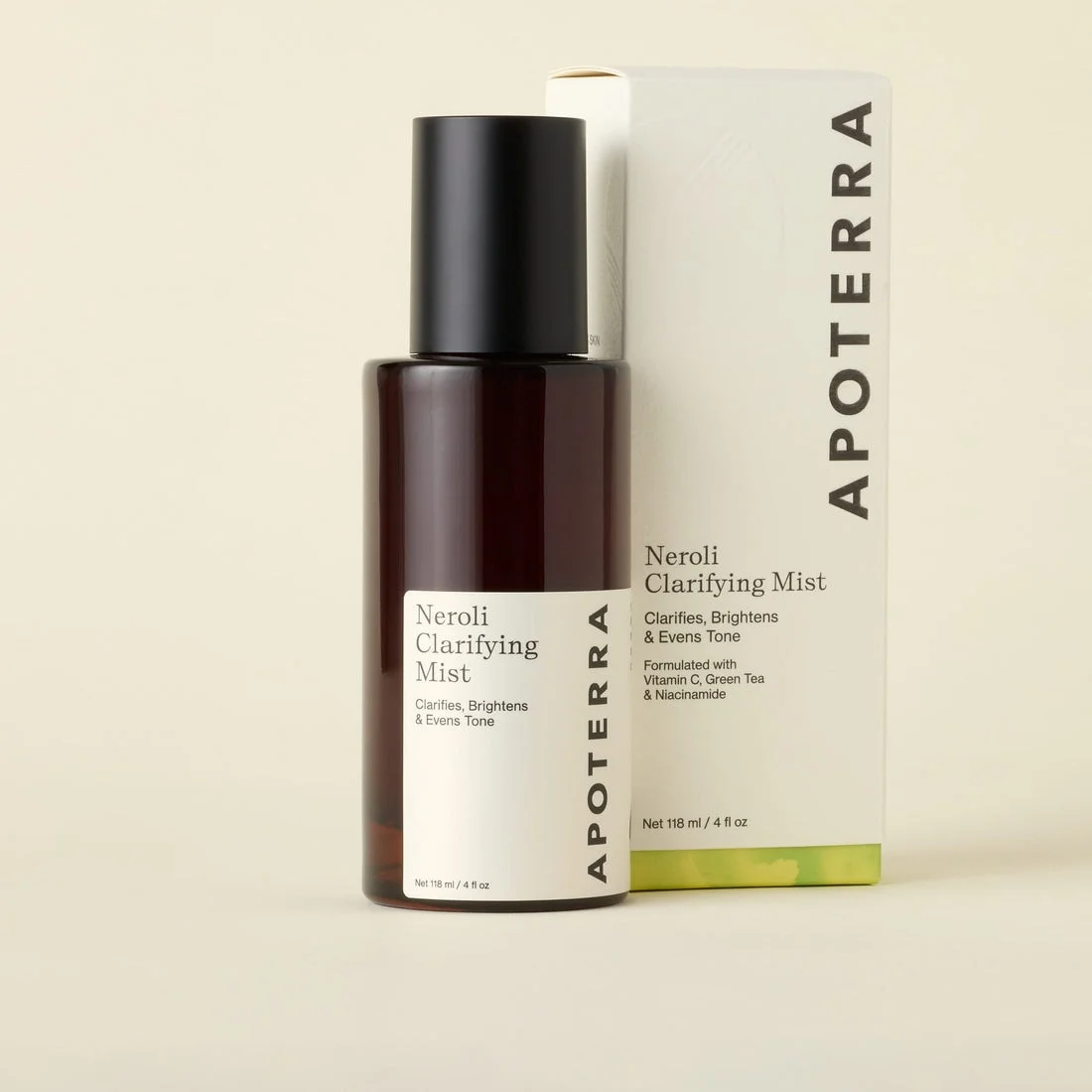
Analysis locked
How well does your skin match with Apoterra Neroli Clarifying Mist?
Login to see detailsOr continue via
Quick 1-minute survey • Completely free
Ingredients
Analysis results of Ingredients


Ingredient List
| EWG | CIR | Ingredient Name & Cosmetic Function | Notes |
|---|---|---|---|
| 1 2 | - | (Skin Conditioning, Fragrance) | |
| 1 | - | | |
| - | - | Thymus Vulgaris (Thyme) Water | |
| 1 | - | (Skin Conditioning, Masking) | |


Apoterra Neroli Clarifying Mist - Ingredient Explanation
Citrus Aurantium Amara (Neroli) Flower Water
1. Definition Citrus Aurantium Amara (Bitter Orange) Flower Water:
Citrus Aurantium Amara (Bitter Orange) Flower Water is a natural floral water derived from the distillation of bitter orange blossoms. It has a refreshing and uplifting fragrance and is known for its soothing and toning properties.2. Use:
Bitter Orange Flower Water is commonly used in cosmetics and skincare products for its hydrating, balancing, and revitalizing effects on the skin. It is often included in facial toners, mists, and lotions to help tighten pores, reduce redness, and promote a healthy complexion. Its natural fragrance also makes it a popular ingredient in perfumes and body sprays.3. Usage Citrus Aurantium Amara (Bitter Orange) Flower Water:
Bitter Orange Flower Water can be applied directly to the skin as a refreshing mist or used as a toner after cleansing. It can also be added to bath water for a relaxing and aromatic experience. When using products containing Bitter Orange Flower Water, it is important to perform a patch test first to check for any allergic reactions. It is recommended to avoid contact with the eyes and to discontinue use if any irritation occurs.4. References:
- Almeida IF, Valentão P, Andrade PB, Seabra RM, Pereira TM. "Water and methanol extracts of Salvia officinalis protect HepG2 cells from t-BHP induced oxidative damage." Chem Biol Interact. 2007;167(2):107-15. doi: 10.1016/j.cbi.2007.02.004.
- Reuter J, Merfort I, Schempp CM. "Botanicals in dermatology: an evidence-based review." Am J Clin Dermatol. 2010;11(4):247-67. doi: 10.2165/11317030-000000000-00000.
- Casetti F, Wölfle U, Gehring W, Schempp CM. "Dermocosmetics for dry skin: a new role for botanical extracts." Skin Pharmacol Physiol. 2011;24(6):309-14. doi: 10.1159/000330044.
Helichrysum Italicum (Immortelle) Flower Water
1. Definition Helichrysum Italicum (Everlasting) Flower Water:
Helichrysum Italicum (Everlasting) Flower Water is a natural floral water obtained through the steam distillation of the flowers of the Helichrysum Italicum plant. This aromatic water contains the beneficial properties of the plant, including anti-inflammatory, antioxidant, and skin-soothing benefits.2. Use:
Helichrysum Italicum Flower Water is commonly used in cosmetics for its skin-rejuvenating properties. It is known to help improve the appearance of scars, fine lines, and wrinkles, as well as soothe irritated or inflamed skin. This floral water is often included in skincare products such as toners, serums, and creams to promote healthy, radiant skin.3. Usage Helichrysum Italicum (Everlasting) Flower Water:
When using Helichrysum Italicum Flower Water in cosmetics, it is important to patch test the product first to ensure compatibility with your skin. This floral water can be applied directly to the skin or mixed with other skincare ingredients for added benefits. It is recommended to store products containing Helichrysum Italicum Flower Water in a cool, dark place to preserve its potency.4. References:
- Bagci, E., & Aydin, E. (2018). Evaluation of the wound healing potential of Helichrysum italicum (Roth) G. Don. on skin burn: histopathological and immunohistochemical studies. Biotech Histochem, 93(4), 257-264.
- Gavazzoni Dias, M. F. (2015). The therapeutic properties of Helichrysum italicum: from antioxidant, antifungal, antibacterial, anti-inflammatory to anticancer activities. J Pharm Pharmacol, 67(10), 1465-1474.
- Tundis, R., Loizzo, M. R., Menichini, F., Statti, G. A., & Menichini, F. (2008). Biological and pharmacological activities of iridoids: recent developments. Mini Rev Med Chem, 8(4), 399-420.
Thymus Vulgaris (Thyme) Water
Ingredient data is being updated. Please check back later.
Cistus Ladaniferus (Rock Rose) Leaf/Stem Water
1. Definition Cistus Ladaniferus Leaf/Stem Water:
Cistus Ladaniferus Leaf/Stem Water, also known as Rock Rose Water, is a hydrosol obtained through the steam distillation of the leaves and stems of the Cistus Ladaniferus plant. This aromatic plant is native to the Mediterranean region and is known for its soothing and healing properties.2. Use:
Cistus Ladaniferus Leaf/Stem Water is commonly used in cosmetics for its astringent, toning, and anti-inflammatory properties. It is often included in skincare products such as toners, face mists, and serums to help tighten pores, reduce redness, and calm irritated skin. Additionally, it is believed to have antioxidant properties that can help protect the skin from environmental stressors.3. Usage Cistus Ladaniferus Leaf/Stem Water:
Cistus Ladaniferus Leaf/Stem Water can be used directly on the skin as a refreshing mist or toner. Simply spritz it onto the face after cleansing to hydrate and tone the skin. It can also be used as a soothing compress for irritated or sunburned skin. For best results, store the product in a cool, dark place and use within six months of opening.4. References:
- Gomes, S., Silva, C., Silva, M. S., & Silva, A. M. (2017). Cistus ladanifer L. Hydrosol: Chemical characterization and bioactivity. Industrial Crops and Products, 109, 661-669.
- Gonçalves, S., Gomes, D., Costa, P., Romano, A., & Silva, S. (2017). Cistus ladanifer L. subsp. ladanifer and Cistus ladanifer L. subsp. sulcatus: A comprehensive review on the health and cosmetic applications of these Mediterranean shrubs. Industrial Crops and Products, 95, 629-642.
- Bakkali, F., Averbeck, S., Averbeck, D., & Idaomar, M. (2008). Biological effects of essential oils – A review. Food and Chemical Toxicology, 46(2), 446-475.
Review

Didn't find
the information you need?



Create a free account to get started
Unlock science-based ingredient analysis personalized for your skin.
Already have an account? Log in
We protect your privacy. We never send spam.