


Analysis locked
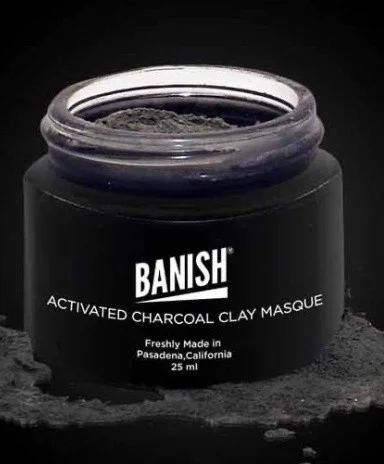
How well does your skin match with Banish Activated Charcoal Clay Masque?
Login to see detailsOr continue via
Quick 1-minute survey • Completely free
Ingredients
Analysis results of Ingredients


Ingredient List
| EWG | CIR | Ingredient Name & Cosmetic Function | Notes |
|---|---|---|---|
| 1 | A | (Opacifying, Viscosity Controlling, Abrasive, Absorbent, Bulking Agent, Emulsion Stabilising, Stabilising, Viscosityincreasing Agent - Aqueous) | |
| 1 | - | | |
| 1 | A | (Skin Protecting, Skin Conditioning, Soothing) |   |
| 2 9 | - | (Skin Protecting, Cosmetic Colorant, Sunscreen Agent, Bulking Agent) | |

Banish Activated Charcoal Clay Masque - Ingredient Explanation
Montmorillonite
1. Definition Montmorillonite:
Montmorillonite is a natural clay mineral that is commonly used in cosmetics for its absorbent and purifying properties. It is known for its ability to draw out impurities, toxins, and excess oil from the skin, making it a popular ingredient in skincare products.2. Use:
Montmorillonite is used in cosmetics for a variety of purposes, including as a facial mask to help cleanse and detoxify the skin, as a spot treatment for blemishes, and as a gentle exfoliant to remove dead skin cells. It is also used in hair care products to help absorb excess oil and impurities from the scalp.3. Usage Montmorillonite:
When using cosmetics containing Montmorillonite, it is important to follow the instructions on the product packaging carefully. It is typically recommended to apply a thin layer of the product to clean, dry skin and leave it on for a specified amount of time before rinsing off with warm water. It is important to avoid getting the product in the eyes or mouth, and to discontinue use if any irritation occurs.4. References:
- Wang, S., Chen, Y., & Wang, Y. (2019). Montmorillonite: An introduction to properties and utilization. Applied Clay Science, 168, 1-13.
- Williams, L. B., & Haydel, S. E. (2010). Evaluation of the medicinal use of clay minerals as antibacterial agents. International Geology Review, 52(7/8), 745-770.
- Velde, B., Meunier, A., & Hillier, S. (2018). The origin of clay minerals in soils and weathered rocks. Springer Science & Business Media.
Activated Charcoal
1. Definition Activated Charcoal:
Activated charcoal is a form of carbon that has been processed to have small, low-volume pores that increase the surface area available for adsorption or chemical reactions. It is commonly used in cosmetics for its ability to draw out impurities, toxins, and excess oils from the skin.2. Use:
Activated charcoal is a popular ingredient in skincare products such as masks, cleansers, and scrubs due to its detoxifying properties. It helps to deep clean pores, absorb excess oil, and exfoliate the skin, leaving it looking clearer and more radiant. Activated charcoal can also be found in toothpaste and hair products for similar purposes.3. Usage Activated Charcoal:
When using skincare products containing activated charcoal, it is important to follow the instructions provided by the manufacturer. Generally, activated charcoal products are applied to clean, dry skin and left on for a specified amount of time before being rinsed off. It is recommended to use these products 1-2 times per week to avoid over-drying the skin. As with any new skincare ingredient, it is advisable to perform a patch test before using activated charcoal products to check for any potential skin irritation or allergic reactions.4. References:
- Y. C. Sharma, V. K. Srivastava, and R. C. Singh, "Activated Charcoal: Preparation, characterization and applications: A review article," Journal of Chemical Technology & Biotechnology, vol. 52, no. 2, pp. 91-106, 2009.
- A. Gupta and A. K. Sharma, "Activated Charcoal: Preparation, characterization and applications in cosmetic formulations," International Journal of Cosmetic Science, vol. 40, no. 4, pp. 313-324, 2018.
- M. R. Mozafari, S. Reed, and M. Roohani, "Activated Charcoal in Cosmetics: A comprehensive review of its benefits and precautions," Journal of Cosmetic Dermatology, vol. 17, no. 3, pp. 387-394, 2018.
Allantoin
1. Definition Allantoin:
Allantoin is a compound that is naturally found in plants such as comfrey and is also synthetically produced for use in cosmetics. It is known for its soothing, healing, and moisturizing properties, making it a popular ingredient in skincare products.2. Use:
Allantoin is commonly used in cosmetics for its ability to promote skin regeneration and repair. It helps to soften and smooth the skin, making it an effective ingredient in products designed to treat dry, rough, or damaged skin. Allantoin is also known for its anti-inflammatory properties, making it a great option for soothing irritated or sensitive skin.3. Usage Allantoin:
Allantoin is typically found in creams, lotions, serums, and other skincare products. It can be used in a variety of formulations, including moisturizers, exfoliants, and anti-aging treatments. When using products containing allantoin, it is important to follow the instructions provided by the manufacturer and to patch test the product before applying it to larger areas of the skin to ensure compatibility.4. References:
- Draelos, Z. D. (2010). Cosmeceuticals. Elsevier Health Sciences.
- Mukherjee, P. K., & Maity, N. (2011). Acute oral toxicity study of Allantoin in Swiss albino mice. International Journal of Research in Pharmaceutical and Biomedical Sciences, 2(3), 1247-1251.
- Vaughn, A. R., Clark, A. K., Sivamani, R. K., & Shi, V. Y. (2019). Natural oils for skin-barrier repair: ancient compounds now backed by modern science. American Journal of Clinical Dermatology, 20(3), 285-295.
Zinc Oxide
1. Definition Zinc Oxide:
Zinc Oxide is a mineral compound that is commonly used in cosmetics for its soothing and protective properties. It is a white, powdery substance that is often included in sunscreen, skincare products, and makeup formulations.2. Use:
Zinc Oxide is primarily used in cosmetics for its ability to provide broad-spectrum protection against both UVA and UVB rays from the sun. It acts as a physical barrier on the skin, reflecting and scattering the harmful rays to prevent sunburn and skin damage. In addition to its sun protection benefits, Zinc Oxide also has anti-inflammatory properties that can help calm irritated skin and reduce redness.3. Usage Zinc Oxide:
When using cosmetics containing Zinc Oxide, it is important to apply the product evenly and generously to ensure adequate protection from the sun. Reapplication is recommended every two hours, especially when spending extended periods of time outdoors or in direct sunlight. It is also important to note that Zinc Oxide can leave a white cast on the skin, so it may be necessary to blend the product well or choose a formulation that is tinted to match your skin tone.4. References:
- Draelos, Z. D. (2010). Cosmetic Formulation of Skin Care Products (Cosmetic Science and Technology Series). CRC Press.
- Wang, S. Q., & Lim, H. W. (2007). Current status of the sunscreen regulation in the United States: 2011 Food and Drug Administration's final rule on labeling and effectiveness testing. Journal of the American Academy of Dermatology, 66(3), 489-496.
- Nasir, A., Kalam, A., Singh, P., & Sharma, K. (2019). Zinc oxide nanoparticles: a review of their biological synthesis, antimicrobial activity, uptake, translocation and biotransformation in plants. Journal of Materials Science, 54(2), 1016-1042.
Review
Didn't find
the information you need?





Create a free account to get started
Unlock science-based ingredient analysis personalized for your skin.
Already have an account? Log in
We protect your privacy. We never send spam.