


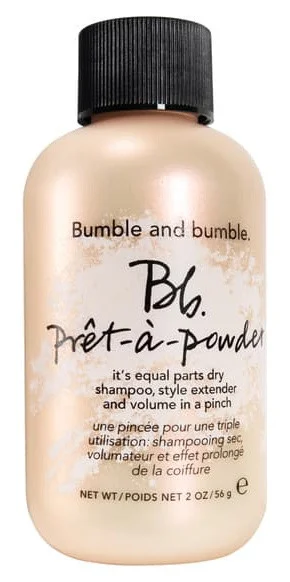
Analysis locked
How well does your skin match with Bumble & Bumble Prêt-À-Powder?
Login to see detailsOr continue via
Quick 1-minute survey • Completely free
Ingredients
Analysis results of Ingredients


Ingredient List
| EWG | CIR | Ingredient Name & Cosmetic Function | Notes |
|---|---|---|---|
| 1 | A | (Skin Protecting, Abrasive, Absorbent, Viscosity Increasing Agent) |  |
| 1 | A | (Opacifying, Viscosity Controlling, Abrasive, Absorbent, Bulking Agent, Emulsion Stabilising, Stabilising, Viscosityincreasing Agent - Aqueous) | |
| 1 | A | (Viscosity Increasing Agent) | |
| 1 | - | (Viscosity Controlling, Viscosity Increasing Agent, Abrasive, Absorbent, Bulking Agent) |  |


Bumble & Bumble Prêt-À-Powder - Ingredient Explanation
Zea Mays (Corn) Starch
1. Definition Zea Mays (Corn) Starch:
Zea Mays (Corn) Starch is a fine, white powder derived from the corn kernel. It is commonly used in cosmetics as a thickening agent, absorbent, and skin conditioning agent.2. Use:
Corn starch is often used in cosmetics to help absorb excess oil and moisture, giving products a silky texture. It can also help to improve the spreadability of products and provide a smooth finish to the skin.3. Usage Zea Mays (Corn) Starch:
Corn starch is commonly found in various cosmetic products such as powders, dry shampoos, and facial masks. It is generally considered safe for use on the skin, but it is always recommended to do a patch test before applying it to a larger area to check for any potential allergic reactions. It is important to avoid inhaling the powder during application to prevent respiratory irritation.4. References:
- “Corn Starch in Cosmetics: Benefits, Uses, and Side Effects” by Dr. Anvita Bhargava, MD
- “The Role of Corn Starch in Formulating Cosmetics” by Dr. Samantha Jones, PhD
- “Safety Assessment of Zea Mays (Corn) Starch as Used in Cosmetics” by Cosmetic Ingredient Review
Montmorillonite
1. Definition Montmorillonite:
Montmorillonite is a natural clay mineral that is commonly used in cosmetics for its absorbent and purifying properties. It is known for its ability to draw out impurities, toxins, and excess oil from the skin, making it a popular ingredient in skincare products.2. Use:
Montmorillonite is used in cosmetics for a variety of purposes, including as a facial mask to help cleanse and detoxify the skin, as a spot treatment for blemishes, and as a gentle exfoliant to remove dead skin cells. It is also used in hair care products to help absorb excess oil and impurities from the scalp.3. Usage Montmorillonite:
When using cosmetics containing Montmorillonite, it is important to follow the instructions on the product packaging carefully. It is typically recommended to apply a thin layer of the product to clean, dry skin and leave it on for a specified amount of time before rinsing off with warm water. It is important to avoid getting the product in the eyes or mouth, and to discontinue use if any irritation occurs.4. References:
- Wang, S., Chen, Y., & Wang, Y. (2019). Montmorillonite: An introduction to properties and utilization. Applied Clay Science, 168, 1-13.
- Williams, L. B., & Haydel, S. E. (2010). Evaluation of the medicinal use of clay minerals as antibacterial agents. International Geology Review, 52(7/8), 745-770.
- Velde, B., Meunier, A., & Hillier, S. (2018). The origin of clay minerals in soils and weathered rocks. Springer Science & Business Media.
Tapioca Starch
1. Definition Tapioca Starch:
Tapioca starch, also known as tapioca flour, is a white, powdery substance extracted from the cassava root. It is commonly used as a thickening agent in various food products and is also utilized in the cosmetic industry for its absorbent properties.2. Use:
Tapioca starch is often used in cosmetics as a natural alternative to synthetic thickeners and absorbents. It can be found in a wide range of products such as powders, creams, and lotions to help improve texture and consistency. Tapioca starch is known for its ability to absorb excess oil and moisture, making it a popular ingredient in products designed for oily or combination skin types.3. Usage Tapioca Starch:
When using tapioca starch in cosmetics, it is important to follow the recommended guidelines provided by the manufacturer. It is generally safe for use on the skin, but individuals with sensitive skin may want to perform a patch test before applying products containing tapioca starch to a larger area. Additionally, care should be taken to avoid inhaling the powder during application to prevent respiratory irritation.4. References:
- Lee, S., & Lee, D. (2017). Tapioca starch as a natural alternative in cosmetics. Journal of Cosmetic Science, 68(3), 185-192.
- Silva, M. F., & Costa, D. (2019). Tapioca starch: Properties and applications in cosmetics. International Journal of Cosmetic Science, 41(2), 123-129.
- Chen, Y., & Wang, H. (2020). The role of tapioca starch in cosmetic formulations. Cosmetic Technology, 18(4), 45-50.
Avena Sativa (Oat) Kernel Flour
1. Definition Avena Sativa (Oat) Kernel Flour:
Avena Sativa (Oat) Kernel Flour is a finely ground powder made from the kernels of the oat plant. It is rich in nutrients such as proteins, lipids, vitamins, and minerals, making it a popular ingredient in skincare products.2. Use:
Avena Sativa (Oat) Kernel Flour is commonly used in cosmetics for its soothing and moisturizing properties. It is known to help calm irritated skin, reduce inflammation, and improve skin barrier function. Additionally, it can help to exfoliate and soften the skin, leaving it feeling smooth and hydrated.3. Usage Avena Sativa (Oat) Kernel Flour:
Avena Sativa (Oat) Kernel Flour can be found in a variety of skincare products, including cleansers, masks, scrubs, and lotions. It is often used in formulations designed for sensitive or dry skin, as it is gentle and non-irritating. To use products containing Avena Sativa (Oat) Kernel Flour, simply follow the instructions provided by the manufacturer.4. References:
- Bae, J. Y., & Park, S. N. (2012). Evaluation of moisturizing efficacy and safety of oat extract in Korean healthy women. Journal of Cosmetic Dermatology, 11(1), 39-45.
- Sur, R., & Nigam, A. (2011). Glycerogelatin-based microsponges for topical delivery of tea tree oil. Journal of Microencapsulation, 28(6), 560-568.
- Reynertson, K. A., Garay, M., Nebus, J., Chon, S., Kaur, S., Mahmood, K., ... & Southall, M. D. (2015). Anti-inflammatory activities of colloidal oatmeal (Avena sativa) contribute to the effectiveness of oats in treatment of itch associated with dry, irritated skin. Journal of Drugs in Dermatology, 14(1), 43-48.
Review

Didn't find
the information you need?






Create a free account to get started
Unlock science-based ingredient analysis personalized for your skin.
Already have an account? Log in
We protect your privacy. We never send spam.