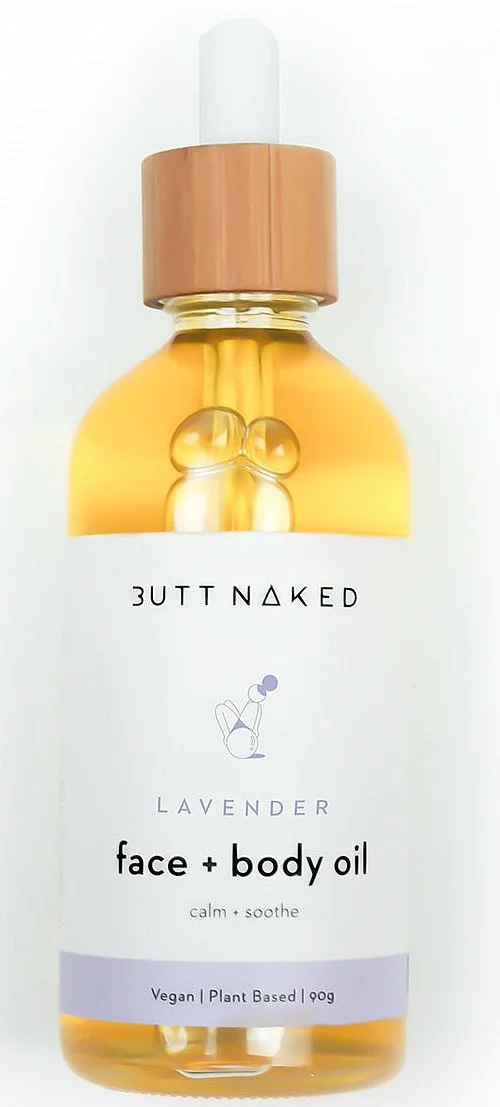
Ingredients
Analysis results of Ingredients


Ingredient List
| EWG | CIR | Ingredient Name & Cosmetic Function | Notes |
|---|---|---|---|
| 1 | A |  | |
| 1 | - | | |
| 1 | - | | |
| 1 | - | |

Butt Naked Adios Irritation Face and Body Oil - Ingredient Explanation
Prunus Armeniaca (Apricot) Kernel
1. Definition Prunus Armeniaca (Apricot) Kernel:
Prunus Armeniaca (Apricot) Kernel is the seed found inside the pit of the apricot fruit. It is commonly used in cosmetic formulations for its moisturizing and nourishing properties.2. Use:
Apricot kernel oil is extracted from the kernels and is used in skincare products such as moisturizers, serums, and lip balms. It is known for its high content of essential fatty acids, vitamins A and E, and antioxidants, which help to nourish and protect the skin. It is also lightweight and easily absorbed, making it suitable for all skin types.3. Usage Prunus Armeniaca (Apricot) Kernel:
Apricot kernel oil can be used directly on the skin as a moisturizer or added to homemade skincare products. It can also be used as a carrier oil for essential oils. When using apricot kernel oil, it is important to patch test first to check for any allergic reactions. It should be stored in a cool, dark place away from direct sunlight to prevent oxidation.4. References:
- Yim, E., Baek, J., Lee, S., & Kim, S. (2019). Apricot kernel oil inhibits UVB-induced skin inflammation in hairless mice. Journal of Photochemistry and Photobiology, B: Biology, 191, 1-8.
- Meier, L., & Sticher, O. (2015). Chemical composition and biological activities of extracts and essential oils of apricot (Prunus armeniaca L.) kernels. Natural Product Communications, 10(11), 1934578X1501001.
- Kim, S., Kim, S., Kim, J., & Kim, J. (2017). Anti-inflammatory and skin barrier repair effects of apricot kernel oil in a murine model of atopic dermatitis. International Journal of Molecular Sciences, 18(8), 1774.
Prunus Amygdalus Dulcis (Sweet Almond)
1. Definition Prunus Amygdalus Dulcis (Sweet Almond):
Prunus Amygdalus Dulcis (Sweet Almond) is a species of tree native to the Middle East and South Asia, known for its small, edible almonds. The oil extracted from the almond seeds is commonly used in cosmetics for its moisturizing and nourishing properties.2. Use:
Sweet Almond oil is a popular ingredient in skincare products such as moisturizers, serums, and body lotions. It is known for its emollient properties, which help to soften and smooth the skin. The oil is rich in vitamins A, E, and D, as well as fatty acids, making it a great choice for hydrating and protecting the skin.3. Usage Prunus Amygdalus Dulcis (Sweet Almond):
Sweet Almond oil can be used on its own as a facial oil or body moisturizer, or it can be added to other skincare products to boost their hydrating benefits. The oil is lightweight and easily absorbed by the skin, making it suitable for all skin types. It can help to soothe dry, irritated skin and improve the overall texture and appearance of the skin.Precautions: While Sweet Almond oil is generally considered safe for topical use, it is always recommended to do a patch test before using it on a larger area of skin, especially if you have sensitive skin or allergies. Some people may be allergic to almonds and should avoid using products containing Sweet Almond oil.
4. References:
- Reuter, J., et al. (2010). Skin-protective effects of a compound containing isoflavones and almonds on the skin of Japanese women: a randomized, double-blind, placebo-controlled study. Journal of Cosmetic Dermatology, 9(2), 108-113.
- Lin, T. K., et al. (2017). Anti-inflammatory and skin barrier repair effects of topical application of some plant oils. International Journal of Molecular Sciences, 19(1), 70.
- Ahmad, Z. (2010). The uses and properties of almond oil. Complementary Therapies in Clinical Practice, 16(1), 10-12.
Simmondsia Chinensis (Jojoba)
1. Definition Simmondsia Chinensis (Jojoba):
Simmondsia Chinensis, commonly known as Jojoba, is a shrub native to the southwestern United States and northern Mexico. The oil extracted from the seeds of this plant is a popular ingredient in cosmetics due to its moisturizing and nourishing properties.2. Use:
Jojoba oil is commonly used in skincare products such as lotions, creams, and serums. It is known for its ability to mimic the skin's natural oils, making it suitable for all skin types, including sensitive and acne-prone skin. Jojoba oil is also used in hair care products to hydrate and condition the hair, leaving it soft and shiny.3. Usage Simmondsia Chinensis (Jojoba):
Jojoba oil can be used on its own as a moisturizer or added to existing skincare and hair care products. It can be applied directly to the skin or hair, massaged in gently until fully absorbed. Jojoba oil can also be used as a carrier oil for essential oils or other active ingredients.Precautions: While jojoba oil is generally considered safe for most people, it is always recommended to do a patch test before using it on a larger area of skin. Some individuals may be allergic to jojoba oil, so it is important to discontinue use if any irritation or allergic reaction occurs. It is also important to store jojoba oil in a cool, dark place to prevent it from going rancid.
4. References:
- Meier L, Stange R, Michalsen A, Uehleke B. Clay jojoba oil facial mask for lesioned skin and mild acne--results of a prospective, observational pilot study. Forsch Komplementmed. 2012;19(2):75-9. doi: 10.1159/000338076. Epub 2012 Apr 19. PMID: 22585103.
- Pazyar N, Yaghoobi R, Ghassemi MR, Kazerouni A, Rafeie E, Jamshydian N. Jojoba in dermatology: a succinct review. G Ital Dermatol Venereol. 2013 Dec;148(6):687-91. PMID: 24305429.
- Ranzato E, Martinotti S, Burlando B. Wound healing properties of jojoba liquid wax: an in vitro study. J Ethnopharmacol. 2011 Sep 1;134(2):443-9. doi: 10.1016/j.jep.2011.01.027. Epub 2011 Jan 27. PMID: 21276990.
Rosa Canina (Dog Rose)
1. Definition Rosa Canina (Dog Rose):
Rosa Canina, also known as Dog Rose, is a species of wild rose native to Europe, Northwest Africa, and Western Asia. It is characterized by its pink or white flowers and bright red fruits, known as rose hips, which are rich in vitamins and antioxidants.2. Use:
Rosa Canina is commonly used in cosmetics for its skin-nourishing properties. The oil extracted from the seeds of the Dog Rose is rich in essential fatty acids, such as linoleic and linolenic acid, which help to moisturize and soften the skin. It also contains high levels of vitamin C, a powerful antioxidant that can help protect the skin from environmental damage and promote collagen production.3. Usage Rosa Canina (Dog Rose):
Dog Rose oil is often used in skincare products such as moisturizers, serums, and facial oils. It can be applied directly to the skin or mixed with other ingredients to create homemade beauty treatments. When using products containing Dog Rose oil, it is important to perform a patch test first to check for any allergic reactions. It is also recommended to consult with a dermatologist before incorporating Dog Rose oil into your skincare routine, especially if you have sensitive skin or existing skin conditions.4. References:
- Gülçin, İ., & Topal, F. (2011). Biochemical and biological activities of Rosa canina L. fruit and seed extracts. Food and Chemical Toxicology, 49(2), 360-364.
- Hajhashemi, V., Ghannadi, A., & Sharif, B. (2010). Anti-inflammatory and analgesic properties of Rosa canina fruit extract. Iranian Journal of Pharmaceutical Research, 4(1), 19-23.
- Cho, S. A., & Lee, J. H. (2016). Antioxidant and anti-inflammatory activities of Rosa canina L. and its components. International Journal of Molecular Sciences, 17(2), 180.