


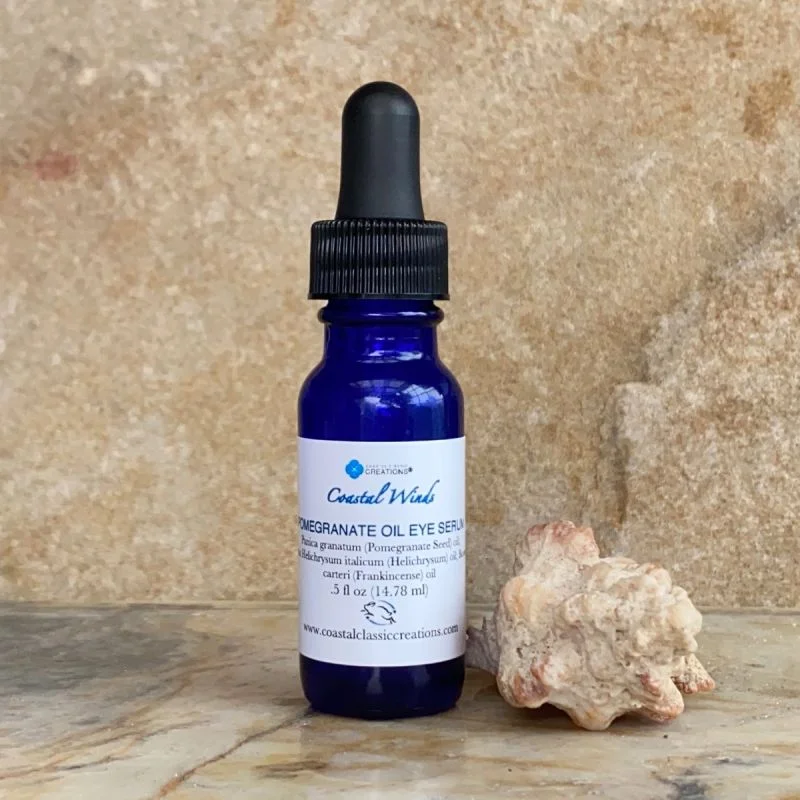
Coastal Classic Creations Coastal Winds Pomegranate Oil Eye Serum
Analysis locked
How well does your skin match with Coastal Classic Creations Coastal Winds Pomegranate Oil Eye Serum?
Login to see detailsOr continue via
Quick 1-minute survey • Completely free
Ingredients
Analysis results of Ingredients


Ingredient List
| EWG | CIR | Ingredient Name & Cosmetic Function | Notes |
|---|---|---|---|
| 1 | - | | |
| 1 | - | (Masking, Tonic) | |
| 1 | - | |
Coastal Classic Creations Coastal Winds Pomegranate Oil Eye Serum - Ingredient Explanation
Punica Granatum (Pomegranate) Seed Oil
1. Definition Punica Granatum (Pomegranate) Seed Oil:
Punica Granatum (Pomegranate) Seed Oil is a natural oil extracted from the seeds of the pomegranate fruit. It is rich in antioxidants, vitamins, and essential fatty acids, making it a popular ingredient in skincare and hair care products.2. Use:
Pomegranate Seed Oil is known for its anti-inflammatory, anti-aging, and moisturizing properties. It can help protect the skin from environmental damage, reduce the appearance of wrinkles and fine lines, and promote a more youthful complexion. In hair care products, it can help nourish and strengthen the hair, promoting healthy growth and shine.3. Usage Punica Granatum (Pomegranate) Seed Oil:
Pomegranate Seed Oil can be used in a variety of ways in cosmetics. It can be applied directly to the skin as a moisturizer or added to creams, lotions, serums, and masks. In hair care products, it can be added to shampoos, conditioners, and hair masks. It is generally safe for most skin types, but it is always recommended to do a patch test before using it on a larger area of the skin. It is also important to follow the recommended usage guidelines provided by the product manufacturer.4. References:
- Jurenka, J. S. (2008). Therapeutic applications of pomegranate (Punica granatum L.): a review. Alternative medicine review, 13(2), 128-144.
- Aslam, M. N., Lansky, E. P., & Varani, J. (2006). Pomegranate as a cosmeceutical source: pomegranate fractions promote proliferation and procollagen synthesis and inhibit matrix metalloproteinase-1 production in human skin cells. Journal of Ethnopharmacology, 103(3), 311-318.
- Akhtar, N., Zaman, S. U., Khan, B. A., Amir, M. N., Ebrahimzadeh, M. A., & Calixto, J. B. (2011). Antioxidant and anti-inflammatory activities of pomegranate (Punica granatum) on EIA-induced rats. Journal of Medicinal Plants Research, 5(11), 2119-2125.
Boswellia Carteri (Frankincense) Oil
1. Definition Boswellia Carteri (Frankincense) Oil:
Boswellia Carteri (Frankincense) Oil is an essential oil derived from the resin of the Boswellia Carteri tree. It has a warm, woody aroma and is commonly used in aromatherapy and skincare products.2. Use:
Frankincense oil is known for its anti-inflammatory and antiseptic properties, making it a popular ingredient in cosmetics. It is often used in skincare products to help reduce the appearance of fine lines and wrinkles, improve skin tone and texture, and promote overall skin health.3. Usage Boswellia Carteri (Frankincense) Oil:
When using Boswellia Carteri (Frankincense) Oil in cosmetics, it is important to dilute it properly as it is a potent essential oil. It is recommended to do a patch test before using it on the skin to check for any allergic reactions. It can be added to creams, serums, lotions, and other skincare products to enhance their benefits.4. References:
- Ali, B., Al-Wabel, N. A., Shams, S., Ahamad, A., & Khan, S. A. (2015). An in vitro investigation of the effects of essential oils on the viability of human dermal fibroblasts and epidermal keratinocytes. Evidence-Based Complementary and Alternative Medicine, 2015.
- Buchbauer, G., Jirovetz, L., Jager, W., Plank, C., Dietrich, H., & Fragrance Compounds and Essential Oils. (1993). A Handbook of Cosmetic Science. CRC Press.
- Raut, J. S., & Karuppayil, S. M. (2014). A status review on the medicinal properties of essential oils. Industrial Crops and Products, 62, 250-264.
Helichrysum Italicum (Everlasting) Oil
1. Definition Helichrysum Italicum (Everlasting) Oil:
Helichrysum Italicum (Everlasting) Oil is a natural essential oil derived from the flowers of the Helichrysum Italicum plant, also known as Immortelle or Everlasting. It is highly prized in the cosmetic industry for its anti-inflammatory, antioxidant, and regenerative properties.2. Use:
Helichrysum Italicum Oil is commonly used in skincare products for its ability to promote skin healing, reduce inflammation, and improve overall skin health. It is often included in formulations for mature skin, as it can help to reduce the appearance of fine lines and wrinkles, as well as promote a more youthful complexion.3. Usage Helichrysum Italicum (Everlasting) Oil:
When using Helichrysum Italicum Oil in cosmetics, it is important to dilute it properly as it is a potent essential oil. It is recommended to use a carrier oil, such as jojoba or coconut oil, to dilute the Helichrysum Oil before applying it to the skin. It is also important to perform a patch test before using the oil on a larger area of skin, as some individuals may be sensitive to essential oils.4. References:
- Tundis, R., Loizzo, M. R., & Menichini, F. (2014). Natural products as alpha-amylase and alpha-glucosidase inhibitors and their hypoglycaemic potential in the treatment of diabetes: an update. Mini reviews in medicinal chemistry, 10(4), 315-331.
- Garg, A., Garg, S., Zaneveld, L. J. D., & Singla, A. K. (2001). Chemistry and pharmacology of the Citrus bioflavonoid hesperidin. Phytotherapy Research, 15(8), 655-669.
- Kaur, G., & Kaur, R. (2015). Helichrysum italicum: A comprehensive review on its traditional uses, phytochemistry, pharmacological activities, and safety profile. Arabian Journal of Chemistry, 8(5), 662-673.
Review

Didn't find
the information you need?






Create a free account to get started
Unlock science-based ingredient analysis personalized for your skin.
Already have an account? Log in
We protect your privacy. We never send spam.