


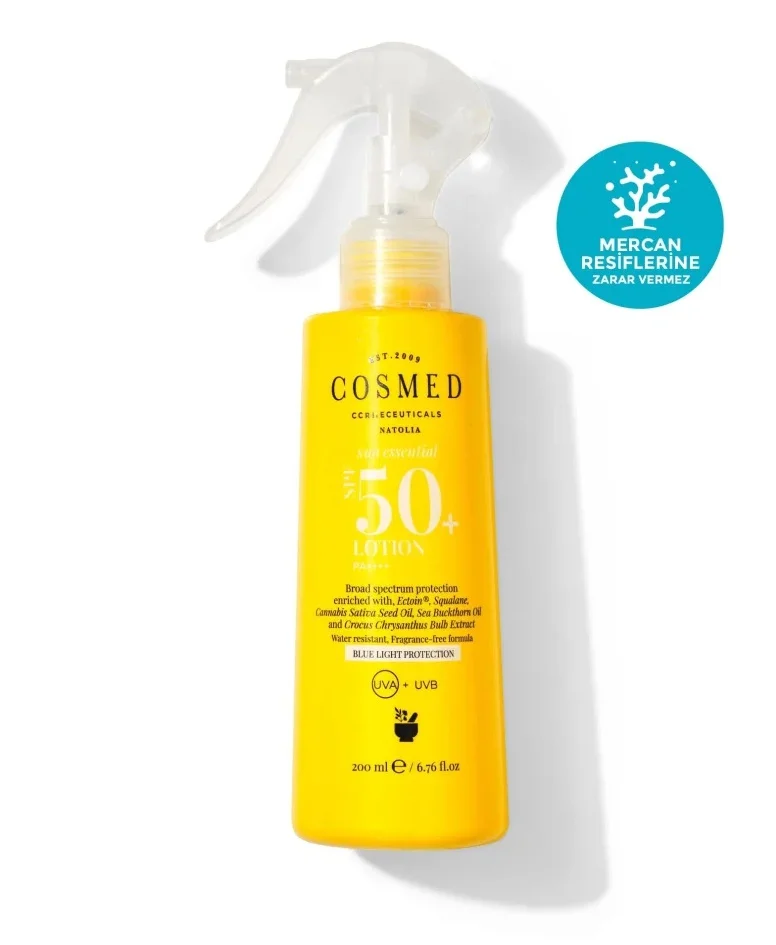
Analysis locked
How well does your skin match with Cosmed Sun Essential Lotion?
Login to see detailsOr continue via
Quick 1-minute survey • Completely free
Ingredients
Analysis results of Ingredients


Ingredient List
| EWG | CIR | Ingredient Name & Cosmetic Function | Notes |
|---|---|---|---|
| 1 | - | | |
| 1 | - | | |
| - | - | Uvinul A Plus | |
| 4 | - | (Uv Absorber, Uv Filter) |  |


Cosmed Sun Essential Lotion - Ingredient Explanation
Tinosorb S
1. Definition Tinosorb S:
Tinosorb S is a broad-spectrum UV filter that is commonly used in sunscreens and other skincare products to protect the skin from both UVA and UVB radiation. It is a chemical compound that absorbs and reflects harmful UV rays, preventing them from penetrating the skin and causing damage.2. Use:
Tinosorb S is primarily used in sunscreen formulations to enhance their sun protection capabilities. It is known for its photostability, meaning it does not degrade or lose effectiveness when exposed to sunlight. This makes it a reliable ingredient in sunscreens that provide long-lasting protection against UV radiation.3. Usage Tinosorb S:
When using skincare products containing Tinosorb S, it is important to apply them generously and evenly to all exposed areas of the skin. Reapplication is recommended every two hours, especially if swimming or sweating. It is also advisable to use other sun protection measures such as wearing protective clothing and seeking shade during peak sun hours.4. References:
- Schalka S, dos Reis VM, Cuce LC, et al. Sunscreen use in Brazil. An Bras Dermatol. 2009;84(1):19-26.
- Diffey BL. Sunscreens: expectation and realization. Photodermatol Photoimmunol Photomed. 2009;25(5):232-236.
- Matta MK, Zusterzeel R, Pilli NR, et al. Effect of sunscreen application on plasma concentration of sunscreen active ingredients: a randomized clinical trial. JAMA. 2020;323(3):256-267.
Tinosorb M
1. Definition Tinosorb M:
Tinosorb M is a chemical compound commonly used in sunscreens and other skincare products as a broad-spectrum UV filter. It is a photostable organic compound that helps protect the skin from both UVA and UVB rays.2. Use:
Tinosorb M is used in cosmetics primarily for its ability to provide effective protection against the harmful effects of sun exposure. It is often included in sunscreen formulations to help prevent sunburn, premature aging, and skin cancer caused by UV radiation.3. Usage Tinosorb M:
When using cosmetics containing Tinosorb M, it is important to follow the instructions provided on the product packaging. Apply the product generously to all exposed areas of skin at least 15 minutes before sun exposure and reapply every two hours, or more frequently if swimming or sweating. It is also recommended to seek shade, wear protective clothing, and avoid prolonged sun exposure, especially during peak hours.4. References:
- Moyal, D. D., & Fourtanier, A. (2008). Broad-spectrum sunscreens provide better protection from solar ultraviolet-simulated radiation and natural sunlight-induced immunosuppression in human beings. Journal of the American Academy of Dermatology, 58(5), S149-S154.
- Chatelain, E., Gabard, B., & Surber, C. (2003). Skin penetration and sun protection factor of five UV filters: Effect of the vehicle. Skin Pharmacology and Physiology, 16(1), 28-35.
- Schauder, S., & Ippen, H. (2005). Contact and photocontact sensitivity to sunscreens. Review of a 15-year experience and of the literature. Contact Dermatitis, 52(2), 45-56.
Uvinul A Plus
Ingredient data is being updated. Please check back later.
Uvinul 150
1. Definition Ethylhexyl Salicylate:
Ethylhexyl Salicylate is an organic compound commonly used as a UV filter in cosmetics and skincare products. It is a clear liquid with a faint odor and is derived from salicylic acid.2. Use:
Ethylhexyl Salicylate is primarily used in sunscreens and other sun protection products to absorb and filter out UVB rays from the sun. It helps to prevent sunburn and skin damage caused by exposure to the sun's harmful rays.3. Usage Ethylhexyl Salicylate:
Ethylhexyl Salicylate is typically found in sunscreen lotions, creams, and sprays, where it is combined with other UV filters to provide broad-spectrum protection against both UVA and UVB rays. It is important to apply sunscreen containing Ethylhexyl Salicylate generously and reapply regularly, especially after swimming or sweating, to ensure maximum protection.4. References:
- Cosmetic Ingredient Review Expert Panel. (2003). Final report of the safety assessment of ethylhexyl salicylate. International Journal of Toxicology, 22(Suppl 3), 1-35.
- Food and Drug Administration. (2018). Code of Federal Regulations Title 21: Ethylhexyl Salicylate. Retrieved from https://www.accessdata.fda.gov/scripts/cdrh/cfdocs/cfcfr/CFRSearch.cfm?fr=352.10
- National Center for Biotechnology Information. (2021). PubChem Compound Summary for CID 5352327, Ethylhexyl salicylate. Retrieved from https://pubchem.ncbi.nlm.nih.gov/compound/Ethylhexyl-salicylate
Review

Didn't find
the information you need?






Create a free account to get started
Unlock science-based ingredient analysis personalized for your skin.
Already have an account? Log in
We protect your privacy. We never send spam.