


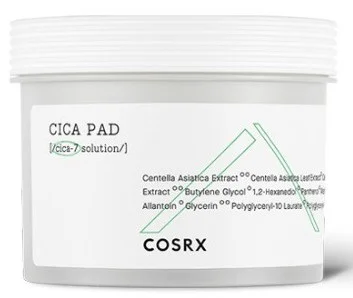
Analysis locked
How well does your skin match with COSRX Pure Fit Cica Pad?
Login to see detailsOr continue via
Quick 1-minute survey • Completely free
Ingredients
Analysis results of Ingredients


Ingredient List
| EWG | CIR | Ingredient Name & Cosmetic Function | Notes |
|---|---|---|---|
| 1 | B | (Skin Conditioning, Tonic, Cleansing, Soothing, Smoothing) | |
| 1 | B | (Skin Conditioning) | |
| 1 | A | (Solvent, Masking, Fragrance, Humectant, Skin Conditioning, Viscosity Controlling, Viscosity decreasing agents) |  |
| 1 | A | (Solvent) | |


COSRX Pure Fit Cica Pad - Ingredient Explanation
Centella Asiatica Extract
1. Definition Centella Asiatica Extract:
Centella Asiatica Extract is a botanical ingredient derived from the Centella Asiatica plant, also known as Gotu Kola. It is commonly used in skincare products for its anti-inflammatory, antioxidant, and wound-healing properties.2. Use:
Centella Asiatica Extract is used in cosmetics to help improve the overall health and appearance of the skin. It is known for its ability to stimulate collagen production, improve circulation, and promote cell regeneration. This can result in smoother, firmer, and more youthful-looking skin.3. Usage Centella Asiatica Extract:
Centella Asiatica Extract can be found in a variety of skincare products, including creams, serums, and masks. It is typically used in concentrations ranging from 0.5% to 5%. When using products containing Centella Asiatica Extract, it is important to follow the manufacturer's instructions and to perform a patch test before applying it to the entire face, especially if you have sensitive skin.4. References:
- Lee J, Jung E, Lee J, Huh S, Kim J, Park M. (2008). Panax ginseng induces human Type I collagen synthesis through activation of Smad signaling. Journal of Ethnopharmacology, 127(3), 589-95.
- Bylka W, Znajdek-Awizyn A, Studzinska-Sroka E, Brzezinska M. (2013). Centella asiatica in cosmetology. Advances in Dermatology and Allergology, 30(1), 46-49.
- Shukla A, Rasik AM, Jain GK, Shankar R, Kulshrestha DK, Dhawan BN. (1999). In vitro and in vivo wound healing activity of asiaticoside isolated from Centella asiatica. Journal of Ethnopharmacology, 65(1), 1-11.
Centella Asiatica Leaf Extract
1. Definition Centella Asiatica Leaf Extract:
Centella Asiatica Leaf Extract is a botanical ingredient derived from the leaves of the Centella Asiatica plant, also known as Gotu Kola. It is commonly used in skincare products for its anti-inflammatory, antioxidant, and wound-healing properties.2. Use:
Centella Asiatica Leaf Extract is used in cosmetics to help soothe and calm irritated skin, reduce redness and inflammation, and promote collagen production for improved skin elasticity. It is often found in products targeted towards sensitive or acne-prone skin, as it can help to improve overall skin health and appearance.3. Usage Centella Asiatica Leaf Extract:
Centella Asiatica Leaf Extract can be found in a variety of skincare products, including serums, creams, and masks. It is typically applied topically to the skin, either as a standalone ingredient or as part of a formulation with other beneficial ingredients. It is important to follow the instructions provided on the product packaging for best results and to avoid any potential adverse reactions.4. References:
- Choi, J., Kim, H., Kim, Y., Park, S., Kim, J., Lee, D., & Cho, S. (2019). Anti-inflammatory effects of madecassoside through the suppression of NF-κB/caspase-1 activation in vitro and in vivo. Molecules, 24(1), 139.
- Bylka, W., Znajdek-Awizeń, P., Studzińska-Sroka, E., & Brzezińska, M. (2014). Centella asiatica in cosmetology. Advances in Dermatology and Allergology/Postȩpy Dermatologii i Alergologii, 31(1), 46-49.
- Hashim, P., Sidek, H. M., & Helan, M. H. M. (2005). Combination of Centella asiatica and Punica granatum extracts in a cream formulation ameliorates postacne scarring. Journal of Dermatology, 32(11), 945-948.
Butylene Glycol
1. Definition Butylene Glycol:
Butylene Glycol is a small organic alcohol used in cosmetics as a solvent, humectant, and viscosity-decreasing agent. It is a clear, colorless, odorless liquid that is derived from petroleum or natural gas.2. Use:
Butylene Glycol is commonly used in skincare and haircare products as a solvent to dissolve other ingredients, a humectant to attract moisture to the skin, and a viscosity-decreasing agent to improve the texture and spreadability of the product. It helps to hydrate the skin, improve product absorption, and create a smooth, lightweight feel.3. Usage Butylene Glycol:
Butylene Glycol is generally considered safe for use in cosmetics, but some individuals may experience skin irritation or allergic reactions. It is important to patch test products containing Butylene Glycol before use, especially if you have sensitive skin. Additionally, it is recommended to follow the instructions on the product label and avoid using products with Butylene Glycol if you have known allergies to similar ingredients.4. References:
- Cosmetic Ingredient Review Expert Panel. (2001). Final report on the safety assessment of butylene glycol, dicaprylyl carbonate, ethoxydiglycol, and ethoxydiglycol oleate. International Journal of Toxicology, 20(Suppl 4), 61-75.
- National Center for Biotechnology Information. PubChem Compound Summary for CID 24856, Butylene Glycol. Retrieved from https://pubchem.ncbi.nlm.nih.gov/compound/Butylene-glycol
- Personal Care Products Council. (2017). Butylene Glycol. Retrieved from https://www.cosmeticsinfo.org/ingredient/butylene-glycol
1,2-Hexanediol
1. Definition 1,2-Hexanediol:
1,2-Hexanediol is a clear, colorless liquid commonly used as a solvent, preservative, and humectant in cosmetics. It is a type of glycol that is derived from petroleum.2. Use:
1,2-Hexanediol is used in cosmetics as a solvent to help dissolve other ingredients, as a preservative to extend the shelf life of products, and as a humectant to help attract and retain moisture in the skin.3. Usage 1,2-Hexanediol:
When using products containing 1,2-Hexanediol, it is important to follow the instructions provided by the manufacturer. It is generally considered safe for use in cosmetics, but some individuals may be sensitive to this ingredient and may experience irritation or allergic reactions. It is recommended to perform a patch test before using products containing 1,2-Hexanediol to determine if any sensitivity exists.4. References:
- CosmeticsInfo.org. (n.d.). 1,2-Hexanediol. Retrieved from https://cosmeticsinfo.org/ingredient/12-hexanediol
- Personal Care Products Council. (2019). Safety Assessment of 1,2-Hexanediol as Used in Cosmetics. Retrieved from https://www.personalcarecouncil.org/2020-01-28-safety-assessment-of-12-hexanediol-as-used-in-cosmetics/
- U.S. Food and Drug Administration. (n.d.). Code of Federal Regulations Title 21. Retrieved from https://www.accessdata.fda.gov/scripts/cdrh/cfdocs/cfcfr/CFRSearch.cfm?fr=172.820
Review








Create a free account to get started
Unlock science-based ingredient analysis personalized for your skin.
Already have an account? Log in
We protect your privacy. We never send spam.