


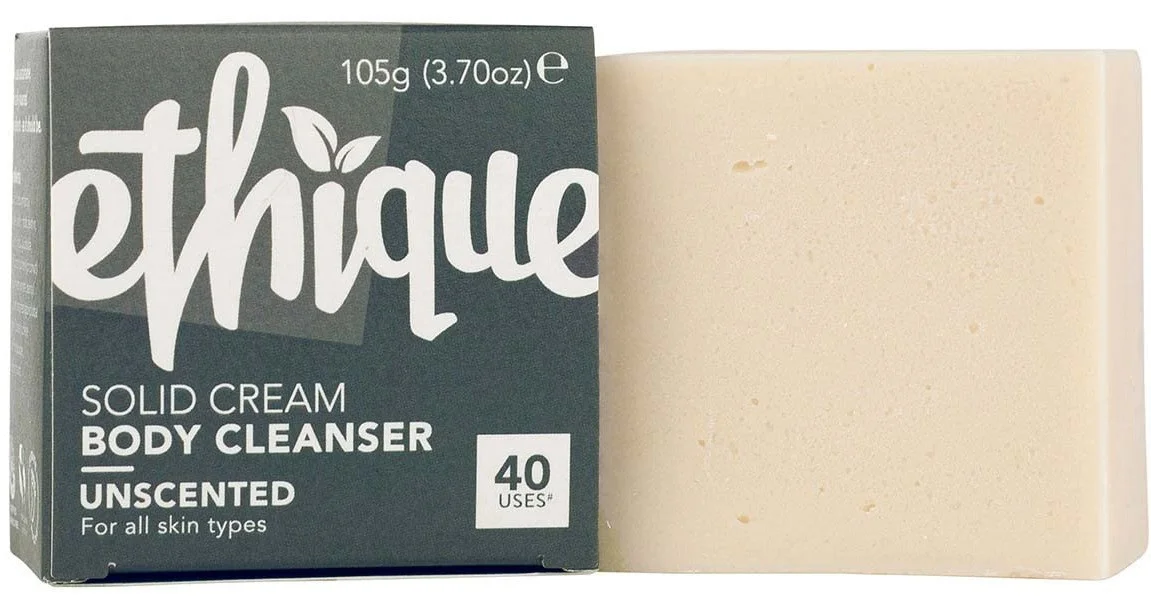
Analysis locked
How well does your skin match with Ethique Unscented Solid Cream Body Cleanser?
Login to see detailsOr continue via
Quick 1-minute survey • Completely free
Ingredients
Analysis results of Ingredients


Ingredient List
| EWG | CIR | Ingredient Name & Cosmetic Function | Notes |
|---|---|---|---|
| 4 6 | A | (Solvent, Masking, Fragrance, Viscosity Decreasing Agent, Preservative, External Analgesic ) |   |
| - | A | | |
| - | - | Cocos Nucifera (Coconut) Fruit Powder | |
| 1 | A | (Masking, Fragrance, Viscosity Controlling, Viscosity Increasing Agent, Emulsion Stabilising, Binding Agent, Binding, Film Forming) | |


Ethique Unscented Solid Cream Body Cleanser - Ingredient Explanation
Benzyl Alcohol
1. Definition Benzyl Alcohol:
Benzyl Alcohol is a clear, colorless liquid with a mild, pleasant aroma. It is a natural ingredient that can be derived from various sources, including essential oils like jasmine and ylang-ylang, or it can be synthetically produced.2. Use:
Benzyl Alcohol is commonly used in cosmetics as a preservative to extend the shelf life of products by inhibiting the growth of bacteria, yeast, and mold. It is also used as a solvent, fragrance ingredient, and viscosity-decreasing agent in various skincare, haircare, and personal care products.3. Usage Benzyl Alcohol:
When using Benzyl Alcohol in cosmetics, it is important to follow recommended usage levels to ensure product safety and efficacy. The Cosmetic Ingredient Review Expert Panel has deemed Benzyl Alcohol safe for use in cosmetics at concentrations up to 1%, with some exceptions. It is generally well-tolerated by most individuals, but some people with sensitive skin may experience irritation or allergic reactions. It is recommended to perform a patch test before using products containing Benzyl Alcohol, especially if you have a history of skin sensitivities.4. References:
- Cosmetic Ingredient Review Expert Panel. (2008). Final report on the safety assessment of Benzyl Alcohol, Benzoic Acid, and Sodium Benzoate. International Journal of Toxicology, 27(1), 1-23.
- Personal Care Products Council. (2019). Benzyl Alcohol. Retrieved from https://www.cosmeticsinfo.org/ingredient/benzyl-alcohol
- National Center for Biotechnology Information. (2021). PubChem Compound Summary for CID 244, Benzyl Alcohol. Retrieved from https://pubchem.ncbi.nlm.nih.gov/compound/Benzyl-alcohol
Cocos Nucifera (Coconut) Fruit
1. Definition Cocos Nucifera (Coconut) Fruit:
Cocos Nucifera (Coconut) Fruit, commonly known as coconut, is a tropical fruit that is widely used in cosmetics for its moisturizing and nourishing properties. The fruit is rich in fatty acids, vitamins, and minerals that help to hydrate and protect the skin.2. Use:
Coconut fruit is used in cosmetics for its emollient and conditioning properties. It is often found in lotions, creams, and hair care products to help moisturize and soften the skin and hair. Coconut oil, derived from the fruit, is a popular ingredient in skincare products due to its ability to deeply hydrate and soothe dry, irritated skin.3. Usage Cocos Nucifera (Coconut) Fruit:
When using cosmetics containing Cocos Nucifera (Coconut) Fruit, it is important to patch test the product before applying it to a larger area of skin, especially if you have sensitive skin or allergies. It is also recommended to follow the instructions on the product label and avoid using the product on broken or irritated skin. Additionally, it is important to store products containing coconut fruit in a cool, dry place to prevent spoilage.4. References:
- Saraf, S. and Jeswani, G. (2006). Bioactive constituents of Cocos nucifera L. (Palmae) and their role in in vitro anti-inflammatory activity. Journal of Pharmacy and Pharmacology, 58(8), 1125-1130.
- Rele, A. S. and Mohile, R. B. (2003). Effect of mineral oil, sunflower oil, and coconut oil on prevention of hair damage. Journal of Cosmetic Science, 54(2), 175-192.
- Evangelista, M. T., Abad-Casintahan, F., and Lopez-Villafuerte, L. (2014). The effect of topical virgin coconut oil on SCORAD index, transepidermal water loss, and skin capacitance in mild to moderate pediatric atopic dermatitis: a randomized, double-blind, clinical trial. International Journal of Dermatology, 53(1), 100-108.
Cocos Nucifera (Coconut) Fruit Powder
Ingredient data is being updated. Please check back later.
Cyamopsis Tetragonoloba (Guar) Gum
1. Definition Cyamopsis Tetragonoloba (Guar) Gum:
Cyamopsis Tetragonoloba (Guar) Gum is a natural plant-based ingredient derived from the seeds of the guar plant. It is a water-soluble polysaccharide that is commonly used as a thickening agent, stabilizer, and emulsifier in various cosmetic formulations.2. Use:
Guar gum is widely used in cosmetics for its ability to improve the texture and consistency of products. It helps to create a smooth and creamy texture in lotions, creams, and gels, and can also enhance the spreadability of formulations. Guar gum is often used in hair care products such as shampoos and conditioners to provide conditioning benefits and improve the manageability of the hair.3. Usage Cyamopsis Tetragonoloba (Guar) Gum:
Guar gum should be used in cosmetics according to the recommended usage levels provided by the manufacturer. It is generally considered safe for use in cosmetics, but individuals with sensitive skin may want to perform a patch test before using products containing guar gum to ensure they do not experience any adverse reactions. Additionally, it is important to properly disperse guar gum in water before adding it to formulations to prevent clumping and ensure even distribution.4. References:
- Sharma, P., & Sharma, S. (2012). Evaluation of guar gum as a binder in the formulation of metronidazole tablets. International Journal of Pharmacy and Pharmaceutical Sciences, 4(3), 515-520.
- Amin, M. C. I. M., Ahmad, N., & Halib, N. (2015). Guar gum as potential natural polymer for the development of floating drug delivery systems: A review. Journal of Food and Drug Analysis, 23(4), 577-587.
- Shah, P., & Mishra, S. (2018). Plant-based natural gums and mucilages in pharmaceutical excipients and drug delivery systems. In Handbook of Polymers for Pharmaceutical Technologies (pp. 377-401). John Wiley & Sons.
Review

Didn't find
the information you need?






Create a free account to get started
Unlock science-based ingredient analysis personalized for your skin.
Already have an account? Log in
We protect your privacy. We never send spam.