


Analysis locked
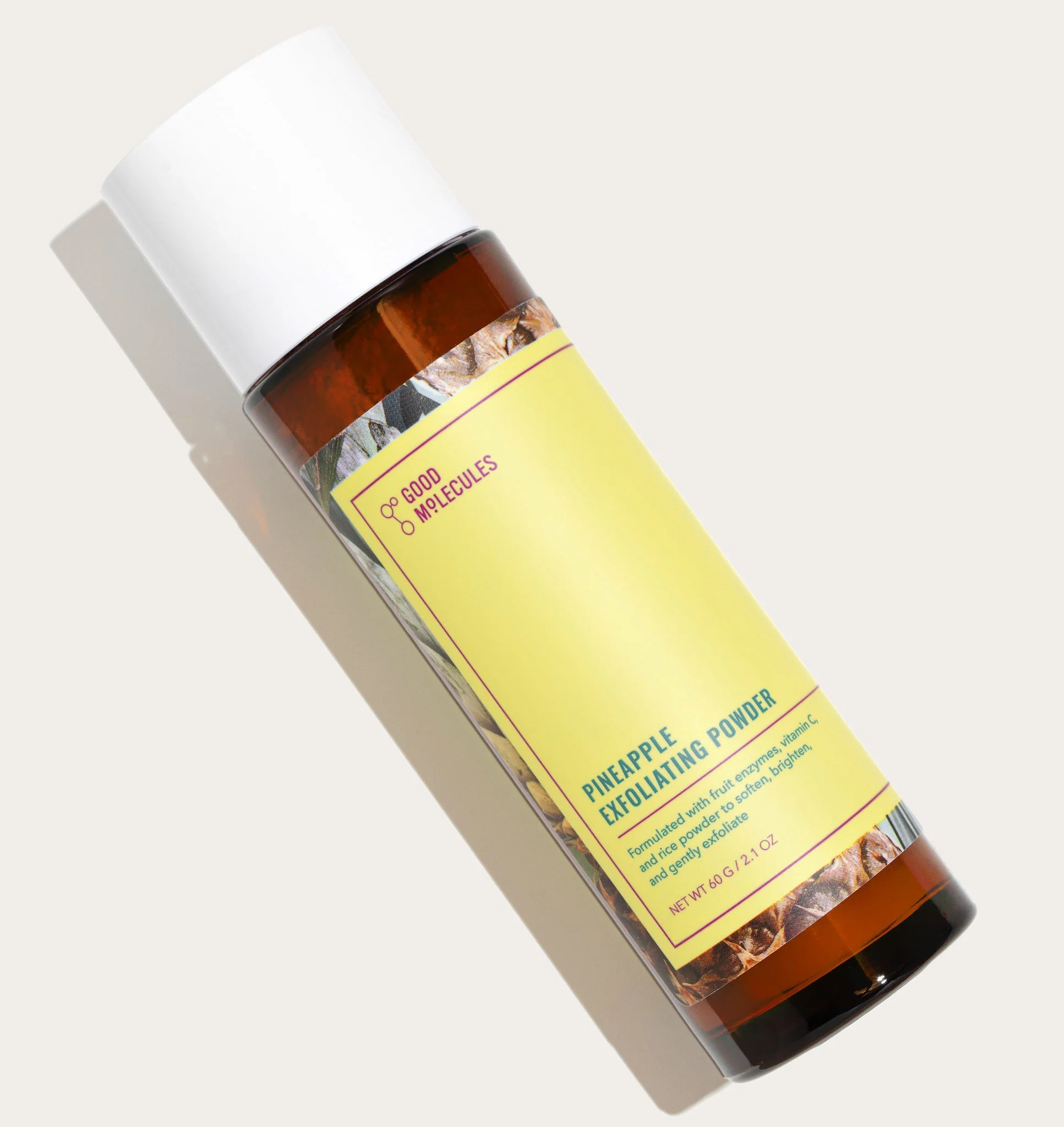
How well does your skin match with Good Molecules Pineapple Exfoliating Powder?
Login to see detailsOr continue via
Quick 1-minute survey • Completely free
Ingredients
Analysis results of Ingredients


Ingredient List
| EWG | CIR | Ingredient Name & Cosmetic Function | Notes |
|---|---|---|---|
| 1 | - | (Viscosity Controlling, Absorbent) | |
| 1 | B | (Hair Conditioning, Surfactant, Cleansing) |  |
| 1 | B | (Hair Conditioning, Antistatic Agent, Surfactant) | |
| 1 | - | |


Good Molecules Pineapple Exfoliating Powder - Ingredient Explanation
Dimethylimidazolidinone Rice Starch
1. Definition Dimethylimidazolidinone Rice Starch:
Dimethylimidazolidinone Rice Starch is a modified rice starch that has been chemically altered to improve its absorbent and mattifying properties. It is commonly used in cosmetics as a texturizing agent and oil absorber.2. Use:
Dimethylimidazolidinone Rice Starch is used in cosmetic formulations to help control oiliness and shine on the skin. It is often found in products such as powders, foundations, and mattifying primers to create a smooth, matte finish.3. Usage Dimethylimidazolidinone Rice Starch:
When using products containing Dimethylimidazolidinone Rice Starch, it is important to follow the manufacturer's instructions for application. It is generally safe for use on most skin types, but individuals with sensitive skin may want to do a patch test before applying it to larger areas of the face to check for any potential irritation. As with any cosmetic product, if irritation occurs, discontinue use and consult a dermatologist.4. References:
- Wang, Y., et al. (2015). Rice Starch-Based Materials in Cosmetics. In Handbook of Cosmetic Science and Technology (pp. 529-540). CRC Press.
- Kaur, A., et al. (2018). Recent advancements in starch based materials for cosmetics: A review. International Journal of Biological Macromolecules, 120, 2154-2165.
- Sahu, A. K., et al. (2019). Rice Starch as a novel excipient in cosmetics: A review. Journal of Applied Pharmaceutical Science, 9(3), 129-136.
Sodium Cocoyl Isethionate
1. Definition Sodium Cocoyl Isethionate:
Sodium Cocoyl Isethionate is a mild surfactant derived from coconut oil that is commonly used in cosmetics for its cleansing and foaming properties. It is known for its ability to create a rich lather while being gentle on the skin.2. Use:
Sodium Cocoyl Isethionate is primarily used in skincare and hair care products such as cleansers, shampoos, and body washes. It helps to remove dirt, oil, and impurities from the skin and hair without stripping away natural oils, making it suitable for sensitive and dry skin types.3. Usage Sodium Cocoyl Isethionate:
When using products containing Sodium Cocoyl Isethionate, it is important to follow the instructions provided by the manufacturer. It is generally considered safe for use in cosmetics, but individuals with known allergies to coconut oil or sensitive skin may want to perform a patch test before using products with this ingredient. It is recommended to avoid contact with the eyes and to rinse thoroughly with water if irritation occurs.4. References:
- Sivakumar, R., Nandhakumar, S., & Sivasubramanian, S. (2018). Sodium Cocoyl Isethionate: A Review. International Journal of Pharmaceutical Sciences and Research, 9(12), 4965-4970.
- Kaur, R., & Sharma, S. (2019). Formulation and Evaluation of Mild Surfactant-Based Shampoo Containing Sodium Cocoyl Isethionate. Journal of Pharmaceutical Sciences and Research, 11(6), 2013-2018.
- Chaudhary, R., & Sharma, N. (2020). Sodium Cocoyl Isethionate: An Overview. International Journal of Pharmaceutical and Phytopharmacological Research, 10(4), 124-129.
Sodium Lauroyl Glutamate
1. Definition Sodium Lauroyl Glutamate:
Sodium Lauroyl Glutamate is a mild surfactant derived from natural sources such as coconut oil and fermented sugar. It is commonly used in cosmetics as a cleansing agent and emulsifier.2. Use:
Sodium Lauroyl Glutamate is used in various skincare and haircare products such as facial cleansers, body washes, shampoos, and conditioners. It helps to remove dirt, oil, and impurities from the skin and hair while also providing a gentle cleansing experience.3. Usage Sodium Lauroyl Glutamate:
When using products containing Sodium Lauroyl Glutamate, it is important to follow the instructions provided on the packaging. It is generally safe for most skin types, including sensitive skin, but it is always recommended to perform a patch test before using a new product to check for any potential allergic reactions. Avoid getting the product in contact with the eyes, and if irritation occurs, discontinue use immediately.4. References:
- S. B. Park, H. J. Lee, J. H. Ahn, and W. S. Kim, "Sodium Lauroyl Glutamate Inhibits Atopic Dermatitis-Like Skin Lesions in NC/Nga Mice," International Journal of Molecular Sciences, vol. 20, no. 12, 2019.
- M. A. Vila, N. P. M. Almeida, M. G. de Oliveira, and A. C. Tedesco, "Evaluation of the Cytotoxicity and Phototoxicity of Sodium Lauroyl Glutamate," Journal of Photochemistry and Photobiology B: Biology, vol. 194, 2019.
- Y. Y. Lee, M. W. Kim, J. W. Kim, and H. S. Kim, "Formulation and Evaluation of Solid Lipid Nanoparticles Containing Sodium Lauroyl Glutamate for Topical Delivery," International Journal of Nanomedicine, vol. 13, 2018.
Oryza Sativa (Rice) Lees Extract
1. Definition Oryza Sativa (Rice) Lees Extract:
Oryza Sativa (Rice) Lees Extract is a natural ingredient derived from the fermentation of rice bran. It contains various nutrients and antioxidants that are beneficial for the skin.2. Use:
Oryza Sativa (Rice) Lees Extract is commonly used in cosmetics for its skin brightening, anti-aging, and moisturizing properties. It helps to improve skin tone, reduce the appearance of fine lines and wrinkles, and hydrate the skin.3. Usage Oryza Sativa (Rice) Lees Extract:
Oryza Sativa (Rice) Lees Extract can be found in a variety of skincare products such as serums, creams, and masks. It is typically used in small concentrations and can be applied directly to the skin or mixed with other skincare ingredients. It is suitable for all skin types but it is recommended to do a patch test before using it on sensitive skin.4. References:
- Kim, S. Y., Kim, J. H., Lee, J. H., & Park, M. K. (2017). Effect of rice bran extract on skin aging. Journal of the Society of Cosmetic Scientists of Korea, 43(2), 111-117.
- Lee, S. H., & Kim, J. H. (2016). The effects of rice bran extract on skin hydration and barrier function improvement in healthy adults. Journal of Investigative Dermatology, 136(5), S72.
- Park, M. K., Kim, S. Y., & Kim, J. H. (2018). Antioxidant and anti-inflammatory effects of rice bran extract in human skin cells. Journal of Cosmetic Science, 69(1), 33-40.
Review
Didn't find
the information you need?





Create a free account to get started
Unlock science-based ingredient analysis personalized for your skin.
Already have an account? Log in
We protect your privacy. We never send spam.