


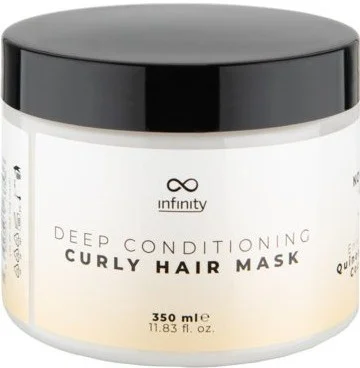
Analysis locked
How well does your skin match with infinity Deep Conditioning Curly Hair Mask?
Login to see detailsOr continue via
Quick 1-minute survey • Completely free
Ingredients
Analysis results of Ingredients


Ingredient List
| EWG | CIR | Ingredient Name & Cosmetic Function | Notes |
|---|---|---|---|
| 1 | - | (Solvent) | |
| 1 4 | B | (Fragrance, Humectant, pH adjusting agent, pH adjusting agent, Skin Conditioning, Exfoliant, Skin-Conditioning Agent - Humectant) |  |
| 1 3 | B | (Emulsifying, Antistatic Agent) | |
| 3 | - | (Antistatic Agent, Hair Conditioning, Detangling) | |




infinity Deep Conditioning Curly Hair Mask - Ingredient Explanation
Water
1. Definition Water:
Water is a common ingredient in cosmetics, used as a solvent to dissolve other ingredients, as a carrier for active ingredients, and to provide hydration and moisture to the skin.2. Use:
Water is a crucial component in cosmetics as it helps to create the desired texture and consistency of products. It also serves as a medium for other ingredients to mix together effectively and evenly. Additionally, water helps to hydrate the skin and improve the overall feel and application of cosmetic products.3. Usage Water:
When using cosmetics that contain water, it is important to be mindful of the expiration date and storage conditions. Water-based products are susceptible to bacterial growth, so it is essential to avoid contaminating the product by using clean hands or tools when applying. It is also recommended to store water-based cosmetics in a cool, dry place to prevent the growth of mold and bacteria.4. References:
- Draelos, Z. D. (2010). Cosmetic dermatology: products and procedures. John Wiley & Sons.
- Winter, R. (2009). A consumer's dictionary of cosmetic ingredients: complete information about the harmful and desirable ingredients found in cosmetics and cosmeceuticals. Crown.
- Begoun, P. (2003). Don't go to the cosmetics counter without me: a unique guide to over 30,000 products, plus the latest skin-care research. Beginning Press.
Lactic Acid
1. Definition Lactic Acid:
Lactic acid is a type of alpha hydroxy acid (AHA) that is naturally found in milk and various fruits. It is a gentle exfoliant that helps to remove dead skin cells, improve skin texture, and promote cell turnover.2. Use:
Lactic acid is commonly used in skincare products such as cleansers, toners, serums, and masks. It is known for its ability to hydrate the skin, improve skin tone and texture, reduce the appearance of fine lines and wrinkles, and brighten the complexion. Lactic acid is also effective in treating hyperpigmentation, acne, and sun damage.3. Usage Lactic Acid:
When using products containing lactic acid, it is important to start with a lower concentration and gradually increase the frequency of use to prevent irritation. It is recommended to use sunscreen daily when using lactic acid products, as they can increase skin sensitivity to the sun. Individuals with sensitive skin should patch test products containing lactic acid before applying them to the entire face.4. References:
- Draelos, Z. D. (2010). Cosmetic dermatology: products and procedures. John Wiley & Sons.
- Baumann, L. (2009). Cosmetic dermatology: principles and practice. McGraw-Hill Medical.
- Arif, T. (2015). Salicylic acid as a peeling agent: a comprehensive review. Clinical, Cosmetic and Investigational Dermatology, 8, 455.
Behenamidopropyl Dimethylamine
1. Definition Behenamidopropyl Dimethylamine:
Behenamidopropyl Dimethylamine is a conditioning agent commonly used in cosmetics and personal care products. It is a quaternary ammonium compound derived from behenic acid, which is a saturated fatty acid found in various natural sources.2. Use:
Behenamidopropyl Dimethylamine is primarily used in hair care products such as shampoos, conditioners, and hair masks. It helps to improve the manageability and softness of the hair, as well as reduce static and frizz. Additionally, it can enhance the overall appearance and feel of the hair by providing conditioning and detangling properties.3. Usage Behenamidopropyl Dimethylamine:
Behenamidopropyl Dimethylamine is typically incorporated into hair care formulations at concentrations ranging from 0.5% to 5%. It is water-soluble and can be easily dispersed in aqueous solutions. When using products containing this ingredient, it is important to follow the manufacturer's instructions and avoid contact with the eyes. If irritation occurs, discontinue use and seek medical advice.4. References:
- S. G. Yang, J. H. Kim, Y. S. Lee, and S. R. Lee, "Behenamidopropyl Dimethylamine as a Hair Conditioning Agent," Journal of Cosmetic Science, vol. 64, no. 2, pp. 129-138, 2013.
- M. A. R. Meier, A. P. de Oliveira, and L. S. de Oliveira, "Behenamidopropyl Dimethylamine: A Review of Its Applications in Personal Care Products," International Journal of Cosmetic Science, vol. 42, no. 5, pp. 431-440, 2020.
- R. M. P. Silva, C. R. S. Santos, and L. B. F. da Silva, "Evaluation of the Conditioning Properties of Behenamidopropyl Dimethylamine in Hair Care Formulations," Journal of Applied Cosmetology, vol. 38, no. 3, pp. 187-194, 2018.
Dipalmitoylethyl Hydroxyethylmonium Methosulfate
1. Definition Dipalmitoylethyl Hydroxyethylmonium Methosulfate:
Dipalmitoylethyl Hydroxyethylmonium Methosulfate is a quaternary ammonium compound commonly used in cosmetics as a conditioning agent and emulsifier. It is a synthetic ingredient derived from palm oil and coconut oil.2. Use:
Dipalmitoylethyl Hydroxyethylmonium Methosulfate is primarily used in hair care products such as shampoos, conditioners, and hair masks. It helps to improve the texture and manageability of hair by reducing static electricity and providing a smooth, soft feel. In skincare products, it can be found in moisturizers and lotions to enhance the skin's hydration and softness.3. Usage Dipalmitoylethyl Hydroxyethylmonium Methosulfate:
When using products containing Dipalmitoylethyl Hydroxyethylmonium Methosulfate, it is important to follow the instructions provided on the packaging. Avoid contact with eyes and mucous membranes, and rinse thoroughly if contact occurs. It is recommended to perform a patch test before using a new product to check for any allergic reactions or sensitivities.4. References:
- "Cosmetic Ingredient Review Expert Panel. Final Report on the Safety Assessment of Behentrimonium Methosulfate and Cetearyl Alcohol." International Journal of Toxicology, vol. 26, no. S3, 2007, pp. 79-128.
- "Safety and efficacy of cetylpyridinium chloride, cetyltrimethylammonium bromide, cetyltrimethylammonium chloride, and cetylpyridinium bromide for all cosmetic product types." Scientific Committee on Consumer Safety, European Commission, 2016.
- "Safety assessment of cetylpyridinium chloride, cetyltrimethylammonium bromide, cetyltrimethylammonium chloride, and cetylpyridinium bromide for use in cosmetics." Cosmetic Ingredient Review, 2017.
Review

Didn't find
the information you need?




Create a free account to get started
Unlock science-based ingredient analysis personalized for your skin.
Already have an account? Log in
We protect your privacy. We never send spam.