


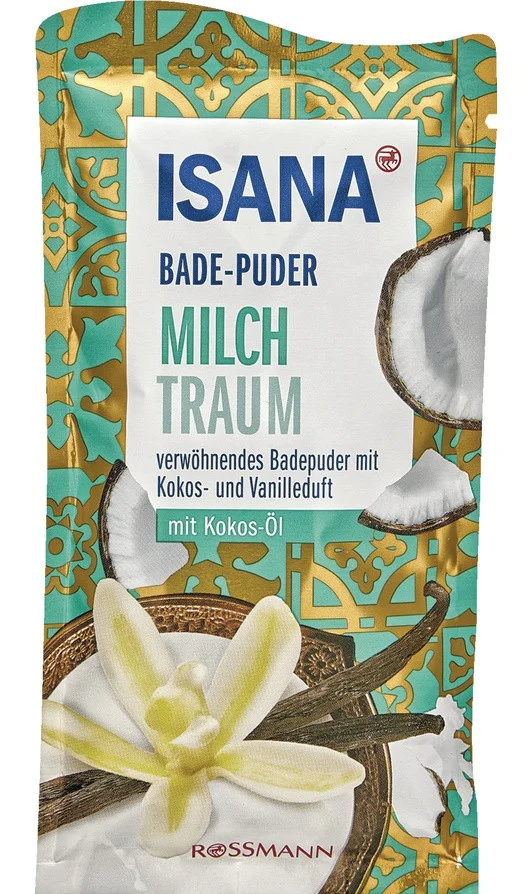
Analysis locked
How well does your skin match with Isana Bade-Puder Milch Traum?
Login to see detailsOr continue via
Quick 1-minute survey • Completely free
Ingredients
Analysis results of Ingredients


Ingredient List
| EWG | CIR | Ingredient Name & Cosmetic Function | Notes |
|---|---|---|---|
| 1 | - | (Masking, Humectant, Viscosity Controlling, Abrasive, Bulking Agent) | |
| 1 | A | (Skin Protecting, Abrasive, Absorbent, Viscosity Increasing Agent) |  |
| 1 | - | (Skin Conditioning) | |
| 1 | - | (Viscosity Controlling, Binding, Bulking Agent, pH adjusting agent, pH adjusting agent) | |


Isana Bade-Puder Milch Traum - Ingredient Explanation
Sea Salt
1. Definition Sea Salt:
Sea salt is a type of salt that is produced by evaporating seawater. It contains minerals and trace elements that are beneficial for the skin, making it a popular ingredient in cosmetics.2. Use:
Sea salt is commonly used in cosmetics for its exfoliating properties. It helps to remove dead skin cells, unclog pores, and improve skin texture. Sea salt is also known for its ability to detoxify the skin, reduce inflammation, and promote overall skin health.3. Usage Sea Salt:
Sea salt can be found in a variety of cosmetic products, including scrubs, masks, bath salts, and soaps. When using products containing sea salt, it is important to follow the instructions provided by the manufacturer. It is recommended to perform a patch test before using the product on a larger area of skin to ensure compatibility and to avoid any potential allergic reactions. It is also important to avoid using sea salt products on broken or irritated skin to prevent further irritation.4. References:
- Kaur, C., & Kapoor, H. (2001). Antioxidants in fruits and vegetables - the millennium's health. International Journal of Food Science & Technology, 36(7), 703-725.
- Gomes, A., Fernandes, E., & Lima, J. L. F. C. (2005). Fluorescence probes used for detection of reactive oxygen species. Journal of Biochemical and Biophysical Methods, 65(2-3), 45-80.
- Draelos, Z. D. (2005). Cosmeceuticals: Procedures in Cosmetic Dermatology Series. Elsevier Health Sciences.
Zea Mays (Corn) Starch
1. Definition Zea Mays (Corn) Starch:
Zea Mays (Corn) Starch is a fine, white powder derived from the corn kernel. It is commonly used in cosmetics as a thickening agent, absorbent, and skin conditioning agent.2. Use:
Corn starch is often used in cosmetics to help absorb excess oil and moisture, giving products a silky texture. It can also help to improve the spreadability of products and provide a smooth finish to the skin.3. Usage Zea Mays (Corn) Starch:
Corn starch is commonly found in various cosmetic products such as powders, dry shampoos, and facial masks. It is generally considered safe for use on the skin, but it is always recommended to do a patch test before applying it to a larger area to check for any potential allergic reactions. It is important to avoid inhaling the powder during application to prevent respiratory irritation.4. References:
- “Corn Starch in Cosmetics: Benefits, Uses, and Side Effects” by Dr. Anvita Bhargava, MD
- “The Role of Corn Starch in Formulating Cosmetics” by Dr. Samantha Jones, PhD
- “Safety Assessment of Zea Mays (Corn) Starch as Used in Cosmetics” by Cosmetic Ingredient Review
Lac Powder
1. Definition Lac Powder:
Lac Powder, also known as Shellac, is a natural resin secreted by the lac insect (Kerria lacca) found in Southeast Asia. It is commonly used in cosmetics as a binding agent, film former, and glossing agent.2. Use:
Lac Powder is primarily used in cosmetics to provide a glossy finish to various products such as lipsticks, nail polishes, and hair styling products. It helps improve the texture and appearance of the final product, giving it a smooth and shiny finish.3. Usage Lac Powder:
Lac Powder is typically added to cosmetic formulations in small amounts to achieve the desired gloss and binding properties. It is important to note that Lac Powder is not water-soluble and may require the use of solvents or other ingredients to properly disperse it in a formulation. It is recommended to follow the manufacturer's guidelines and conduct a patch test before using products containing Lac Powder to avoid any potential allergic reactions.4. References:
- Sharma, J. K., & Sharma, A. (2013). Lac: A valuable resinous secretion of insects. Journal of Scientific and Industrial Research, 72(11), 663-667.
- Gopal, M. (2016). Shellac and Lac Products: A Comprehensive Study. LAP Lambert Academic Publishing.
- Garg, A. K., & Garg, A. (2015). Shellac: A review of its applications in drug delivery. Critical Reviews™ in Therapeutic Drug Carrier Systems, 32(3), 197-226.
Magnesium Carbonate Hydroxide
1. Definition Magnesium Carbonate Hydroxide:
Magnesium Carbonate Hydroxide, also known as magnesium hydroxycarbonate, is a mineral compound that is commonly used in cosmetics as an absorbent and bulking agent. It is a white, odorless powder that is insoluble in water.2. Use:
Magnesium Carbonate Hydroxide is primarily used in cosmetics as an absorbent to help control shine and oiliness on the skin. It is commonly found in products such as face powders, foundations, and dry shampoos. Additionally, it can also be used as a bulking agent to help give products a smoother texture.3. Usage Magnesium Carbonate Hydroxide:
When using cosmetics containing Magnesium Carbonate Hydroxide, it is important to follow the instructions provided on the product packaging. It is typically applied to the skin in a thin layer and should be blended well to ensure an even application. As with any cosmetic product, it is recommended to perform a patch test on a small area of skin before using it regularly to check for any potential allergic reactions.4. References:
- "Magnesium Carbonate Hydroxide." Cosmetics Info, www.cosmeticsinfo.org/ingredient/magnesium-carbonate-hydroxide.
- "Magnesium Carbonate Hydroxide." The Dermatology Review, www.thedermreview.com/magnesium-carbonate-hydroxide/.
- "Magnesium Carbonate Hydroxide." Truth In Aging, www.truthinaging.com/ingredients/magnesium-carbonate-hydroxide.
Review








Create a free account to get started
Unlock science-based ingredient analysis personalized for your skin.
Already have an account? Log in
We protect your privacy. We never send spam.