


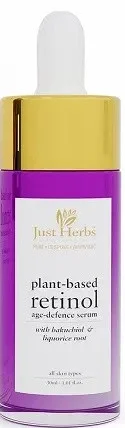
Analysis locked
How well does your skin match with Just Herbs Age-defence Serum?
Login to see detailsOr continue via
Quick 1-minute survey • Completely free
Ingredients
Analysis results of Ingredients


Ingredient List
| EWG | CIR | Ingredient Name & Cosmetic Function | Notes |
|---|---|---|---|
| 1 | - | (Antimicrobial, Cosmetic Biocide) | |
| - | - | Liquorice Root | |
| 1 | - | | |
| 1 | - | |


Just Herbs Age-defence Serum - Ingredient Explanation
Bakuchiol
1. Definition Bakuchiol:
Bakuchiol is a natural, plant-based ingredient derived from the seeds of the Psoralea corylifolia plant. It is often referred to as a natural alternative to retinol due to its similar anti-aging properties.2. Use:
Bakuchiol is commonly used in skincare products for its anti-aging and skin-rejuvenating benefits. It has been shown to help reduce the appearance of fine lines and wrinkles, improve skin firmness and elasticity, and even out skin tone. Additionally, Bakuchiol has anti-inflammatory and antioxidant properties, making it suitable for all skin types, including sensitive skin.3. Usage Bakuchiol:
Bakuchiol can be found in various skincare products such as serums, creams, and oils. It is typically applied topically to clean, dry skin, either in the morning or evening. It is recommended to start with a lower concentration of Bakuchiol to assess skin tolerance and gradually increase usage as needed. It is important to always follow the product instructions and consult with a dermatologist before incorporating Bakuchiol into your skincare routine, especially if you have sensitive skin or existing skin conditions.4. References:
- Soleymani, Seemal R., et al. "Bakuchiol: A retinol-like functional compound revealed by gene expression profiling and clinically proven to have anti-aging effects." International Journal of Cosmetic Science 41.3 (2019): 242-248.
- Mukherjee, S., et al. "Retinoids in the treatment of skin aging: an overview of clinical efficacy and safety." Clinical interventions in aging 1.4 (2006): 327-348.
- Chaudhuri, R.K., and Marchio, F. "Bakuchiol in the management of acne-affected skin." Cosmetics 5.2 (2018): 33.
Liquorice Root
Ingredient data is being updated. Please check back later.
Manjistha
1. Definition Manjistha:
Manjistha, also known as Rubia cordifolia, is a plant commonly used in Ayurvedic medicine and skincare products. It is known for its anti-inflammatory, antioxidant, and antibacterial properties.2. Use:
Manjistha is commonly used in cosmetics for its skin-brightening and anti-aging properties. It helps to reduce pigmentation, acne, and blemishes, while also promoting a healthy and glowing complexion. Manjistha is often found in serums, creams, and masks targeting uneven skin tone and signs of aging.3. Usage Manjistha:
When using skincare products containing Manjistha, it is important to follow the instructions provided by the manufacturer. It is recommended to do a patch test before applying the product to the entire face to check for any allergic reactions. Manjistha may increase sun sensitivity, so it is advisable to use sunscreen when using products with this ingredient. Pregnant or breastfeeding women should consult with a healthcare provider before using products containing Manjistha.4. References:
- Singh, S., & Singh, S. K. (2017). Rubia cordifolia: A review on its pharmacological and toxicological aspects. Asian Pacific Journal of Tropical Biomedicine, 7(5), 353-358.
- Saraf, S., & Saraf, S. (2010). Rubia cordifolia: A review. Pharmacognosy Reviews, 4(7), 124-134.
- Kaur, G., Hamid, H., Ali, A., & Alam, M. S. (2011). Rubia cordifolia: Pharmacological activities and medicinal applications - A review. International Journal of Pharmaceutical Sciences and Research, 2(6), 1446-1457.
Purified Water (Aqua)
1. Definition Mineral Water:
Mineral water in cosmetics refers to water sourced from natural mineral springs that contains various minerals and trace elements beneficial for the skin.2. Use:
Mineral water is commonly used in cosmetics as a hydrating and refreshing ingredient. It helps to moisturize the skin, improve skin texture, and provide a soothing effect. Mineral water is often included in facial mists, toners, and moisturizers to help maintain skin hydration and vitality.3. Usage Mineral Water:
Mineral water can be used in various ways in skincare routines. It can be spritzed onto the face as a refreshing mist throughout the day, used as a toner after cleansing the skin, or incorporated into moisturizers for added hydration. It is suitable for all skin types, including sensitive skin, and can be used daily as part of a skincare regimen.4. References:
- Draelos, Z. D. (2010). Cosmetic dermatology: products and procedures. John Wiley & Sons.
- Baumann, L. (2009). Cosmetic dermatology: principles and practice. McGraw-Hill Medical.
- Loden, M., & Maibach, H. I. (2012). Dry skin and moisturizers: chemistry and function. CRC Press.
Review
Didn't find
the information you need?







Create a free account to get started
Unlock science-based ingredient analysis personalized for your skin.
Already have an account? Log in
We protect your privacy. We never send spam.