


Analysis locked
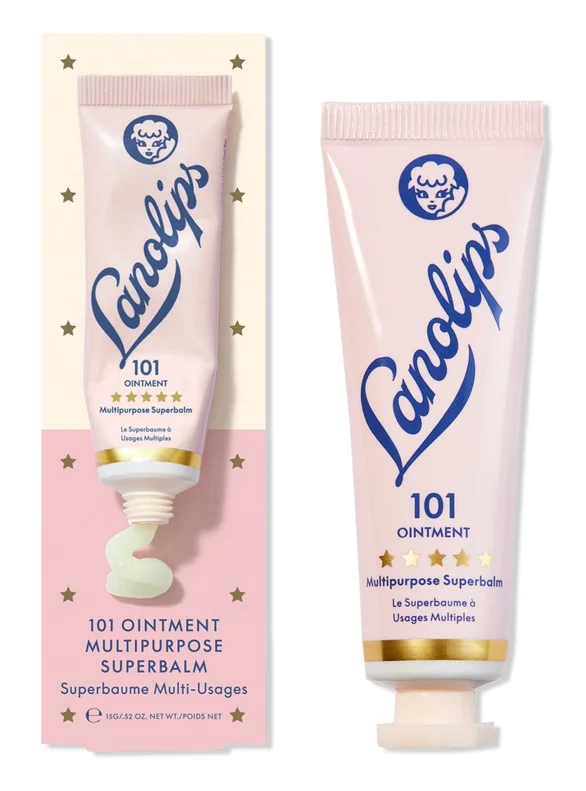
How well does your skin match with Lanolips The Original 101 Ointment Multipurpose Superbalm?
Login to see detailsOr continue via
Quick 1-minute survey • Completely free
Ingredients
Analysis results of Ingredients

Ingredient List
| EWG | CIR | Ingredient Name & Cosmetic Function | Notes |
|---|---|---|---|
| 1 | A | (Hair Conditioning, Skin Conditioning, Emollient, Antistatic Agent, Emulsion Stabilising, Emulsifying, Surfactant, Skinprotectant) | |
| 1 | - |   |
Lanolips The Original 101 Ointment Multipurpose Superbalm - Ingredient Explanation
Lanolin
1. Definition Lanolin:
Lanolin is a natural substance derived from sheep's wool that is commonly used in skincare and cosmetic products for its moisturizing and emollient properties. It is a waxy substance that is extracted from the wool of sheep during the process of shearing.2. Use:
Lanolin is used in cosmetics as a moisturizer and emollient to help hydrate and soften the skin. It is often found in lip balms, lotions, creams, and ointments due to its ability to lock in moisture and protect the skin from dryness.3. Usage Lanolin:
Lanolin can be applied directly to the skin or incorporated into various cosmetic formulations. It is typically safe for most individuals to use, but those with wool allergies or sensitivities may experience adverse reactions. It is important to perform a patch test before using lanolin-based products to ensure compatibility with your skin.Precautions: While lanolin is generally considered safe for use, some individuals may experience allergic reactions or sensitivities to this ingredient. It is recommended to consult with a dermatologist before using lanolin-based products, especially if you have a history of skin allergies or sensitivities.
4. References:
- Paula Begoun, Bryan Barron. "The Original Beauty Bible: Skin Care Facts for Ageless Beauty." Beginning Press, 2003.
- Zoe Diana Draelos. "Cosmetic Dermatology: Products and Procedures." John Wiley & Sons, 2010.
- Raja Sivamani, Jared Jagdeo, Peter Elsner, Howard Maibach. "Cosmetic Formulation of Skin Care Products." CRC Press, 2015.
Tocopherol (Vit E)
1. Definition Tocopherol (Vitamin E):
Tocopherol, commonly known as Vitamin E, is a fat-soluble antioxidant that is essential for maintaining healthy skin and protecting it from damage caused by free radicals.2. Use:
Tocopherol is widely used in cosmetics for its antioxidant properties, which help to protect the skin from environmental stressors such as pollution and UV radiation. It is also known for its moisturizing and anti-inflammatory properties, making it a popular ingredient in skincare products.3. Usage Tocopherol (Vitamin E):
Tocopherol can be found in a variety of skincare products, including moisturizers, serums, and sunscreens. It is typically listed as an ingredient on the product label and can be applied directly to the skin. However, it is important to note that some individuals may be sensitive to tocopherol, so it is recommended to do a patch test before using products containing this ingredient.4. References:
- Lin, F.-H., Lin, J.-Y., Gupta, R. D., Tournas, J. A., Burch, J. A., Selim, M. A., … & Fisher, G. J. (2005). Ferulic acid stabilizes a solution of vitamins C and E and doubles its photoprotection of skin. Journal of Investigative Dermatology, 125(4), 826-832.
- Thiele, J. J., Hsieh, S. N., Briviba, K., Sies, H. (1999). Protein oxidation in human stratum corneum: susceptibility of keratins to oxidation in vitro and presence of a keratin oxidation gradient in vivo. Journal of Investigative Dermatology, 113(3), 335-339.
- Nachbar, F., Korting, H. C. (1995). The role of vitamin E in normal and damaged skin. Journal of Molecular Medicine, 73(1), 7-17.
Review

Didn't find
the information you need?





Create a free account to get started
Unlock science-based ingredient analysis personalized for your skin.
Already have an account? Log in
We protect your privacy. We never send spam.