


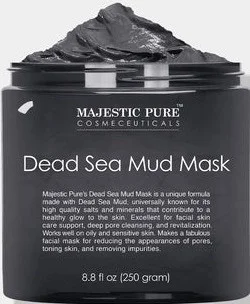
Analysis locked
How well does your skin match with Majestic Pure Cosmeceuticals Dead Sea Mud Mask?
Login to see detailsOr continue via
Quick 1-minute survey • Completely free
Ingredients
Analysis results of Ingredients


Ingredient List
| EWG | CIR | Ingredient Name & Cosmetic Function | Notes |
|---|---|---|---|
| - | - | Potato Starch | |
| 1 | - | | |
| 1 | - | (Solvent) | |
| 1 | A | (Skin Protecting, Abrasive, Absorbent, Viscosity Increasing Agent) |  |



Majestic Pure Cosmeceuticals Dead Sea Mud Mask - Ingredient Explanation
Potato Starch
Ingredient data is being updated. Please check back later.
Dead Sea Mud
1. Definition Dead Sea Mud:
Dead Sea Mud is a natural substance that is rich in minerals and salts, harvested from the shores of the Dead Sea. It is known for its detoxifying, exfoliating, and nourishing properties, making it a popular ingredient in skincare products.2. Use:
Dead Sea Mud is commonly used in cosmetics such as face masks, body scrubs, and bath salts. It is believed to help draw out impurities from the skin, unclog pores, and improve overall skin texture. The minerals found in Dead Sea Mud, including magnesium, calcium, and potassium, are thought to provide numerous benefits for the skin, such as hydration, anti-inflammatory properties, and improved circulation.3. Usage Dead Sea Mud:
When using Dead Sea Mud in cosmetics, it is important to follow the instructions provided on the product packaging. Typically, Dead Sea Mud masks are applied to clean, dry skin and left on for a specified amount of time before being rinsed off with warm water. It is recommended to perform a patch test before using Dead Sea Mud products to check for any potential allergic reactions or skin sensitivities. It is also important to avoid getting the mud in contact with the eyes or mouth.4. References:
- "Dead Sea Mud: Benefits for Skin and Overall Health." Healthline, www.healthline.com/health/dead-sea-mud-benefits#benefits-for-skin.
- "The Healing Power of Dead Sea Mud." The Spa at the Dead Sea Marriott Resort & Spa, www.deadsea-marriott.com/the-healing-power-of-dead-sea-mud/.
- "Dead Sea Mud: Benefits and Uses for Skin." Byrdie, www.byrdie.com/dead-sea-mud-uses-and-benefits-5078563.
Water
1. Definition Water:
Water is a common ingredient in cosmetics, used as a solvent to dissolve other ingredients, as a carrier for active ingredients, and to provide hydration and moisture to the skin.2. Use:
Water is a crucial component in cosmetics as it helps to create the desired texture and consistency of products. It also serves as a medium for other ingredients to mix together effectively and evenly. Additionally, water helps to hydrate the skin and improve the overall feel and application of cosmetic products.3. Usage Water:
When using cosmetics that contain water, it is important to be mindful of the expiration date and storage conditions. Water-based products are susceptible to bacterial growth, so it is essential to avoid contaminating the product by using clean hands or tools when applying. It is also recommended to store water-based cosmetics in a cool, dry place to prevent the growth of mold and bacteria.4. References:
- Draelos, Z. D. (2010). Cosmetic dermatology: products and procedures. John Wiley & Sons.
- Winter, R. (2009). A consumer's dictionary of cosmetic ingredients: complete information about the harmful and desirable ingredients found in cosmetics and cosmeceuticals. Crown.
- Begoun, P. (2003). Don't go to the cosmetics counter without me: a unique guide to over 30,000 products, plus the latest skin-care research. Beginning Press.
Zea Mays (Corn) Starch
1. Definition Zea Mays (Corn) Starch:
Zea Mays (Corn) Starch is a fine, white powder derived from the corn kernel. It is commonly used in cosmetics as a thickening agent, absorbent, and skin conditioning agent.2. Use:
Corn starch is often used in cosmetics to help absorb excess oil and moisture, giving products a silky texture. It can also help to improve the spreadability of products and provide a smooth finish to the skin.3. Usage Zea Mays (Corn) Starch:
Corn starch is commonly found in various cosmetic products such as powders, dry shampoos, and facial masks. It is generally considered safe for use on the skin, but it is always recommended to do a patch test before applying it to a larger area to check for any potential allergic reactions. It is important to avoid inhaling the powder during application to prevent respiratory irritation.4. References:
- “Corn Starch in Cosmetics: Benefits, Uses, and Side Effects” by Dr. Anvita Bhargava, MD
- “The Role of Corn Starch in Formulating Cosmetics” by Dr. Samantha Jones, PhD
- “Safety Assessment of Zea Mays (Corn) Starch as Used in Cosmetics” by Cosmetic Ingredient Review
Review

Didn't find
the information you need?






Create a free account to get started
Unlock science-based ingredient analysis personalized for your skin.
Already have an account? Log in
We protect your privacy. We never send spam.