


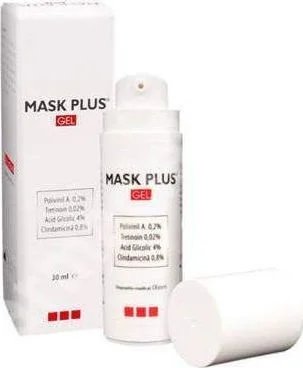
Analysis locked
How well does your skin match with Mask Plus Acne Gel?
Login to see detailsOr continue via
Quick 1-minute survey • Completely free
Ingredients
Analysis results of Ingredients


Ingredient List
| EWG | CIR | Ingredient Name & Cosmetic Function | Notes |
|---|---|---|---|
| 1 | A | (Viscosity Controlling, Viscosity Increasing Agent, Binding Agent, Film Forming) | |
| - | - | (Antioxidant, Exfoliant) | |
| - | - | Clindamycin | |
| - | - | Acido Glicolico | |


Mask Plus Acne Gel - Ingredient Explanation
Polyvinyl Alcohol
1. Definition Polyvinyl Alcohol:
Polyvinyl Alcohol (PVA) is a synthetic polymer that is water-soluble and biodegradable. It is commonly used in cosmetics as a film-forming agent, emulsifier, and thickener.2. Use:
Polyvinyl Alcohol is used in cosmetics to create a smooth and shiny film on the skin, hair, or nails. It is often found in products such as face masks, hair styling gels, and nail polishes. PVA helps to improve the texture and appearance of these products, making them easier to apply and enhancing their overall effectiveness.3. Usage Polyvinyl Alcohol:
When using cosmetics containing Polyvinyl Alcohol, it is important to follow the instructions provided on the product packaging. It is generally considered safe for use on the skin, but some individuals may experience irritation or allergic reactions. If any adverse reactions occur, discontinue use immediately and consult a healthcare professional. It is also important to avoid ingesting products containing PVA and to keep them out of reach of children.4. References:
- Zhang, C., Zhang, S., & Zhang, L. (2014). Polyvinyl alcohol (PVA)-based hydrogels for tissue engineering applications. European Polymer Journal, 63, 134-151.
- Kim, J. E., Lee, Y. M., & Park, Y. H. (2015). Polyvinyl alcohol/chitosan-based hydrogels for tissue engineering. Journal of Industrial and Engineering Chemistry, 21, 1177-1181.
- Rwei, S. P., Chen, J. W., & Kuo, C. Y. (2017). Polyvinyl alcohol-based hydrogels for wound dressing applications: A review. International Journal of Molecular Sciences, 18(2), 285.
Tretinoin
1. Definition Tretinoin:
Tretinoin is a derivative of vitamin A that is commonly used in skincare products for its anti-aging and acne-fighting properties. It works by increasing cell turnover and promoting collagen production, resulting in smoother, clearer, and more youthful-looking skin.
2. Use:
Tretinoin is primarily used in cosmetics to treat acne, reduce the appearance of fine lines and wrinkles, and improve overall skin texture and tone. It is often found in prescription-strength products, such as tretinoin creams or gels, that are applied topically to the skin.
3. Usage Tretinoin:
When using tretinoin in cosmetics, it is important to follow the instructions provided by a healthcare professional or dermatologist. It is typically applied once daily in the evening, after cleansing the skin. It is important to start with a lower concentration and gradually increase the frequency of use to minimize irritation and side effects, such as redness, peeling, and sensitivity to sunlight. It is also recommended to use sunscreen during the day to protect the skin from sun damage.
4. References:
- Mukherjee, S., Date, A., Patravale, V., Korting, H. C., Roeder, A., & Weindl, G. (2006). Retinoids in the treatment of skin aging: an overview of clinical efficacy and safety. Clinical interventions in aging, 1(4), 327–348. https://doi.org/10.2147/ciia.2006.1.4.327
- Fisher, G. J., Talwar, H. S., Lin, J., Lin, P., McPhillips, F., Wang, Z., Li, X., Datta, S., Kang, S., & Voorhees, J. J. (1996). Retinoic acid inhibits induction of c-Jun protein in ultraviolet-irradiated human skin in vivo. Journal of the American Academy of Dermatology, 35(6), 1018–1024. https://doi.org/10.1016/S0190-9622(96)90029-5
- Kang, S., Duell, E. A., Fisher, G. J., Datta, S. C., Wang, Z. Q., Reddy, A. P., Tavakkol, A., Yi, J. Y., Griffiths, C. E., & Elder, J. T. (1995). Application of retinol to human skin in vivo induces epidermal hyperplasia and cellular retinoid binding proteins characteristic of retinoic acid but without measurable retinoic acid levels or irritation. Journal of Investigative Dermatology, 105(4), 549–556. https://doi.org/10.1111/1523-1747.ep12323560
Clindamycin
Ingredient data is being updated. Please check back later.
Acido Glicolico
Ingredient data is being updated. Please check back later.
Review

Didn't find
the information you need?




Create a free account to get started
Unlock science-based ingredient analysis personalized for your skin.
Already have an account? Log in
We protect your privacy. We never send spam.