


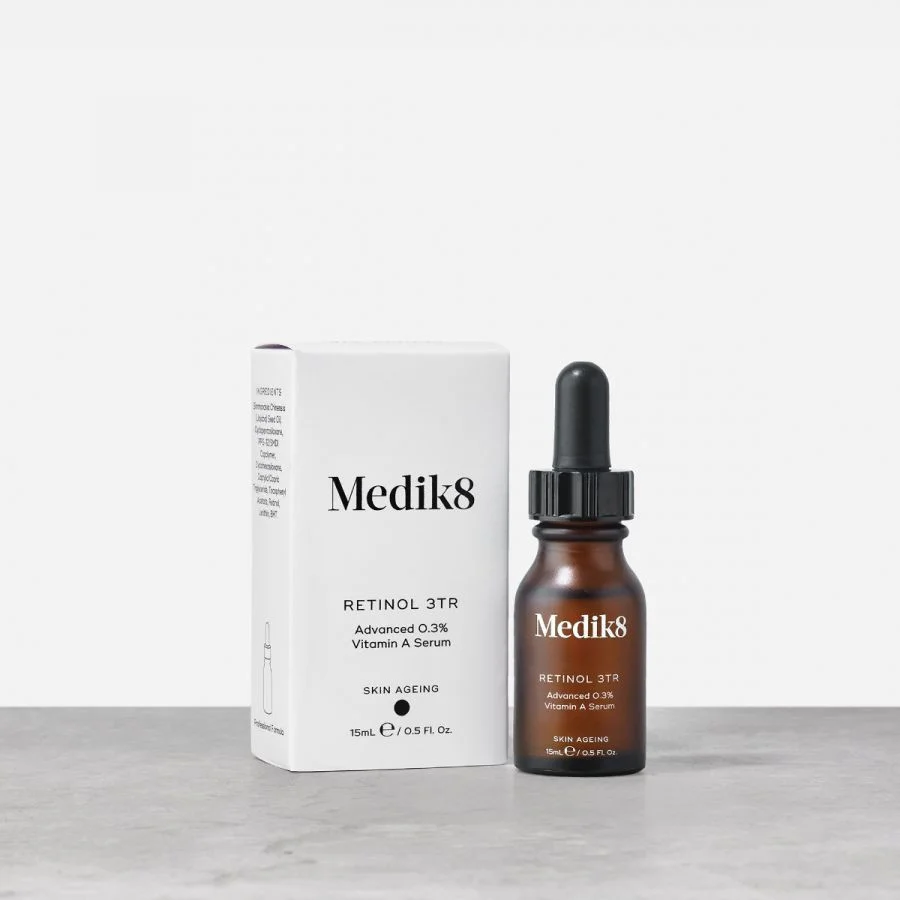
Analysis locked
How well does your skin match with Medik8 Retinol 3 Tr Serum?
Login to see detailsOr continue via
Quick 1-minute survey • Completely free
Ingredients
Analysis results of Ingredients


Ingredient List
| EWG | CIR | Ingredient Name & Cosmetic Function | Notes |
|---|---|---|---|
| 1 | - | (Skin Conditioning, Emollient, Hair Conditioning, Abrasive) | |
| 3 | A | (Solvent, Hair Conditioning, Skin Conditioning, Emollient) |  |
| 1 | - | (Skin Conditioning, Emollient, Film Forming, Hair Fixing) | |
| 2 | A | (Solvent, Hair Conditioning, Skin Conditioning, Emollient) | |

Medik8 Retinol 3 Tr Serum - Ingredient Explanation
Simmondsia Chinensis (Jojoba) Seed Oil Extract
1. Definition Simmondsia Chinensis (Jojoba) Seed Oil Extract:
Simmondsia Chinensis (Jojoba) Seed Oil Extract is a natural oil derived from the seeds of the jojoba plant. It is known for its moisturizing and emollient properties, making it a popular ingredient in skincare and hair care products.2. Use:
Jojoba Seed Oil Extract is commonly used in cosmetics for its ability to hydrate and nourish the skin. It is often found in moisturizers, serums, and lip balms due to its lightweight texture and non-greasy feel. Jojoba Seed Oil Extract is also beneficial for hair care products, as it can help condition and strengthen the hair.3. Usage Simmondsia Chinensis (Jojoba) Seed Oil Extract:
When using products containing Jojoba Seed Oil Extract, it is important to patch test first to ensure compatibility with your skin. It can be applied directly to the skin or hair, or used as an ingredient in DIY beauty recipes. Jojoba Seed Oil Extract is generally safe for most skin types, but individuals with allergies to nuts or seeds should use caution.4. References:
- Paula Begoun. (2003). "Don't Go to the Cosmetics Counter Without Me." 7th Edition.
- Dweck, A. C. (2003). "The Jojoba Story." Personal Care Magazine, 4(1), 1-4.
- Meier, L., & Sticher, O. (2004). "Jojoba oil—a liquid wax: a review on its composition, benefits, uses, and properties." Revista Brasileira de Farmacognosia, 14(1), 1-6.
Cyclopentasiloxane
1. Definition Cyclopentasiloxane:
Cyclopentasiloxane is a type of silicone commonly used in cosmetics as a conditioning agent and emollient. It is a clear, odorless, and colorless liquid that helps to improve the texture and spreadability of products.2. Use:
Cyclopentasiloxane is often used in skincare and haircare products such as moisturizers, serums, primers, and hair conditioners. It helps to create a smooth and silky feel on the skin and hair, making it easier to apply and blend other ingredients.3. Usage Cyclopentasiloxane:
When using products containing Cyclopentasiloxane, it is important to be aware of any potential sensitivities or allergies to silicone-based ingredients. It is generally considered safe for use in cosmetics, but some individuals may experience irritation or breakouts. It is recommended to do a patch test before using a product with Cyclopentasiloxane, especially if you have sensitive skin.4. References:
- Ulery, B. D., Nair, L. S., & Laurencin, C. T. (2011). Biomedical applications of biodegradable polymers. Journal of Polymer Science Part B: Polymer Physics, 49(12), 832-864.
- Lefebvre, M. A., Pham, D. M., Boussouira, B., & Bernard, D. (2015). Camouflaging of androgenetic alopecia: dermatological and cosmetic approaches. Skin Research and Technology, 21(4), 219-227.
- Mavon, A., Miquel, C., Lejeune, O., Payre, B., & Moret, N. (2015). In vitro percutaneous absorption and in vivo stratum corneum distribution of an organic and a mineral sunscreen. Skin Pharmacology and Physiology, 28(5), 266-275.
Ppg 12/ Smdi Copolymer
1. Definition Ppg 12/ Smdi Copolymer:
Ppg 12/ Smdi Copolymer is a copolymer consisting of polypropylene glycol (PPG) and stearyl methacrylate dimethyl ammonium chloride (SMDI). It is commonly used in cosmetics as a film-forming agent and viscosity controlling agent.2. Use:
Ppg 12/ Smdi Copolymer is primarily used in cosmetics as a film-forming agent to create a smooth and even film on the skin or hair. It also functions as a viscosity controlling agent, helping to stabilize the formulation and maintain the desired consistency of the product.3. Usage Ppg 12/ Smdi Copolymer:
Ppg 12/ Smdi Copolymer is used in a wide range of cosmetic products, including hair care products such as styling gels, mousses, and hairsprays, as well as in skincare products like lotions, creams, and sunscreens. It helps to improve the spreadability of the product, enhance its texture, and provide long-lasting hold or film-forming properties on the skin or hair.Precautions: While Ppg 12/ Smdi Copolymer is considered safe for use in cosmetics, some individuals may be sensitive or allergic to this ingredient. It is always recommended to perform a patch test before using a product containing this ingredient, especially if you have sensitive skin or a history of allergies. If irritation occurs, discontinue use immediately and consult a healthcare professional.
4. References:
- CosmeticsInfo.org. (2021). Ppg-12/Smdi Copolymer. Retrieved from https://cosmeticsinfo.org/ingredient/ppg-12smdi-copolymer
- Personal Care Council. (2021). Ppg-12/Smdi Copolymer. Retrieved from https://www.personalcarecouncil.org/ingredient/ppg-12smdi-copolymer/
- U.S. Food and Drug Administration. (2021). Ppg-12/Smdi Copolymer. Retrieved from https://www.fda.gov/cosmetics/cosmetic-ingredients/ppg-12smdi-copolymer
Cyclohexasiloxane
1. Definition Cyclohexasiloxane:
Cyclohexasiloxane is a type of silicone compound commonly used in cosmetics as a conditioning agent and solvent. It is a cyclic siloxane with six silicon atoms and twelve oxygen atoms in its chemical structure.2. Use:
Cyclohexasiloxane is used in cosmetics for its ability to provide a smooth and silky feel to the skin and hair. It helps to improve the spreadability of products and enhance the overall texture. Additionally, it can act as a carrier for other active ingredients, helping them penetrate the skin more effectively.3. Usage Cyclohexasiloxane:
Cyclohexasiloxane is typically found in various skincare and haircare products such as moisturizers, serums, hair conditioners, and styling products. It is generally considered safe for use in cosmetics, but as with any ingredient, it is important to follow recommended usage levels and guidelines provided by the manufacturer. Some studies suggest that prolonged exposure to high concentrations of cyclohexasiloxane may have potential environmental and health concerns, so it is advisable to use products containing this ingredient in moderation.4. References:
- Fiume, M. M., Bergfeld, W. F., Belsito, D. V., Hill, R. A., Klaassen, C. D., Liebler, D. C., ... & Andersen, F. A. (2017). Safety assessment of cyclopentasiloxane and cyclohexasiloxane. International journal of toxicology, 36(1_suppl), 3S-19S.
- SCCS (Scientific Committee on Consumer Safety). (2015). Opinion on cyclohexasiloxane (cyclohexamethylsiloxane) (D6). SCCS/1549/14.
- Cosmetic Ingredient Review. (2008). Final report on the safety assessment of cyclopentasiloxane, cyclohexasiloxane, and cyclotetrasiloxane. International journal of toxicology, 27, 87-110.
Review

Didn't find
the information you need?






Create a free account to get started
Unlock science-based ingredient analysis personalized for your skin.
Already have an account? Log in
We protect your privacy. We never send spam.