


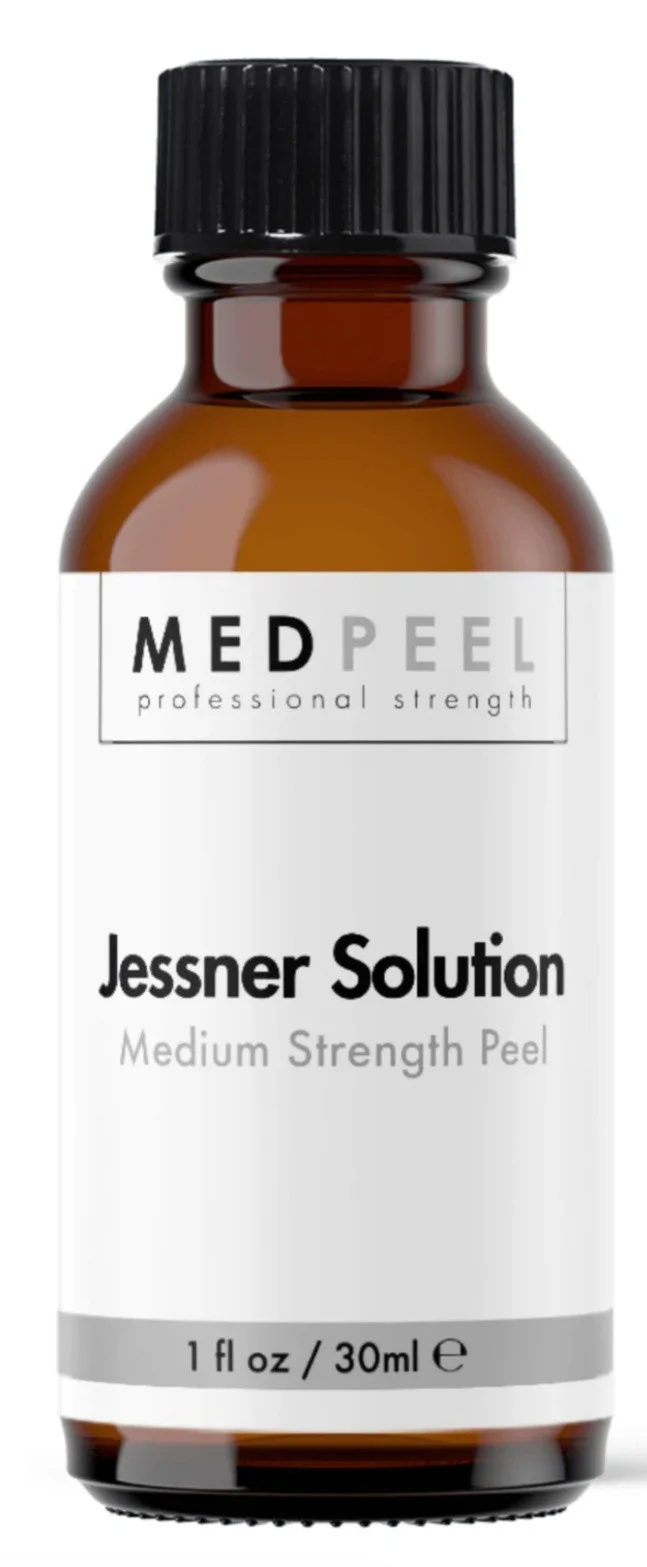
Analysis locked
How well does your skin match with medpeel Jessner Solution?
Login to see detailsOr continue via
Quick 1-minute survey • Completely free
Ingredients
Analysis results of Ingredients


Ingredient List
| EWG | CIR | Ingredient Name & Cosmetic Function | Notes |
|---|---|---|---|
| 1 | B | (pH adjusting agent, pH adjusting agent) | |
| 7 | A | (Masking, Fragrance, Antiacne Agent, Denaturant , External Analgesic , Hair Dyeing) | |
| 1 3 | B | (Masking, Fragrance, Hair Conditioning, Denaturant , Preservative, Skin Conditioning, Exfoliant, Antidandruff Agent, Antiacne Agent, Keratolytic, Corn/Callus/Wart Remover) |   |
| 1 4 | B | (Fragrance, Humectant, pH adjusting agent, pH adjusting agent, Skin Conditioning, Exfoliant, Skin-Conditioning Agent - Humectant) | |
medpeel Jessner Solution - Ingredient Explanation
Ethanol
1. Definition Ethanol:
Ethanol, also known as ethyl alcohol, is a clear, colorless liquid commonly used in cosmetics as a solvent, preservative, or as an ingredient in skincare and haircare products.2. Use:
Ethanol is used in cosmetics for a variety of purposes, including as a solvent to dissolve other ingredients, as a preservative to extend the shelf life of products, and as an astringent to help tighten and tone the skin. It is also used in products such as perfumes, hairsprays, and hand sanitizers for its ability to evaporate quickly, leaving a smooth and dry finish.3. Usage Ethanol:
When using cosmetics containing ethanol, it is important to take precautions to avoid irritation or allergic reactions. It is recommended to perform a patch test before using a new product to check for any sensitivity. Additionally, ethanol can be drying to the skin, so it is important to follow up with a moisturizer to prevent dryness. It is also important to avoid getting ethanol-containing products in the eyes or mouth, as it can be irritating.4. References:
- Burdock, G. A. (2010). Safety assessment of ethanol in cosmetic products. International Journal of Toxicology, 29(1), 69-79.
- Lachenmeier, D. W., & Rehm, J. (2015). Comparative risk assessment of carcinogens in alcoholic beverages using the margin of exposure approach. International Journal of Cancer, 136(5), 1464-1475.
- Reisch, M. S., & Givens, J. (2016). Ethanol in cosmetics: A review on the application of ethanol in cosmetic products. Cosmetics, 3(3), 28.
Resorcinol
1. Definition Resorcinol:
Resorcinol is a chemical compound that is commonly used in cosmetics for its antiseptic and disinfectant properties. It is a white crystalline solid that is soluble in water and alcohol.2. Use:
Resorcinol is often used in cosmetics as an ingredient in products such as hair dyes, acne treatments, and skin lightening creams. It is known for its ability to help treat various skin conditions, including acne, eczema, and psoriasis. Resorcinol is also used in hair dyes to help produce long-lasting color results.3. Usage Resorcinol:
When using products containing resorcinol, it is important to follow the instructions provided on the packaging carefully. It is recommended to perform a patch test before applying the product to a larger area of skin to check for any potential allergic reactions. It is also advised to avoid using products containing resorcinol on broken or irritated skin, as it may cause further irritation. Additionally, prolonged or excessive use of resorcinol-containing products may lead to skin sensitivity or other adverse reactions.4. References:
- "Resorcinol." Cosmetics Info, www.cosmeticsinfo.org/ingredient/resorcinol.
- "Resorcinol in Cosmetics." Truth In Aging, www.truthinaging.com/ingredients/resorcinol.
- "Safety Assessment of Resorcinol as Used in Cosmetics." Cosmetic Ingredient Review, www.cir-safety.org/sites/default/files/resorcin0614slr.pdf.
Salicylic Acid
1. Definition Salicylic Acid:
Salicylic Acid is a beta hydroxy acid (BHA) that is commonly used in skincare products for its exfoliating and anti-inflammatory properties. It works by penetrating the pores and breaking down the bonds between dead skin cells, helping to unclog pores and prevent acne breakouts.
2. Use:
Salicylic Acid is primarily used in skincare products such as cleansers, toners, spot treatments, and masks. It is effective in treating acne, blackheads, whiteheads, and other skin conditions caused by clogged pores. Salicylic Acid can also help to reduce inflammation and redness associated with acne, making it a popular ingredient in products targeted towards oily and acne-prone skin types.
3. Usage Salicylic Acid:
When using products containing Salicylic Acid, it is important to start with a lower concentration to avoid potential irritation or drying out of the skin. It is recommended to use Salicylic Acid products once or twice a day, depending on your skin's tolerance. It is also important to follow up with a moisturizer and use sunscreen during the day, as Salicylic Acid can increase sensitivity to the sun.
4. References:
- Kornhauser, A., Coelho, S. G., & Hearing, V. J. (2010). Applications of hydroxy acids: classification, mechanisms, and photoactivity. Clinical, Cosmetic and Investigational Dermatology, 3, 135–142. https://doi.org/10.2147/CCID.S9042
- Arif, T. (2015). Salicylic acid as a peeling agent: a comprehensive review. Clinical, Cosmetic and Investigational Dermatology, 8, 455–461. https://doi.org/10.2147/CCID.S84765
- Chien, A. L., Qi, J., Rainer, B., & Sachs, D. L. (2018). Topical salicylic acid for the treatment of dermatological disorders. Journal of Drugs in Dermatology, 17(6), 725–730. https://jddonline.com/articles/dermatology/S1545961618P0725X/1
Lactic Acid
1. Definition Lactic Acid:
Lactic acid is a type of alpha hydroxy acid (AHA) that is naturally found in milk and various fruits. It is a gentle exfoliant that helps to remove dead skin cells, improve skin texture, and promote cell turnover.2. Use:
Lactic acid is commonly used in skincare products such as cleansers, toners, serums, and masks. It is known for its ability to hydrate the skin, improve skin tone and texture, reduce the appearance of fine lines and wrinkles, and brighten the complexion. Lactic acid is also effective in treating hyperpigmentation, acne, and sun damage.3. Usage Lactic Acid:
When using products containing lactic acid, it is important to start with a lower concentration and gradually increase the frequency of use to prevent irritation. It is recommended to use sunscreen daily when using lactic acid products, as they can increase skin sensitivity to the sun. Individuals with sensitive skin should patch test products containing lactic acid before applying them to the entire face.4. References:
- Draelos, Z. D. (2010). Cosmetic dermatology: products and procedures. John Wiley & Sons.
- Baumann, L. (2009). Cosmetic dermatology: principles and practice. McGraw-Hill Medical.
- Arif, T. (2015). Salicylic acid as a peeling agent: a comprehensive review. Clinical, Cosmetic and Investigational Dermatology, 8, 455.
Review

Didn't find
the information you need?




Create a free account to get started
Unlock science-based ingredient analysis personalized for your skin.
Already have an account? Log in
We protect your privacy. We never send spam.