


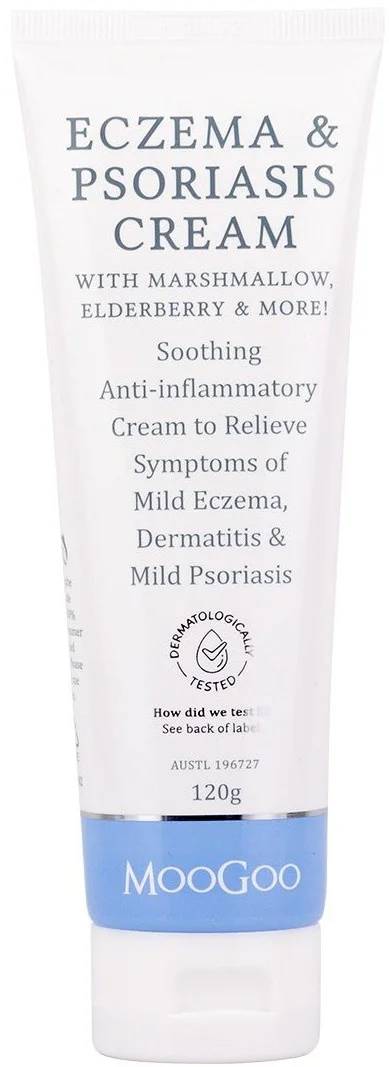
MooGoo Eczema & Psoriasis Cream With Marshmallow, Elderberry & More
Analysis locked
How well does your skin match with MooGoo Eczema & Psoriasis Cream With Marshmallow, Elderberry & More?
Login to see detailsOr continue via
Quick 1-minute survey • Completely free
Ingredients
Analysis results of Ingredients


Ingredient List
| EWG | CIR | Ingredient Name & Cosmetic Function | Notes |
|---|---|---|---|
| 1 | - | (Skin Conditioning) | |
| 1 | A | (Solvent, Skin Conditioning, Masking, Emollient, Fragrance, Hair Conditioning) |   |
| 1 | - | (Skin Conditioning, Astringent) | |
| 1 | A | (Skin Conditioning, Masking, Perfuming) | |


MooGoo Eczema & Psoriasis Cream With Marshmallow, Elderberry & More - Ingredient Explanation
Althaea Officinalis Root Extract
1. Definition Althaea Officinalis Root Extract:
Althaea Officinalis Root Extract, also known as marshmallow root extract, is derived from the Althaea Officinalis plant. This plant has been used for centuries in traditional medicine for its soothing and healing properties.2. Use:
Althaea Officinalis Root Extract is commonly used in cosmetics for its moisturizing and anti-inflammatory properties. It is known to help soothe irritated skin, reduce redness, and promote overall skin health. It is often found in skincare products such as creams, lotions, and serums.3. Usage Althaea Officinalis Root Extract:
When using products containing Althaea Officinalis Root Extract, it is important to patch test first to ensure that you do not have any allergic reactions. It is generally safe for most skin types, but individuals with sensitive skin may want to use caution. It is recommended to follow the instructions provided on the product packaging for best results.4. References:
- Choi JY, Kim YJ, Kim HJ, Kim YS, Kim YC. Althaea rosea Cavanil and Plantago major L. suppress neuropeptide-induced inflammation. J Ethnopharmacol. 2018;211:104-111. doi:10.1016/j.jep.2017.09.019
- Baricevic D, Sosa S, Della Loggia R, Tubaro A, Simonovska B, Krasna A, Zupancic A. Topical anti-inflammatory activity of Salvia officinalis L. leaves: the relevance of ursolic acid. J Ethnopharmacol. 2001;75(2-3):125-132. doi:10.1016/s0378-8741(00)00407-4
- Saeedi M, Eslamifar A, Khezri K, Khezri K. Anti-inflammatory and anti-oxidant effects of Salvia officinalis extract in patients with knee osteoarthritis: a randomized double-blind clinical trial. Avicenna J Phytomed. 2020;10(2):154-165.
Cocos Nucifera (Coconut) Oil
1. Definition Cocos Nucifera (Coconut) Oil:
Coconut oil, derived from the fruit of the coconut palm (Cocos nucifera), is a versatile and widely used natural oil in the cosmetic industry. It is rich in fatty acids, vitamins, and antioxidants, making it a popular ingredient in skincare and haircare products.2. Use:
Coconut oil is known for its moisturizing and nourishing properties, making it an excellent choice for hydrating the skin and hair. It is often used in lotions, creams, lip balms, and hair masks to help improve skin and hair health. Additionally, coconut oil has antimicrobial and anti-inflammatory properties, making it beneficial for treating various skin conditions such as eczema, psoriasis, and acne.3. Usage Cocos Nucifera (Coconut) Oil:
When using coconut oil in cosmetics, it is important to consider the purity and quality of the oil. Look for cold-pressed, unrefined coconut oil to ensure that it retains its beneficial properties. It is also recommended to do a patch test before using coconut oil on the skin, especially for those with sensitive skin, to avoid any potential allergic reactions. Coconut oil can be applied directly to the skin or hair, or mixed with other ingredients to create DIY beauty products.4. References:
- Rele, A. S., & Mohile, R. B. (2003). Effect of mineral oil, sunflower oil, and coconut oil on prevention of hair damage. Journal of cosmetic science, 54(2), 175-192.
- Evangelista, M. T., Abad-Casintahan, F., & Lopez-Villafuerte, L. (2014). The effect of topical virgin coconut oil on SCORAD index, transepidermal water loss, and skin capacitance in mild to moderate pediatric atopic dermatitis: a randomized, double-blind, clinical trial. International Journal of Dermatology, 53(1), 100-108.
- Nevin, K. G., & Rajamohan, T. (2010). Beneficial effects of virgin coconut oil on lipid parameters and in vitro LDL oxidation. Clinical biochemistry, 43(4-5), 349-357.
Sambucus Nigra Fruit Juice
1. Definition Sambucus Nigra Fruit Juice:
Sambucus Nigra Fruit Juice, also known as elderberry juice, is derived from the fruit of the Sambucus Nigra plant. It is known for its high antioxidant content, which helps protect the skin from environmental stressors and signs of aging.2. Use:
Sambucus Nigra Fruit Juice is commonly used in cosmetics for its skin-nourishing and protective properties. It is often included in skincare products such as serums, moisturizers, and masks to help improve the overall health and appearance of the skin.3. Usage Sambucus Nigra Fruit Juice:
When using cosmetics containing Sambucus Nigra Fruit Juice, it is important to follow the instructions provided on the product packaging. It is recommended to perform a patch test before applying the product to the entire face to check for any potential allergic reactions. Additionally, it is best to store products containing elderberry juice in a cool, dry place away from direct sunlight to maintain their efficacy.4. References:
- Młynarczyk K, Walkowiak-Tomczak D, Łysiak GP, et al. The Effect of Sambucus Nigra L. Fruit Extract on the Oxidative Stress in the Liver and Kidneys of Rats with Streptozotocin-Induced Diabetes. Molecules. 2018;23(1):185. doi:10.3390/molecules23010185
- Roschek B Jr, Fink RC, McMichael MD, Li D, Alberte RS. Elderberry flavonoids bind to and prevent H1N1 infection in vitro. Phytochemistry. 2009;70(10):1255-61. doi:10.1016/j.phytochem.2009.06.003
- Tiralongo E, Wee SS, Lea RA. Elderberry Supplementation Reduces Cold Duration and Symptoms in Air-Travellers: A Randomized, Double-Blind Placebo-Controlled Clinical Trial. Nutrients. 2016;8(4):182. doi:10.3390/nu8040182
Calendula Officinalis Flower Extract
1. Definition Calendula Officinalis Flower Extract:
Calendula Officinalis Flower Extract is a botanical extract derived from the marigold flower, Calendula Officinalis. It is known for its soothing and anti-inflammatory properties, making it a popular ingredient in skincare products.2. Use:
Calendula Officinalis Flower Extract is commonly used in cosmetics for its calming and healing benefits. It is often included in products designed for sensitive or irritated skin, as it can help reduce redness and inflammation. Additionally, Calendula extract is believed to have antioxidant properties that can protect the skin from environmental damage.3. Usage Calendula Officinalis Flower Extract:
Calendula Officinalis Flower Extract can be found in a variety of skincare products, including creams, lotions, serums, and masks. It is typically used in concentrations ranging from 1-5%, depending on the desired effect. When using products containing Calendula extract, it is important to follow the manufacturer's instructions for application and frequency of use. Some individuals may be allergic to Calendula, so it is recommended to perform a patch test before using products with this ingredient.4. References:
- Dweck, A. C. (2002). Calendula officinalis: A review. International Journal of Cosmetic Science, 24(5), 303-306.
- Preethi, K. C., & Kuttan, R. (2009). Wound healing activity of flower extract of Calendula officinalis. Journal of Basic and Clinical Physiology and Pharmacology, 20(1), 73-79.
- Raskovic, A., Milanovic, I., Pavlovic, N., Cebovic, T., Vukmirovic, S., & Mikov, M. (2011). Antioxidant activity of Calendula officinalis L. flower extract. Acta Poloniae Pharmaceutica, 68(5), 793-801.
Review

Didn't find
the information you need?







Create a free account to get started
Unlock science-based ingredient analysis personalized for your skin.
Already have an account? Log in
We protect your privacy. We never send spam.