


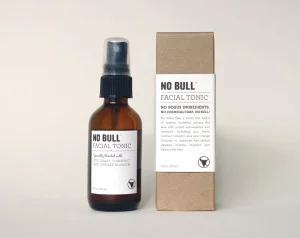
Analysis locked
How well does your skin match with No Bull FACIAL TONIC?
Login to see detailsOr continue via
Quick 1-minute survey • Completely free
Ingredients
Analysis results of Ingredients


Ingredient List
| EWG | CIR | Ingredient Name & Cosmetic Function | Notes |
|---|---|---|---|
| 1 3 | - | | |
| 1 | - | (Antimicrobial, Antidandruff Agent) | |
| 1 | - | (Skin Conditioning, Hair Conditioning, Astringent) | |
| 1 | - | (Skin Conditioning) | |
No Bull FACIAL TONIC - Ingredient Explanation
Aloe Barbadensis (Aloe Vera) Leaf Juice
1. Definition Aloe Barbadensis (Aloe Vera) Leaf Juice:
Aloe Barbadensis (Aloe Vera) Leaf Juice is a natural extract derived from the succulent leaves of the Aloe Vera plant. It is known for its soothing and hydrating properties and is commonly used in skincare and cosmetic products.2. Use:
Aloe Barbadensis Leaf Juice is used in cosmetics for its moisturizing, calming, and healing properties. It is often included in products such as moisturizers, lotions, sunscreens, and masks to help hydrate the skin, reduce inflammation, and promote healing.3. Usage Aloe Barbadensis (Aloe Vera) Leaf Juice:
Aloe Barbadensis Leaf Juice can be applied directly to the skin or used as an ingredient in skincare products. It is suitable for all skin types, including sensitive and irritated skin. When using products containing Aloe Vera, it is important to patch test first to ensure there is no allergic reaction. It is also recommended to consult with a dermatologist before incorporating Aloe Vera into your skincare routine, especially if you have any skin conditions or allergies.4. References:
- Surjushe, A., Vasani, R., & Saple, D. G. (2008). Aloe vera: A short review. Indian Journal of Dermatology, 53(4), 163–166.
- Radha, M. H., & Laxmipriya, N. P. (2015). Evaluation of biological properties and clinical effectiveness of Aloe vera: A systematic review. Journal of Traditional and Complementary Medicine, 5(1), 21–26.
- Choi, S., Chung, M. H., & Aeschbach, R. (2001). Antioxidant activity of Aloe vera in vitro study. Journal of Agricultural and Food Chemistry, 50(16), 3718–3722.
Leuconostoc/Radish Root Ferment Filtrate
1. Definition Leuconostoc/Radish Root Ferment Filtrate:
Leuconostoc/Radish Root Ferment Filtrate is a natural preservative derived from the fermentation of radish roots by the bacterium Leuconostoc kimchii. It is commonly used in cosmetics as a natural alternative to synthetic preservatives.2. Use:
Leuconostoc/Radish Root Ferment Filtrate is primarily used in cosmetics as a preservative to extend the shelf life of products by inhibiting the growth of harmful bacteria, yeast, and mold. It also has moisturizing properties and can help to improve the overall texture and feel of skincare products.3. Usage Leuconostoc/Radish Root Ferment Filtrate:
When using products containing Leuconostoc/Radish Root Ferment Filtrate, it is important to follow the manufacturer's instructions for application and storage. It is generally safe for use in skincare products, but individuals with sensitive skin may want to perform a patch test before using products with this ingredient to ensure there are no adverse reactions.4. References:
- Alves, A., et al. (2016). Radish (Raphanus sativus L.) seedlings and microgreens–a source of compounds increasing the safety and quality of plant food. Food Chemistry, 213, 286-295.
- Clardy, J., et al. (2013). Leuconostoc kimchii sp. nov., a new species from kimchi. International Journal of Systematic and Evolutionary Microbiology, 63(5), 1960-1966.
- Kim, S. H., et al. (2018). Antimicrobial effect of Radish (Raphanus sativus L.) root against foodborne pathogens. Journal of Food Science, 83(1), 180-186.
Lycium Barbarum (Matrimony Vine) Fruit Extract
1. Definition Lycium Barbarum (Matrimony Vine) Fruit Extract:
Lycium Barbarum (Matrimony Vine) Fruit Extract is a natural ingredient derived from the fruit of the Lycium Barbarum plant, commonly known as Goji Berry. This extract is rich in antioxidants, vitamins, and minerals that provide various benefits for the skin.2. Use:
Lycium Barbarum Fruit Extract is commonly used in cosmetics and skincare products for its anti-aging and skin-rejuvenating properties. It helps to protect the skin from environmental damage, reduce the appearance of fine lines and wrinkles, and promote a more youthful and radiant complexion.3. Usage Lycium Barbarum (Matrimony Vine) Fruit Extract:
Lycium Barbarum Fruit Extract can be found in a variety of skincare products, such as serums, moisturizers, and masks. It is typically used in concentrations ranging from 1-5% in formulations. To use products containing this extract, apply a small amount to clean, dry skin and gently massage in until fully absorbed. It is recommended to use products with Lycium Barbarum Fruit Extract regularly as part of a skincare routine for best results.4. References:
- Zhang M, Chen H, Huang J, Li Z, Zhu C, Zhang S, Wang Z. Protective effects of Lycium barbarum polysaccharide on 6-OHDA-induced apoptosis in PC12 cells through the ROS-NO pathway. Molecules. 2011;16(5):3492-3508. doi:10.3390/molecules16053492
- Amagase H, Farnsworth NR. A review of botanical characteristics, phytochemistry, clinical relevance in efficacy and safety of Lycium barbarum fruit (Goji). Food Res Int. 2011;44(7):1702-1717. doi:10.1016/j.foodres.2011.04.029
- Wu D, Zhang X, Liu J, et al. Protective effects of Lycium barbarum polysaccharide on 2,2',4,4'-tetrabromodiphenyl ether-induced neurotoxicity in primary cultured rat hippocampal neurons. Food Chem Toxicol. 2013;59:439-445. doi:10.1016/j.fct.2013.06.022
Curcuma Longa (Turmeric) Root Powder
1. Definition Curcuma Longa (Turmeric) Root Powder:
Curcuma Longa (Turmeric) Root Powder is a natural ingredient derived from the root of the Curcuma longa plant. It is known for its bright yellow color and has been used for centuries in traditional medicine and skincare for its anti-inflammatory and antioxidant properties.2. Use:
Turmeric Root Powder is commonly used in cosmetics for its skin-brightening and anti-inflammatory properties. It can help to even out skin tone, reduce the appearance of dark spots, and calm irritated skin. Additionally, turmeric is believed to have antibacterial properties, making it beneficial for acne-prone skin.3. Usage Curcuma Longa (Turmeric) Root Powder:
Turmeric Root Powder can be incorporated into various skincare products such as face masks, scrubs, serums, and creams. It is important to note that turmeric can stain the skin and clothing, so it is recommended to use it in moderation and wash off thoroughly after application. It is also advisable to perform a patch test before using products containing turmeric to check for any potential allergic reactions.4. References:
- Prasad S, Aggarwal BB. Turmeric, the Golden Spice: From Traditional Medicine to Modern Medicine. In: Benzie IFF, Wachtel-Galor S, editors. Herbal Medicine: Biomolecular and Clinical Aspects. 2nd edition. Boca Raton (FL): CRC Press/Taylor & Francis; 2011. Chapter 13. Available from: https://www.ncbi.nlm.nih.gov/books/NBK92752/
- Vaughn AR, Branum A, Sivamani RK. Effects of Turmeric (Curcuma longa) on Skin Health: A Systematic Review of the Clinical Evidence. Phytother Res. 2016 Aug;30(8):1243-64. doi: 10.1002/ptr.5640. Epub 2016 May 3. PMID: 27187333.
- Hewlings SJ, Kalman DS. Curcumin: A Review of Its' Effects on Human Health. Foods. 2017 Oct 22;6(10):92. doi: 10.3390/foods6100092. PMID: 29065496; PMCID: PMC5664031.
Review
Didn't find
the information you need?




Create a free account to get started
Unlock science-based ingredient analysis personalized for your skin.
Already have an account? Log in
We protect your privacy. We never send spam.