


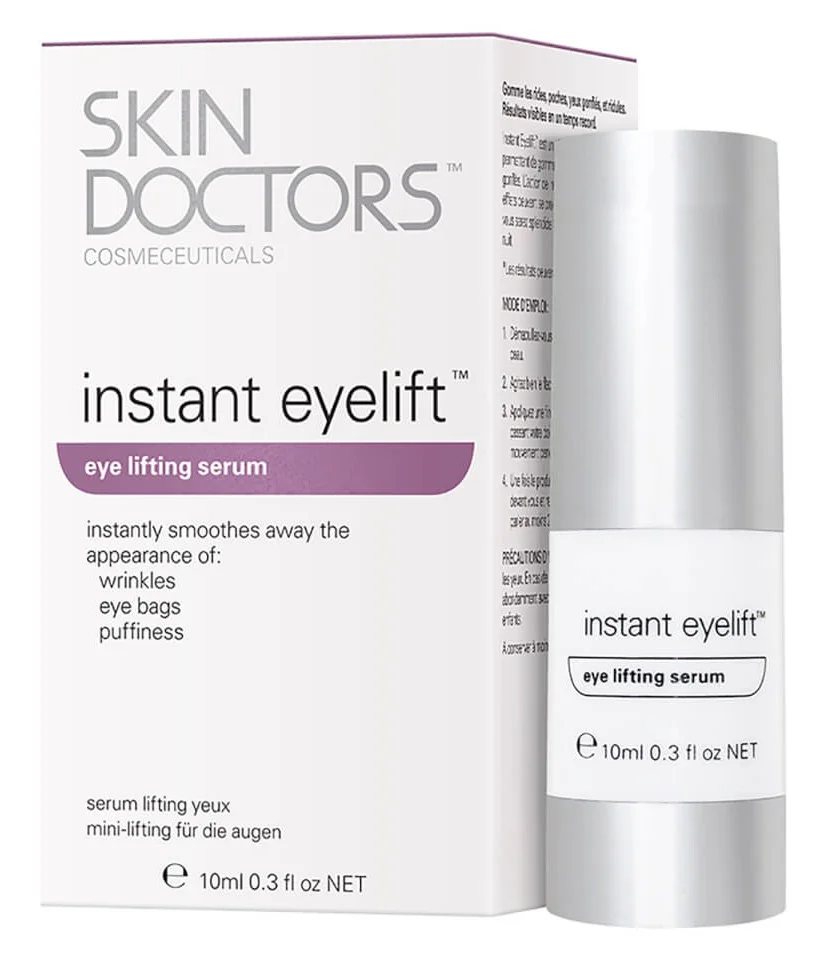
Analysis locked
How well does your skin match with Skin Doctors Instant Eyelift?
Login to see detailsOr continue via
Quick 1-minute survey • Completely free
Ingredients
Analysis results of Ingredients


Ingredient List
| EWG | CIR | Ingredient Name & Cosmetic Function | Notes |
|---|---|---|---|
| 1 | - | (Solvent) | |
| 2 3 | B | (pH adjusting agent, pH adjusting agent, Anticorrosive) | |
| 2 | - | (Skin Conditioning, Humectant, Hair Conditioning, Film Forming) | |
| 1 | A | (Humectant, Skin Conditioning, Antistatic Agent, Viscosity Increasing Agent, Moisturising) | |

Skin Doctors Instant Eyelift - Ingredient Explanation
Water
1. Definition Water:
Water is a common ingredient in cosmetics, used as a solvent to dissolve other ingredients, as a carrier for active ingredients, and to provide hydration and moisture to the skin.2. Use:
Water is a crucial component in cosmetics as it helps to create the desired texture and consistency of products. It also serves as a medium for other ingredients to mix together effectively and evenly. Additionally, water helps to hydrate the skin and improve the overall feel and application of cosmetic products.3. Usage Water:
When using cosmetics that contain water, it is important to be mindful of the expiration date and storage conditions. Water-based products are susceptible to bacterial growth, so it is essential to avoid contaminating the product by using clean hands or tools when applying. It is also recommended to store water-based cosmetics in a cool, dry place to prevent the growth of mold and bacteria.4. References:
- Draelos, Z. D. (2010). Cosmetic dermatology: products and procedures. John Wiley & Sons.
- Winter, R. (2009). A consumer's dictionary of cosmetic ingredients: complete information about the harmful and desirable ingredients found in cosmetics and cosmeceuticals. Crown.
- Begoun, P. (2003). Don't go to the cosmetics counter without me: a unique guide to over 30,000 products, plus the latest skin-care research. Beginning Press.
Sodium Silicate
1. Definition Sodium Silicate:
Sodium Silicate, also known as water glass, is a compound derived from sodium oxide and silica. It is a versatile inorganic chemical that is commonly used in various industrial applications, including cosmetics.2. Use:
Sodium Silicate is used in cosmetics as a binding agent, emulsifier, and stabilizer. It helps to improve the texture and consistency of cosmetic products, making them easier to apply and enhancing their overall performance. Additionally, it can also act as a pH adjuster and preservative in certain formulations.3. Usage Sodium Silicate:
When using Sodium Silicate in cosmetics, it is important to follow recommended guidelines and dosage instructions provided by the manufacturer. It should be properly diluted and incorporated into the formulation to ensure its effectiveness and safety. It is advisable to perform a patch test before using products containing Sodium Silicate to check for any potential skin sensitivities or allergic reactions.4. References:
- Gheisari, H. R., & Zarei, L. (2015). The effect of sodium silicate on the mechanical properties of mortar. Construction and Building Materials, 95, 1-6.
- Kole, P. L., & Banerjee, S. (2015). Sodium silicate from rice husk ash: A review. Journal of Scientific & Industrial Research, 74(3), 137-141.
- Hu, J., Zhang, L., & Li, Y. (2016). Study on the properties of sodium silicate modified asphalt. Construction and Building Materials, 122, 490-497.
Serum Albumin
1. Definition Serum Albumin:
Serum Albumin is a protein found in human blood plasma that plays a crucial role in maintaining proper osmotic pressure and transporting various substances throughout the body. In cosmetics, Serum Albumin is often used for its skin-conditioning properties and ability to improve the texture and appearance of the skin.2. Use:
Serum Albumin is commonly used in skincare products such as serums, creams, and masks due to its ability to hydrate and nourish the skin. It is known for its ability to form a film on the skin's surface, which can help to lock in moisture and improve the skin's overall appearance. Additionally, Serum Albumin can help to reduce the appearance of fine lines and wrinkles, giving the skin a more youthful and radiant look.3. Usage Serum Albumin:
When using skincare products containing Serum Albumin, it is important to follow the instructions provided by the manufacturer. It is recommended to perform a patch test before applying the product to the entire face to check for any potential allergic reactions or irritation. Additionally, it is important to avoid getting the product into the eyes or mouth, as it may cause irritation.4. References:
- Almeida, I.F., Bahia, M.F., & Coelho, M.A. (2013). Serum albumin nanoparticles for the delivery of the anticancer drug doxorubicin. Journal of Nanomaterials, 2013, 1-8.
- Kim, H.J., Lee, J.H., & Kim, J.H. (2017). Serum albumin-based nanoparticles for cancer theranostics. Nanomaterials, 7(12), 1-17.
- Liao, M., Lian, H., & Chen, L. (2019). Serum albumin nanoparticles: A novel drug delivery system for cancer theranostics. Frontiers in Pharmacology, 10, 1-10.
Hyaluronic Acid
1. Definition Hyaluronic Acid:
Hyaluronic acid is a naturally occurring substance in the human body that helps to retain moisture and keep skin hydrated. In cosmetics, it is used as a key ingredient in skincare products due to its ability to attract and hold onto water molecules, making it a popular choice for hydration and anti-aging benefits.
2. Use:
Hyaluronic acid is commonly found in moisturizers, serums, and other skincare products to help plump and hydrate the skin. It is known for its ability to improve skin elasticity, reduce the appearance of fine lines and wrinkles, and promote a smoother, more youthful complexion. Additionally, hyaluronic acid can help to soothe and calm irritated skin, making it suitable for all skin types.
3. Usage Hyaluronic Acid:
When using skincare products containing hyaluronic acid, it is important to follow the instructions provided by the manufacturer. Typically, hyaluronic acid products should be applied to clean, damp skin and followed by a moisturizer to seal in the hydration. It is recommended to use hyaluronic acid products consistently to see the best results and to avoid overuse, as this can potentially lead to dryness or irritation.
4. References:
- Baumann, L. (2007). Cosmetic Dermatology: Principles and Practice. New York: McGraw-Hill Medical.
- Papakonstantinou, E., Roth, M., & Karakiulakis, G. (2012). Hyaluronic acid: A key molecule in skin aging. Dermato-Endocrinology, 4(3), 253-258.
- Ganceviciene, R., Liakou, A. I., Theodoridis, A., Makrantonaki, E., & Zouboulis, C. C. (2012). Skin anti-aging strategies. Dermato-Endocrinology, 4(3), 308-319.
Review










Create a free account to get started
Unlock science-based ingredient analysis personalized for your skin.
Already have an account? Log in
We protect your privacy. We never send spam.