


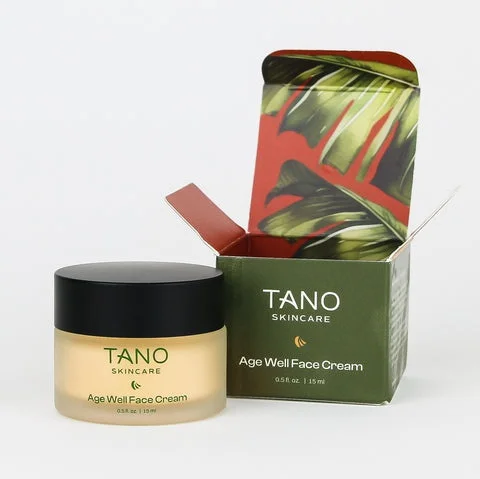
Analysis locked
How well does your skin match with Tano Skincare Age Well Face Cream?
Login to see detailsOr continue via
Quick 1-minute survey • Completely free
Ingredients
Analysis results of Ingredients


Ingredient List
| EWG | CIR | Ingredient Name & Cosmetic Function | Notes |
|---|---|---|---|
| - | - | Distilled Water | |
| 1 | - | | |
| - | B | (Skin Conditioning) |  |
| 1 | A | (Skin Conditioning) | |


Tano Skincare Age Well Face Cream - Ingredient Explanation
Distilled Water
Ingredient data is being updated. Please check back later.
Musa Balbisiana Fruit Extract (Banana Stem Sap)
1. Definition Musa Balbisiana (Banana) Fruit Extract:
Musa Balbisiana (Banana) Fruit Extract is derived from the fruit of the Musa Balbisiana plant, which is a species of wild banana native to Southeast Asia. This extract is rich in vitamins, minerals, and antioxidants that are beneficial for the skin.2. Use:
Musa Balbisiana (Banana) Fruit Extract is commonly used in cosmetics for its moisturizing and nourishing properties. It helps to hydrate the skin, improve its elasticity, and promote a more youthful appearance. Additionally, the extract contains natural enzymes that can help to exfoliate the skin and remove dead skin cells, resulting in a smoother and brighter complexion.3. Usage Musa Balbisiana (Banana) Fruit Extract:
Musa Balbisiana (Banana) Fruit Extract can be found in a variety of skincare products, including moisturizers, serums, masks, and creams. It is typically used in small concentrations to provide the skin with its benefits without causing any irritation. To use products containing this extract, simply apply them to clean, dry skin and gently massage in until fully absorbed.4. References:
- Kim, S. Y., & Kim, J. H. (2016). Antioxidant and anti-inflammatory effects of Musa balbisiana Colla extracts on UVB-irradiated human keratinocytes. Journal of Photochemistry and Photobiology B: Biology, 163, 327-333.
- Kaur, P., & Kaur, S. (2017). Phytochemical and pharmacological properties of Musa balbisiana: A review. International Journal of Pharmaceutical Sciences and Research, 8(10), 4014-4023.
- Arora, R., & Gupta, D. (2019). Banana (Musa sp.)-based natural ingredients in cosmeceuticals. In Natural Ingredients for Cosmetics (pp. 191-204). Woodhead Publishing.
Aloe Barbadensis Leaf Juice
1. Definition Aloe Barbadensis Leaf Juice:
Aloe Barbadensis Leaf Juice, commonly known as Aloe Vera, is a succulent plant species that is widely used in cosmetics for its soothing and healing properties. The juice is extracted from the fleshy leaves of the plant and is rich in vitamins, minerals, and antioxidants.2. Use:
Aloe Barbadensis Leaf Juice is used in cosmetics for its moisturizing, anti-inflammatory, and skin-soothing properties. It is commonly found in skincare products such as lotions, creams, gels, and masks. Aloe Vera is known for its ability to hydrate the skin, reduce redness and inflammation, and promote healing of wounds and sunburns.3. Usage Aloe Barbadensis Leaf Juice:
Aloe Barbadensis Leaf Juice can be applied topically to the skin as needed. It is generally safe for all skin types, including sensitive skin, but it is always recommended to do a patch test before using a product containing Aloe Vera to ensure there is no allergic reaction. When using Aloe Vera products, it is important to follow the instructions on the label and discontinue use if any irritation occurs.4. References:
- Surjushe, A., Vasani, R., & Saple, D. G. (2008). Aloe Vera: A short review. Indian Journal of Dermatology, 53(4), 163–166.
- Radha, M. H., Laxmipriya, N. P., & Amin, M. (2015). Aloe Vera: A short review. Indian Journal of Dermatology, 60(3), 260–268.
- Reynolds, T., & Dweck, A. C. (1999). Aloe Vera leaf gel: a review update. Journal of Ethnopharmacology, 68(1-3), 3–37.
Mangifera Indica (Mango) Butter
1. Definition Mangifera Indica (Mango) Seed Butter:
Mango seed butter is a natural butter extracted from the seeds of the mango fruit (Mangifera Indica). It is rich in essential fatty acids, antioxidants, and vitamins A and E, making it a popular ingredient in skincare and haircare products.2. Use:
Mango seed butter is commonly used in cosmetics for its moisturizing, nourishing, and soothing properties. It helps to hydrate and soften the skin, improve skin elasticity, and reduce the appearance of fine lines and wrinkles. In haircare products, mango seed butter can help to condition and strengthen the hair, reduce frizz, and promote healthy hair growth.3. Usage Mangifera Indica (Mango) Seed Butter:
Mango seed butter can be used in a variety of cosmetic products, including lotions, creams, balms, soaps, shampoos, conditioners, and hair masks. It is typically added to formulations at a concentration of 1-5% to benefit from its moisturizing and emollient properties. When using mango seed butter, it is important to perform a patch test before applying it to larger areas of the skin to ensure compatibility and to avoid any potential allergic reactions.4. References:
- Akhtar, N., & Khan, B. A. (2017). Formulation and evaluation of mango butter-based cosmetic emulsions. Journal of Cosmetic Science, 68(2), 93-102.
- Jamil, W., & Al-Asmari, A. K. (2019). Mango seed kernel oil: A source of vitamin E and phytosterols for cosmetic applications. Journal of Cosmetic Science, 70(1), 31-43.
- Silva, M. R., et al. (2018). Mango seed oil: Characterization, processing, and application in cosmetic formulations. Journal of Cosmetic Science, 69(3), 217-229.
Review






Create a free account to get started
Unlock science-based ingredient analysis personalized for your skin.
Already have an account? Log in
We protect your privacy. We never send spam.