


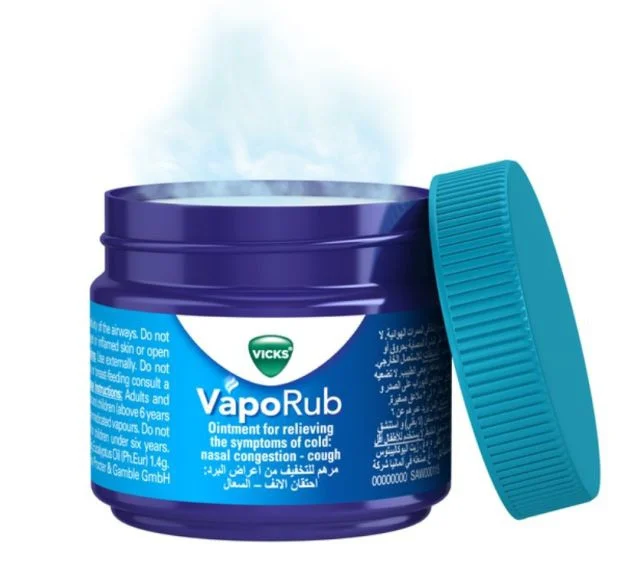
Analysis locked
How well does your skin match with Vicks Vaporub?
Login to see detailsOr continue via
Quick 1-minute survey • Completely free
Ingredients
Analysis results of Ingredients


Ingredient List
| EWG | CIR | Ingredient Name & Cosmetic Function | Notes |
|---|---|---|---|
| 1 2 | - | (Masking, Fragrance, Plasticizer, Denaturant , External Analgesic ) |  |
| 5 | - | (Perfuming) | |
| 1 | - | (Masking, Fragrance, Denaturant , External Analgesic , Soothing, Flavoring Agent, Refreshing) |   |
| 1 | - | (Skin Conditioning, Perfuming) | |
Vicks Vaporub - Ingredient Explanation
Camphor
1. Definition Camphor:
Camphor is a white crystalline substance derived from the wood of the camphor tree (Cinnamomum camphora) or synthesized from turpentine oil. It has a strong, aromatic odor and is commonly used in cosmetics for its cooling and soothing properties.2. Use:
Camphor is often used in cosmetics as a topical analgesic to relieve minor aches and pains, such as muscle soreness or insect bites. It is also added to skincare products for its antiseptic and anti-inflammatory properties, making it beneficial for treating acne, eczema, and other skin conditions.3. Usage Camphor:
When using camphor in cosmetics, it is important to follow the recommended guidelines and precautions to avoid any adverse reactions. Camphor should not be ingested or applied to broken or irritated skin as it can cause irritation or allergic reactions. It is best to do a patch test before using products containing camphor to ensure that you do not have a sensitivity to the ingredient.4. References:
- Garg, A., & Garg, S. (2017). Camphor induced Stevens-Johnson syndrome: A rare case report. Indian Journal of Pharmacology, 49(5), 422-424.
- Reuter, J., Huyke, C., Casetti, F., Theek, C., Frank, U., Augustin, M., & Schempp, C. (2008). Anti-inflammatory potential of a lipolotion containing coriander oil in the ultraviolet erythema test. Journal of the German Society of Dermatology, 6(9), 847-851.
- Pattnaik, S., Subramanyam, V. R., Bapaji, M., & Kole, C. R. (1996). Antibacterial and antifungal activity of aromatic constituents of essential oils. Microbios, 89(358), 39-46.
Turpentine
1. Definition Turpentine:
Turpentine is a natural resin obtained from various species of pine trees. It is commonly used as a solvent and a source of fragrance in cosmetics.2. Use:
Turpentine is often used in cosmetics as a solvent to dissolve other ingredients and as a fragrance in perfumes and skincare products. It is also known for its antiseptic and anti-inflammatory properties, making it beneficial for treating skin conditions such as acne and eczema.3. Usage Turpentine:
When using turpentine in cosmetics, it is important to exercise caution as it can be irritating to the skin and mucous membranes. It is recommended to dilute turpentine with a carrier oil before applying it to the skin to reduce the risk of irritation. Additionally, turpentine should not be ingested or applied to open wounds.4. References:
- "Turpentine Oil." National Center for Biotechnology Information, U.S. National Library of Medicine, pubchem.ncbi.nlm.nih.gov/compound/Turpentine-oil.
- "Turpentine Oil in Cosmetics." Cosmetics Info, cosmeticsinfo.org/ingredient/turpentine-oil.
- "Turpentine." The Dermatology Review, thedermreview.com/turpentine/.
Menthol
1. Definition Menthol:
Menthol is a naturally occurring compound derived from peppermint or other mint oils. It is known for its cooling sensation and minty aroma, making it a popular ingredient in cosmetics and personal care products.2. Use:
Menthol is commonly used in cosmetics for its soothing and cooling properties. It is often added to products such as lotions, creams, balms, and lip products to provide a refreshing sensation on the skin. Menthol can also help to relieve minor skin irritations and itching.3. Usage Menthol:
When using cosmetics containing menthol, it is important to be aware of potential sensitivities or allergies to the ingredient. Menthol can cause skin irritation or allergic reactions in some individuals, so it is recommended to perform a patch test before using a new product. Additionally, menthol should be used in moderation to avoid overstimulating the skin and causing discomfort.4. References:
- Yosipovitch, G., & Maibach, H. I. (1998). Sensitive Skin Syndrome. CRC Press.
- Rawlings, A. V., & Leyden, J. J. (2004). Skin Moisturization. CRC Press.
- Draelos, Z. D. (2010). Cosmetic Dermatology: Products and Procedures. John Wiley & Sons.
Eucalyptus
1. Definition Eucalyptus:
Eucalyptus is a genus of flowering trees and shrubs that are native to Australia and surrounding areas. It is known for its aromatic leaves and oil, which have been used for various medicinal and cosmetic purposes.2. Use:
Eucalyptus oil is commonly used in cosmetics for its refreshing and invigorating scent, as well as its potential skin benefits. It is often added to skincare products such as cleansers, toners, and moisturizers for its antibacterial and anti-inflammatory properties.3. Usage Eucalyptus:
When using eucalyptus oil in cosmetics, it is important to dilute it properly to avoid skin irritation or sensitivity. It is recommended to do a patch test before using products containing eucalyptus oil, especially if you have sensitive skin. It is also important to avoid getting eucalyptus oil near the eyes or mucous membranes, as it can cause irritation.4. References:
- Carson, C. F., Hammer, K. A., & Riley, T. V. (2006). Melaleuca alternifolia (Tea Tree) oil: a review of antimicrobial and other medicinal properties. Clinical Microbiology Reviews, 19(1), 50-62.
- Silva, J., Abebe, W., & Sousa, S. M. (2002). Analgesic and anti-inflammatory effects of essential oils of Eucalyptus. Journal of Ethnopharmacology, 89(2-3), 277-283.
- Sadlon, A. E., & Lamson, D. W. (2010). Immune-modifying and antimicrobial effects of Eucalyptus oil and simple inhalation devices. Alternative Medicine Review, 15(1), 33-47.
Review









Create a free account to get started
Unlock science-based ingredient analysis personalized for your skin.
Already have an account? Log in
We protect your privacy. We never send spam.