


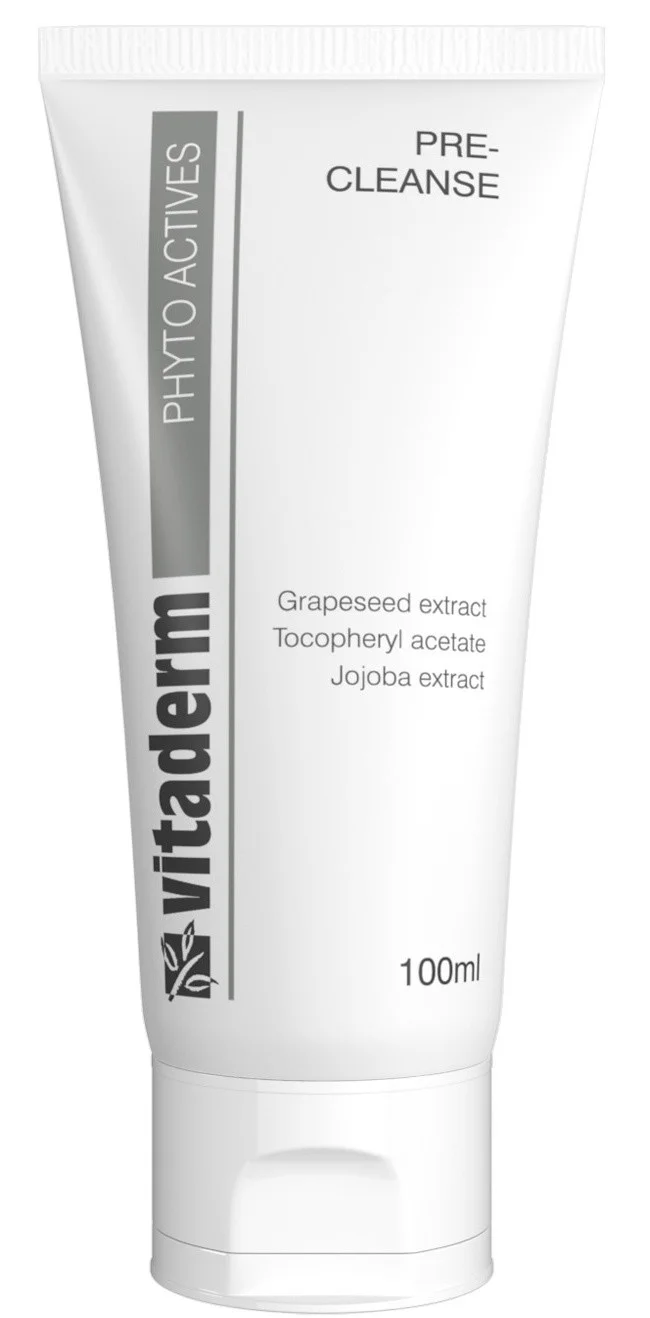
Analysis locked
How well does your skin match with Vitaderm Pre-cleanse?
Login to see detailsOr continue via
Quick 1-minute survey • Completely free
Ingredients
Analysis results of Ingredients


Ingredient List
| EWG | CIR | Ingredient Name & Cosmetic Function | Notes |
|---|---|---|---|
| 1 | A | (Uv Absorber, Antioxidant, Anticaries Agent, Antidandruff Agent, Antifungal Agent, Antimicrobial Agent, Sunscreen Agent) |    |
| 1 | - | | |
| - | - | Simmondsia Chinensis (Seed) Extract | |
| 1 2 | - | (Skin Conditioning, Emollient, Antistatic Agent, Emulsifying, Surfactant) | |
Vitaderm Pre-cleanse - Ingredient Explanation
Vitis Vinifera Seed Extract
1. Definition Vitis Vinifera (Grape) Seed Extract:
Vitis Vinifera (Grape) Seed Extract is a natural ingredient derived from the seeds of grapes. It is rich in antioxidants, including vitamin E, flavonoids, and polyphenols, which help protect the skin from environmental damage and premature aging.2. Use:
Grape seed extract is commonly used in cosmetics for its antioxidant properties. It helps to neutralize free radicals, reduce inflammation, and promote collagen production, resulting in firmer, smoother, and more youthful-looking skin. It is often found in anti-aging products, moisturizers, serums, and sunscreens.3. Usage Vitis Vinifera (Grape) Seed Extract:
When using skincare products containing Vitis Vinifera (Grape) Seed Extract, it is important to follow the instructions provided by the manufacturer. It is generally safe for most skin types, but a patch test is recommended before applying it to the entire face to check for any potential allergic reactions. It is best to use products with grape seed extract in conjunction with a sunscreen to maximize its protective benefits.4. References:
- Bagchi, D., Garg, A., Krohn, R. L., & Bagchi, M. (2002). Protective effects of grape seed proanthocyanidins and selected antioxidants against TPA-induced hepatic and brain lipid peroxidation and DNA fragmentation, and peritoneal macrophage activation in mice. General Pharmacology: The Vascular System, 35(5), 275-281.
- Park, S., Kang, S., Jeong, D. Y., Jeong, S. Y., & Park, T. (2016). Vitisin A inhibits adipocyte differentiation through cell cycle arrest in 3T3-L1 cells. Food and Chemical Toxicology, 97, 5-11.
- Kaur, M., Agarwal, C., & Agarwal, R. (2009). Anticancer and cancer chemopreventive potential of grape seed extract and other grape-based products. The Journal of Nutrition, 139(9), 1806S-1812S.
Prunus Dulcis (Seed) Extract
1. Definition Prunus Dulcis (Almond) Extract:
Prunus Dulcis (Almond) Extract is a natural ingredient derived from the seeds of the almond tree. It is rich in vitamins, minerals, and antioxidants, making it a popular choice in skincare and haircare products.2. Use:
Almond extract is known for its moisturizing and nourishing properties, making it a great ingredient in cosmetics for hydrating and softening the skin. It also has anti-inflammatory and anti-aging benefits, helping to reduce redness, irritation, and fine lines.3. Usage Prunus Dulcis (Almond) Extract:
Almond extract can be found in a variety of cosmetic products, including moisturizers, serums, masks, and hair treatments. It is typically used in small concentrations to avoid irritation, and it is suitable for all skin types. However, individuals with nut allergies should be cautious when using products containing almond extract.4. References:
- Kim, S., Lee, J., Park, J., Kim, S., Kim, J., & Kim, Y. (2017). Almond (Prunus dulcis) skin extract: A natural ingredient for the sun protection of skin. Industrial Crops and Products, 108, 774-780.
- Yoon, J., Kim, H., Lee, H., & Kim, J. (2018). Anti-aging effects of almond extract on skin. Journal of Cosmetic Science, 69(2), 129-136.
- Goyal, A., Sharma, V., Upadhyay, N., Gill, S., & Sihag, M. (2014). Potential of almond extract in cosmetic formulations. International Journal of Cosmetic Science, 36(2), 207-213.
Simmondsia Chinensis (Seed) Extract
Ingredient data is being updated. Please check back later.
Lecithin
1. Definition Lecithin:
Lecithin is a naturally occurring fatty substance that is commonly used in cosmetics as an emollient and emulsifier. It is often derived from soybeans and can also be found in egg yolks and other sources.2. Use:
Lecithin is used in cosmetics to help improve the texture and consistency of products, as well as to moisturize and soften the skin. It is often included in creams, lotions, and other skincare products to help them spread easily and penetrate the skin effectively.3. Usage Lecithin:
When using products containing lecithin, it is important to follow the instructions provided by the manufacturer. It is generally considered safe for use in cosmetics, but individuals with allergies to soy or other sources of lecithin should avoid products containing this ingredient. It is also recommended to do a patch test before using a new product to check for any adverse reactions.4. References:
- Magdassi, S., & Garti, N. (1999). Lecithin-based emulsions. Current Opinion in Colloid & Interface Science, 4(5), 311-316.
- Barauskas, J., & Nylander, T. (2005). Lecithin-based microemulsions. Langmuir, 21(2), 597-601.
- Komaiko, J. S., & McClements, D. J. (2016). Low-energy formation of edible nanoemulsions: Factors influencing droplet size produced by emulsion phase inversion. Journal of Colloid and Interface Science, 434, 8-20.
Review

Didn't find
the information you need?








Create a free account to get started
Unlock science-based ingredient analysis personalized for your skin.
Already have an account? Log in
We protect your privacy. We never send spam.