


Analysis locked
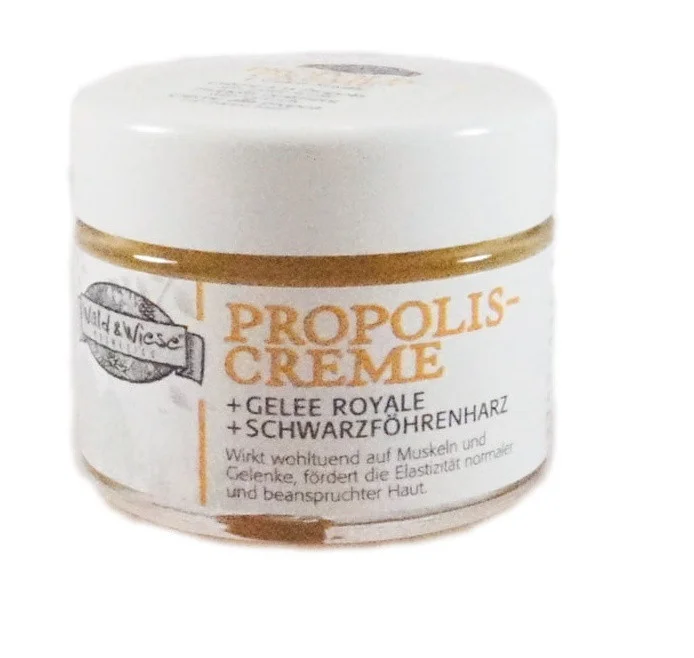
How well does your skin match with wald und wiese Propoliscreme?
Login to see detailsOr continue via
Quick 1-minute survey • Completely free
Ingredients
Analysis results of Ingredients


Ingredient List
| EWG | CIR | Ingredient Name & Cosmetic Function | Notes |
|---|---|---|---|
| 1 | A | (Solvent, Skin Conditioning, Masking, Emollient, Fragrance, Hair Conditioning) |   |
| 1 | - | (Perfuming, Fragrance, Emollient, Viscosity Increasing Agent, Emulsion Stabilising, Binding Agent, Emulsifying, Surfactant, Film Forming, Epilating Agent, Skin-Conditioning Agent -Miscellaneous) | |
| 1 | A | (Skin Conditioning, Emollient) | |
| 1 | B | (Surfactant, Emulsifying) | |


wald und wiese Propoliscreme - Ingredient Explanation
Cocos Nucifera Oil
1. Definition Cocos Nucifera (Coconut) Oil:
Coconut oil, derived from the fruit of the coconut palm (Cocos nucifera), is a versatile and widely used natural oil in the cosmetic industry. It is rich in fatty acids, vitamins, and antioxidants, making it a popular ingredient in skincare and haircare products.2. Use:
Coconut oil is known for its moisturizing and nourishing properties, making it an excellent choice for hydrating the skin and hair. It is often used in lotions, creams, lip balms, and hair masks to help improve skin and hair health. Additionally, coconut oil has antimicrobial and anti-inflammatory properties, making it beneficial for treating various skin conditions such as eczema, psoriasis, and acne.3. Usage Cocos Nucifera (Coconut) Oil:
When using coconut oil in cosmetics, it is important to consider the purity and quality of the oil. Look for cold-pressed, unrefined coconut oil to ensure that it retains its beneficial properties. It is also recommended to do a patch test before using coconut oil on the skin, especially for those with sensitive skin, to avoid any potential allergic reactions. Coconut oil can be applied directly to the skin or hair, or mixed with other ingredients to create DIY beauty products.4. References:
- Rele, A. S., & Mohile, R. B. (2003). Effect of mineral oil, sunflower oil, and coconut oil on prevention of hair damage. Journal of cosmetic science, 54(2), 175-192.
- Evangelista, M. T., Abad-Casintahan, F., & Lopez-Villafuerte, L. (2014). The effect of topical virgin coconut oil on SCORAD index, transepidermal water loss, and skin capacitance in mild to moderate pediatric atopic dermatitis: a randomized, double-blind, clinical trial. International Journal of Dermatology, 53(1), 100-108.
- Nevin, K. G., & Rajamohan, T. (2010). Beneficial effects of virgin coconut oil on lipid parameters and in vitro LDL oxidation. Clinical biochemistry, 43(4-5), 349-357.
Cera Alba
1. Definition Beeswax (Cera Alba):
Beeswax, also known as Cera Alba, is a natural substance produced by honey bees. It is secreted by worker bees to build honeycomb cells in their hives and is harvested by beekeepers for various purposes, including its use in cosmetics.2. Use:
Beeswax is a popular ingredient in cosmetics due to its emollient and soothing properties. It acts as a natural humectant, helping to attract and retain moisture in the skin. Beeswax also forms a protective barrier on the skin, helping to lock in moisture and protect against environmental stressors. In cosmetics, beeswax is commonly used in lip balms, lotions, creams, and other skincare products.3. Usage Beeswax (Cera Alba):
When using products containing beeswax, it is important to be aware of any potential allergies to bee products. Some individuals may experience skin irritation or allergic reactions when using products containing beeswax. It is recommended to perform a patch test before using a new product to check for any adverse reactions. Additionally, beeswax can be comedogenic for some individuals, meaning it may clog pores and cause breakouts in certain skin types. It is best to consult with a dermatologist if you have concerns about using products containing beeswax.4. References:
- Boukhatem, M. N., Kameli, A., Ferhat, M. A., & Saidi, F. (2014). The effect of beeswax on skin wound healing in rats. Journal of Intercultural Ethnopharmacology, 3(3), 113-118.
- Orafidiya, L. O., Agbani, E. O., & Oyedele, A. O. (2002). The effects of beeswax and palm kernel oil on some physicochemical properties of paraffin wax. Journal of Cosmetic Science, 53(6), 363-374.
- Watanabe, K., & Shinmoto, H. (2005). Evaluation of the skin moisturizing effects of beeswax. Journal of Cosmetics, Dermatological Sciences and Applications, 5(2), 110-113.
Zea Mays Germ Oil
1. Definition Zea Mays (Corn) Germ Oil:
Zea Mays (Corn) Germ Oil is a natural oil extracted from the germ of corn kernels. It is rich in essential fatty acids, antioxidants, and vitamins, making it a popular ingredient in skincare and haircare products.2. Use:
Corn germ oil is known for its moisturizing and nourishing properties, making it a common ingredient in cosmetics. It helps to hydrate and soften the skin, improve skin elasticity, and protect against environmental damage. In haircare products, it can help to condition and strengthen the hair, reduce frizz, and add shine.3. Usage Zea Mays (Corn) Germ Oil:
Corn germ oil can be found in a variety of cosmetic products such as moisturizers, serums, hair masks, and conditioners. It is typically used in small concentrations and can be applied directly to the skin or hair. It is suitable for all skin types, including sensitive skin, but it is always recommended to do a patch test before using it to check for any allergic reactions.4. References:
- Ghasemzadeh, A., Jaafar, H. Z. E., & Rahmat, A. (2010). Antioxidant activities, total phenolics and flavonoids content in two varieties of Malaysia young ginger (Zingiber officinale Roscoe). Molecules, 15(6), 4324-4333.
- Oomah, B. D., Ladet, S., Godfrey, D. V., Liang, J., & Girard, B. (2000). Characteristics of raspberry (Rubus idaeus L.) seed oil. Food Chemistry, 69(2), 187-193.
- Ramadan, M. F., & Mörsel, J. T. (2003). Oil goldenberry (Physalis peruviana L.). Journal of Agricultural and Food Chemistry, 51(4), 969-974.
Beheneth 10
1. Definition Beheneth 10:
Beheneth-10 is a synthetic compound that belongs to the group of fatty alcohols. It is commonly used in cosmetics as an emulsifier and emollient.2. Use:
Beheneth-10 is primarily used in cosmetics as an emulsifier, helping to blend water and oil-based ingredients together. It also functions as an emollient, providing hydration and smoothing properties to the skin.3. Usage Beheneth 10:
Beheneth-10 is commonly found in a variety of skincare and haircare products, such as creams, lotions, serums, shampoos, and conditioners. It helps to stabilize formulations, improve texture, and enhance the overall performance of the product. When using products containing Beheneth-10, it is important to follow the manufacturer's instructions and guidelines. It is generally considered safe for use in cosmetics, but individuals with sensitive skin or allergies may want to perform a patch test before using products containing Beheneth-10.4. References:
- Cosmetic Ingredient Review (CIR) Expert Panel. Final report on the safety assessment of Beheneth-10. International Journal of Toxicology. 2008;27(Suppl 3):1-17.
- Personal Care Products Council. Ingredients Database: Beheneth-10. Available online: https://www.personalcarecouncil.org/ingredients-database/ingredient/1793
- The European Commission. CosIng: Cosmetic Ingredients Database. Beheneth-10. Available online: https://ec.europa.eu/growth/tools-databases/cosing/index.cfm?fuseaction=search.simple&searc h=beheneth-10
Review

Didn't find
the information you need?








Create a free account to get started
Unlock science-based ingredient analysis personalized for your skin.
Already have an account? Log in
We protect your privacy. We never send spam.