


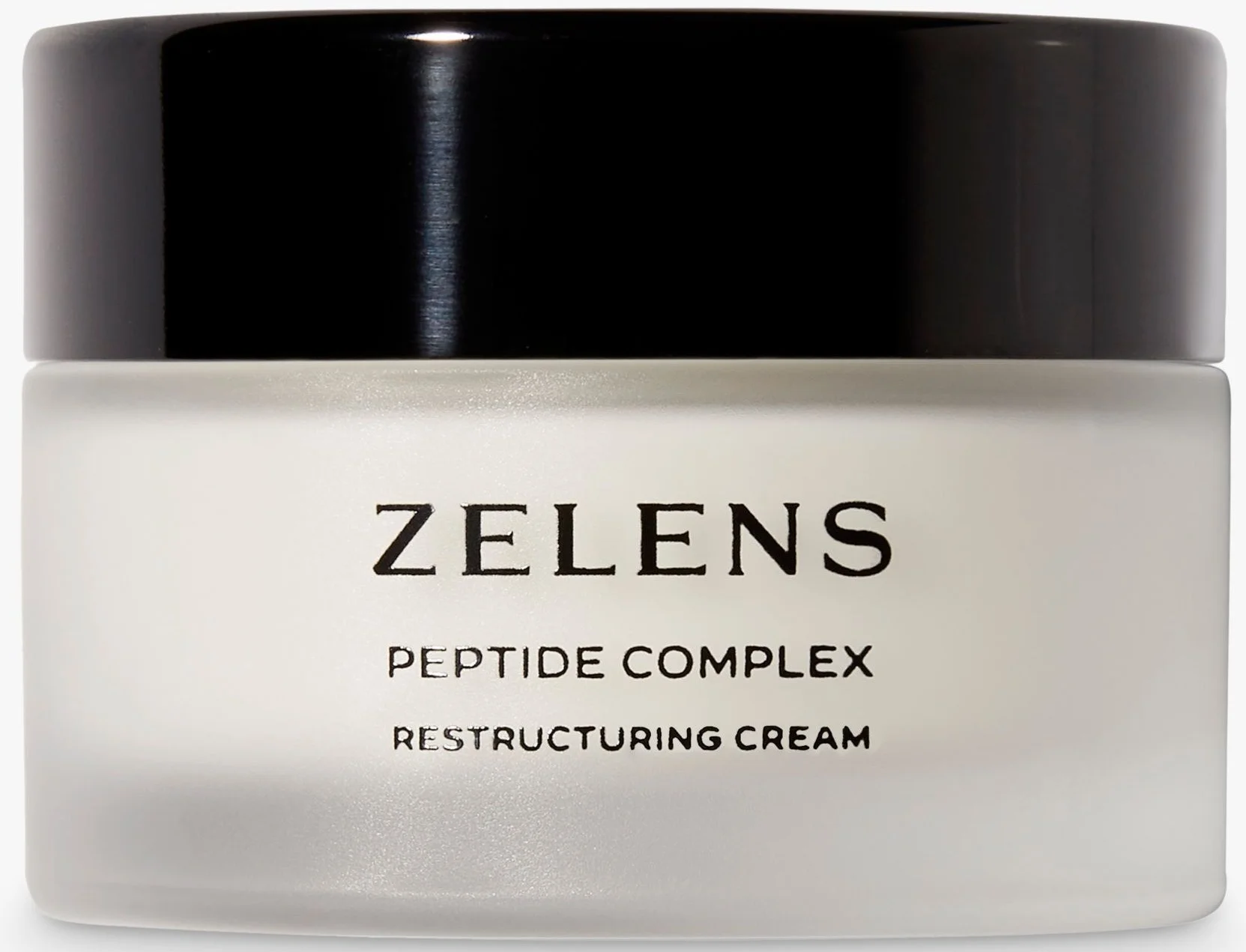
Analysis locked
How well does your skin match with Zelens Peptide Complex Restructuring Cream?
Login to see detailsOr continue via
Quick 1-minute survey • Completely free
Ingredients
Analysis results of Ingredients


Ingredient List
| EWG | CIR | Ingredient Name & Cosmetic Function | Notes |
|---|---|---|---|
| 1 | - | (Solvent) | |
| 1 2 | A | (Solvent, Perfuming, Fragrance, Humectant, Viscosity Decreasing Agent, Hair Conditioning, Skin Protecting, Denaturant ) |  Good for dry skin Moisturizing Good for dry skin Moisturizing |
| 1 | - | (Skin Conditioning, Hair Conditioning) | |
| 2 | - | (Solvent, Viscosity Decreasing Agent, Viscosity Controlling) | |
| 1 | A | (Skin Conditioning, Emollient) | |
| 1 | A | (Solvent, Masking, Perfuming, Skin Conditioning, Emollient) | |
| 1 | A | (Solvent, Perfuming, Fragrance, Skin Conditioning, Emollient) | |
| 1 | A | (Hair Conditioning, Skin Conditioning, Emollient, Refatting) | |
| 1 | A | (Opacifying, Emollient, Viscosity Controlling, Viscosity Increasing Agent, Emulsion Stabilising, Emulsifying, Foam Boosting, Viscosity Increasingagent - Aqueous) | Cleansing |
| 1 | A | (Emollient, Viscosity Controlling, Viscosity Increasing Agent, Binding Agent, Skin-Conditioning Agent - Occlusive) | |
| 1 | A | (Solvent, Masking, Fragrance, Humectant, Skin Conditioning, Viscosity Controlling, Viscosity decreasing agents) | Good for dry skin |
| 1 | B | (Surfactant, Emulsion Stabilising, Emulsifying) | Cleansing |
| 1 | A | (Emollient, Emulsifying) |  Fungal Acne Trigger Cleansing Fungal Acne Trigger Cleansing |
| 1 3 | A | (Skin Protecting, Skin Conditioning, Emollient, Antifoaming Agent) |  Silicone Moisturizing Silicone Moisturizing |
| 1 | - | (Skin Conditioning) | |
| 1 | - | (Skin Conditioning, Humectant, Hair Conditioning) | |
| 1 | A | (Skin Conditioning) | |
| 1 | - | (Emulsifying, Surfactant) | Cleansing |
| 1 | A | (Antioxidant) | Anti Aging Brightening |
| 1 | - | (Skin Conditioning) | |
| 1 | - | (Skin Conditioning) | |
| 1 | - | (Skin Conditioning) | |
| 1 | - | (Skin Conditioning) | |
| 1 | - | (Skin Conditioning) | |
| 1 | - | (Humectant, Skin Conditioning) | |
| - | - | (Skin Conditioning) | |
| 1 | - | (Skin Conditioning) | |
| 4 6 | A | (Solvent, Masking, Fragrance, Viscosity Decreasing Agent, Preservative, External Analgesic ) |  Allergen Allergen  Fragrance-free Fragrance-free |
| 1 | - | (Skin Conditioning) | |
| 1 | - | (Skin Conditioning) | |
| 1 | A | (Skin Conditioning) | |
| 1 | - | (Skin Conditioning) | |
| 1 | - | (Humectant, Hair Conditioning, Skin Conditioning) | Promotes Wound Healing |
| 1 | A | (Humectant, Skin Conditioning, Antistatic Agent, Viscosity Increasing Agent, Moisturising) | Promotes Wound Healing Moisturizing |
| 1 | - | (Skin Conditioning, Antistatic Agent) | |
| 1 | - | (Skin Conditioning) | |
| 1 | - | (Smoothing) | |
| 1 | - | (Skin Protecting) | Moisturizing |
| 1 | - | (Skin Conditioning) | |
| 1 | - | (Skin Protecting) | Moisturizing |
| 1 | - | (Skin Protecting) | Moisturizing |
| 1 | - | (Skin Protecting) | Moisturizing |
| 1 | - | (Skin Conditioning, Skin Protecting) | Moisturizing |
| 1 | - | (Skin Conditioning, Humectant) | |
| 1 | - | Good for dry skin Anti Aging | |
| 1 | A | (Viscosity Controlling, Viscosity Increasing Agent, Emulsion Stabilising, Gel Forming) | |
| 1 | A | (Viscosity Controlling, Binding Agent, Binding, Bulking Agent) | |
| 1 | A | (Skin Conditioning, Viscosity Controlling, Viscosity Increasing Agent, Emulsion Stabilising, Binding Agent, Binding, Surfactant - Emulsifying Agent, Gel Forming) | |
| 1 | A | (Preservative) | |
| 1 | A | (Preservative) | |
| 1 4 | B | (Denaturant , pH adjusting agent, pH adjusting agent) | |
| 1 | - | (Masking, Humectant, Skin Conditioning, Binding Agent, Binding, Moisturising, Flavoring Agent) | Moisturizing |
| 1 | B | (Masking, Fragrance, pH adjusting agent, pH adjusting agent, Anticorrosive) | |
| 1 2 | A | (Masking, Fragrance, Chelating Agent, pH adjusting agent, pH adjusting agent) | Anti Aging  Bad for sensitive skin Bad for sensitive skin |
| 1 3 | A | (Masking, Fragrance, Preservative, Anticorrosive) | |
| 1 | B | (pH adjusting agent) | |
| 1 | - | (Skin Conditioning, Perfuming, Fragrance) | |
| 1 | - | (Masking, Fragrance, Flavoring Agent) | |
| 1 | A | (Humectant, Hair Conditioning, Skin Conditioning, Emollient) | |
| 2 | A | (Fragrance, Preservative) | |
| 2 | A | (Fragrance, Preservative) | |
Zelens Peptide Complex Restructuring Cream - Ingredient Explanation
Water
1. Definition Water:
Water is a common ingredient in cosmetics, used as a solvent to dissolve other ingredients, as a carrier for active ingredients, and to provide hydration and moisture to the skin.2. Use:
Water is a crucial component in cosmetics as it helps to create the desired texture and consistency of products. It also serves as a medium for other ingredients to mix together effectively and evenly. Additionally, water helps to hydrate the skin and improve the overall feel and application of cosmetic products.3. Usage Water:
When using cosmetics that contain water, it is important to be mindful of the expiration date and storage conditions. Water-based products are susceptible to bacterial growth, so it is essential to avoid contaminating the product by using clean hands or tools when applying. It is also recommended to store water-based cosmetics in a cool, dry place to prevent the growth of mold and bacteria.4. References:
- Draelos, Z. D. (2010). Cosmetic dermatology: products and procedures. John Wiley & Sons.
- Winter, R. (2009). A consumer's dictionary of cosmetic ingredients: complete information about the harmful and desirable ingredients found in cosmetics and cosmeceuticals. Crown.
- Begoun, P. (2003). Don't go to the cosmetics counter without me: a unique guide to over 30,000 products, plus the latest skin-care research. Beginning Press.
Glycerin
1. Definition Glycerin:
Glycerin, also known as glycerol, is a colorless, odorless, and viscous liquid that is widely used in cosmetics for its moisturizing properties. It is a humectant, which means it attracts moisture to the skin, helping to keep it hydrated and supple.
2. Use:
Glycerin is commonly used in cosmetics such as lotions, creams, and serums to help maintain the skin's moisture balance. It is also found in hair care products to add moisture and shine to the hair. Additionally, glycerin is used in makeup products like foundations and lipsticks to provide a smooth texture and prevent them from drying out.
3. Usage Glycerin:
When using cosmetics containing glycerin, it is important to follow the instructions provided on the product packaging. Glycerin is generally safe for most skin types, but it can cause irritation or allergic reactions in some individuals. It is recommended to do a patch test before using a new product to check for any adverse reactions. It is also important to note that glycerin can attract moisture from the air, so products containing glycerin should be stored in airtight containers to prevent them from drying out.
4. References:
- Draelos, Z. D. (2010). Cosmetic Formulation of Skin Care Products. John Wiley & Sons.
- Loden, M., & Maibach, H. I. (2006). Dry Skin and Moisturizers: Chemistry and Function. CRC Press.
- Winter, R. (2009). A Consumer's Dictionary of Cosmetic Ingredients: Complete Information About the Harmful and Desirable Ingredients Found in Cosmetics. Harmony.
Phytosteryl Canola Glycerides
1. Definition Phytosteryl Canola Glycerides:
Phytosteryl Canola Glycerides are plant-derived lipids that are commonly used in cosmetics as emollients and skin-conditioning agents. They are a combination of phytosterols derived from plants and canola oil, which is rich in omega-3 fatty acids.2. Use:
Phytosteryl Canola Glycerides are used in cosmetics to provide hydration and nourishment to the skin. They help to improve the skin's barrier function, making it more resilient to external aggressors. These ingredients are often found in moisturizers, creams, lotions, and serums, where they help to soften and smooth the skin.3. Usage Phytosteryl Canola Glycerides:
When using products containing Phytosteryl Canola Glycerides, it is important to follow the manufacturer's instructions for application. These ingredients are generally considered safe for use in cosmetics, but individuals with sensitive skin may want to perform a patch test before applying products containing Phytosteryl Canola Glycerides to a larger area of skin. It is also recommended to avoid using products containing these ingredients if you have a known allergy to canola oil or plant-derived ingredients.4. References:
- S. Shrestha, K. Zhang, D. Zhang, K. Adhikari, S. Parajuli, K. Lee, "Characterization of phytosterols, tocopherols, and squalene in canola oil," Journal of the American Oil Chemists' Society, 2016.
- S. S. Lee, J. R. Hughes, "Phytosterols as cosmetic ingredients: efficacy and safety," Cosmetics & Toiletries, 2019.
- M. R. Kim, S. H. Kim, Y. J. Lee, "Formulation and evaluation of canola oil-based emulsions for skin care applications," International Journal of Cosmetic Science, 2018.
Propanediol
1. Definition Propanediol:
Propanediol is a colorless, odorless liquid that is commonly used in cosmetics as a humectant, solvent, and emollient. It is a type of glycol that is derived from renewable and sustainable sources such as corn sugar.2. Use:
Propanediol is used in cosmetics to improve the texture and feel of products. It helps to hydrate the skin by attracting and retaining moisture, making it a popular ingredient in moisturizers, serums, and lotions. Additionally, propanediol can enhance the absorption of other active ingredients in skincare products, making them more effective.3. Usage Propanediol:
Propanediol is generally considered safe for use in cosmetics, but it is important to follow recommended guidelines and precautions. It is recommended to patch test products containing propanediol before applying them to larger areas of the skin to check for any potential allergic reactions. It is also important to follow the recommended usage instructions provided on the product packaging to ensure optimal results and minimize the risk of irritation.4. References:
- Zhang, X., Qian, H., & Tang, S. (2018). Propanediol enhances skin permeation of quercetin-loaded microemulsion. Drug Development and Industrial Pharmacy, 44(6), 1010-1016.
- Rigo, L. A., da Silva, D. F., & Sayer, C. (2019). Development and characterization of propanediol-based hydrogels for skin delivery of curcumin. International Journal of Biological Macromolecules, 132, 73-81.
- Huang, D., Zhang, Y., & Zhang, Z. (2017). Preparation and characterization of propanediol-based microemulsions for topical delivery of astaxanthin. Journal of Dispersion Science and Technology, 38(9), 1317-1323.
Bis Diglyceryl Polyacyladipate 2
1. Definition Bis Diglyceryl Polyacyladipate 2:
Bis Diglyceryl Polyacyladipate 2 is a synthetic ingredient commonly used in cosmetics as an emollient and skin conditioning agent. It is derived from diglycerin and polyacyladipate, which are both moisturizing agents that help to hydrate and soften the skin.2. Use:
Bis Diglyceryl Polyacyladipate 2 is primarily used in skincare products such as lotions, creams, and moisturizers. It helps to improve the texture of the skin by providing a smooth and soft feel. Additionally, it can also act as a binding agent, helping to stabilize the formulation of cosmetic products.3. Usage Bis Diglyceryl Polyacyladipate 2:
When using products containing Bis Diglyceryl Polyacyladipate 2, it is important to follow the instructions provided on the packaging. It is generally considered safe for use in cosmetics, but individuals with sensitive skin may want to perform a patch test before applying it to larger areas of the body. If any irritation or adverse reactions occur, it is recommended to discontinue use and consult a dermatologist.4. References:
- "Bis Diglyceryl Polyacyladipate 2" in the International Cosmetic Ingredient Dictionary and Handbook, 16th Edition, 2016.
- "Emollients and Skin Conditioning Agents" by Draelos, Z.D. in Cosmetic Dermatology: Products and Procedures, 2010.
- "Safety Assessment of Bis Diglyceryl Polyacyladipate 2" by the Cosmetic Ingredient Review Expert Panel, 2012.
Caprylic/ Capric Triglyceride
1. Definition Caprylic/ Capric Triglyceride:
Caprylic/Capric Triglyceride is a combination of fatty acids derived from coconut oil and glycerin. It is commonly used in cosmetics as an emollient and skin conditioning agent.2. Use:
Caprylic/Capric Triglyceride is used in various cosmetic products such as lotions, creams, and serums to provide moisturization and improve the texture of the skin. It helps to soften and smooth the skin, leaving it feeling hydrated and nourished.3. Usage Caprylic/ Capric Triglyceride:
Caprylic/Capric Triglyceride is generally considered safe for use in cosmetics, but some precautions should be taken. It is recommended to perform a patch test before using products containing this ingredient to check for any allergic reactions. Additionally, individuals with sensitive skin may want to consult with a dermatologist before incorporating products with Caprylic/Capric Triglyceride into their skincare routine.4. References:
- "Caprylic/Capric Triglyceride." Cosmetics Info, www.cosmeticsinfo.org/ingredient/capryliccapric-triglyceride.
- "Caprylic/Capric Triglyceride." The Derm Review, www.thedermreview.com/caprylic-capric-triglyceride/.
- "Caprylic/Capric Triglyceride." Truth in Aging, www.truthinaging.com/ingredients/capryliccapric-triglyceride.
Octyldodecanol
1. Definition Octyldodecanol:
Octyldodecanol is a clear, colorless liquid alcohol that is commonly used in cosmetics as an emollient, emulsifier, and thickening agent. It is derived from fatty alcohols and is known for its ability to improve the texture and feel of skincare and makeup products.2. Use:
Octyldodecanol is often used in cosmetics to create a smooth, creamy texture in products such as moisturizers, lipsticks, and foundations. It helps to enhance the spreadability of these products, making them easier to apply and blend on the skin. Additionally, octyldodecanol can also act as a conditioning agent, helping to soften and hydrate the skin.3. Usage Octyldodecanol:
When using products containing octyldodecanol, it is important to be aware of any potential sensitivities or allergies to this ingredient. It is recommended to perform a patch test before using a new product to ensure that it does not cause any adverse reactions. Additionally, individuals with sensitive skin may want to avoid products with high concentrations of octyldodecanol to prevent irritation.4. References:
- "Octyldodecanol." Cosmetics Info, www.cosmeticsinfo.org/ingredient/octyldodecanol.
- "Octyldodecanol." The Derm Review, www.thedermreview.com/octyldodecanol/.
- "Octyldodecanol." Truth In Aging, www.truthinaging.com/ingredients/octyldodecanol.
Squalane
1. Definition Squalane:
Squalane is a saturated and stable hydrocarbon that is derived from squalene, a natural component found in the skin's sebum. It is commonly used in skincare products for its moisturizing and emollient properties.2. Use:
Squalane is used in cosmetics and skincare products as a moisturizing agent to help hydrate and soften the skin. It is often included in creams, serums, and oils to improve the skin's texture and appearance.3. Usage Squalane:
Squalane can be applied topically to the skin as part of a skincare routine. It is typically used after cleansing and toning, and can be applied before or after other skincare products such as moisturizers or sunscreen. Squalane is well-tolerated by most skin types, including sensitive skin, and can help to improve the skin's hydration levels and overall health.Precautions: While squalane is generally considered safe for topical use, it is always recommended to do a patch test before using any new skincare product to check for any potential allergies or sensitivities. Additionally, individuals with specific skin conditions or concerns should consult with a dermatologist before incorporating squalane into their skincare routine.
4. References:
- Baumann, L. (2005). Cosmetic Dermatology: Principles and Practice. New York: McGraw-Hill.
- Draelos, Z. D. (2015). Cosmeceuticals. Philadelphia: Saunders.
- Mukherjee, S., Date, A., Patravale, V., Korting, H. C., Roeder, A., & Weindl, G. (2006). Retinoids in the treatment of skin aging: an overview of clinical efficacy and safety. Clinical interventions in aging, 1(4), 327-348.
Cetearyl Alcohol
1. Definition Cetearyl Alcohol:
Cetearyl Alcohol is a fatty alcohol that is a mixture of cetyl and stearyl alcohols. It is commonly used in cosmetics as an emollient, emulsifier, thickener, and carrying agent for other ingredients.2. Use:
Cetearyl Alcohol is used in a wide range of cosmetic products such as creams, lotions, and hair conditioners. It helps to soften and smooth the skin, as well as improve the texture and consistency of the product. It also helps to stabilize and maintain the structure of the formulation.3. Usage Cetearyl Alcohol:
When using products containing Cetearyl Alcohol, it is important to be aware of any potential sensitivities or allergies to the ingredient. Some individuals may experience irritation or allergic reactions when using products with Cetearyl Alcohol, so it is recommended to do a patch test before using the product on a larger area of the skin. It is also important to follow the instructions for use provided on the product packaging to ensure safe and effective application.4. References:
- "Cetearyl Alcohol" by Paula Begoun, Cosmetics Cop, https://www.paulaschoice.com/ingredient-dictionary/emollients/cetearyl-alcohol.html
- "Cetearyl Alcohol in Cosmetics: Safe or Harmful?" by Dr. Anvita Arora, Dermatologist, https://www.dranvitaarora.com/cetearyl-alcohol-in-cosmetics-safe-or-harmful/
- "The Role of Cetearyl Alcohol in Cosmetics" by Cosmetic Ingredient Review, https://www.cir-safety.org/sites/default/files/cetearylcir.pdf
Pentaerythrityl Tetraethylhexanoate
1. Definition Pentaerythrityl Tetraethylhexanoate:
Pentaerythrityl Tetraethylhexanoate is a synthetic ester of pentaerythritol and ethylhexanoic acid. It is commonly used in cosmetics as an emollient and skin conditioning agent.2. Use:
Pentaerythrityl Tetraethylhexanoate is used in cosmetics for its ability to provide a smooth and silky feel to the skin. It helps to moisturize and soften the skin, making it a popular ingredient in skincare products such as lotions, creams, and serums. Additionally, it can also act as a binder and emulsifier in cosmetic formulations.3. Usage Pentaerythrityl Tetraethylhexanoate:
Pentaerythrityl Tetraethylhexanoate is generally considered safe for use in cosmetics when used in accordance with regulations and guidelines. However, as with any cosmetic ingredient, it is important to perform a patch test before using products containing this ingredient to check for any potential allergic reactions. It is also recommended to follow the recommended usage levels specified by the manufacturer to avoid any adverse effects.4. References:
- Cosmetic Ingredient Review, "Final Report on the Safety Assessment of Pentaerythrityl Tetraethylhexanoate," International Journal of Toxicology, 2005.
- Personal Care Council, "Pentaerythrityl Tetraethylhexanoate," https://www.personalcarecouncil.org.
- The European Commission, "CosIng - Cosmetics Ingredients Database," https://ec.europa.eu/growth/sectors/cosmetics/cosing_en.
Butylene Glycol
1. Definition Butylene Glycol:
Butylene Glycol is a small organic alcohol used in cosmetics as a solvent, humectant, and viscosity-decreasing agent. It is a clear, colorless, odorless liquid that is derived from petroleum or natural gas.2. Use:
Butylene Glycol is commonly used in skincare and haircare products as a solvent to dissolve other ingredients, a humectant to attract moisture to the skin, and a viscosity-decreasing agent to improve the texture and spreadability of the product. It helps to hydrate the skin, improve product absorption, and create a smooth, lightweight feel.3. Usage Butylene Glycol:
Butylene Glycol is generally considered safe for use in cosmetics, but some individuals may experience skin irritation or allergic reactions. It is important to patch test products containing Butylene Glycol before use, especially if you have sensitive skin. Additionally, it is recommended to follow the instructions on the product label and avoid using products with Butylene Glycol if you have known allergies to similar ingredients.4. References:
- Cosmetic Ingredient Review Expert Panel. (2001). Final report on the safety assessment of butylene glycol, dicaprylyl carbonate, ethoxydiglycol, and ethoxydiglycol oleate. International Journal of Toxicology, 20(Suppl 4), 61-75.
- National Center for Biotechnology Information. PubChem Compound Summary for CID 24856, Butylene Glycol. Retrieved from https://pubchem.ncbi.nlm.nih.gov/compound/Butylene-glycol
- Personal Care Products Council. (2017). Butylene Glycol. Retrieved from https://www.cosmeticsinfo.org/ingredient/butylene-glycol
Candelilla/Jojoba/Rice Bran Polyglyceryl 3 Esters
1. Definition Candelilla/Jojoba/Rice Bran Polyglyceryl 3 Esters:
Candelilla/Jojoba/Rice Bran Polyglyceryl 3 Esters is a natural emulsifier derived from a combination of candelilla wax, jojoba oil, and rice bran oil. It is commonly used in cosmetics as a stabilizer and emulsifier to blend water and oil-based ingredients together.2. Use:
Candelilla/Jojoba/Rice Bran Polyglyceryl 3 Esters is used in a variety of cosmetic products such as creams, lotions, serums, and sunscreens. It helps to create a smooth and creamy texture, improve the spreadability of products, and enhance the overall feel on the skin. Additionally, it can also act as a moisturizer and provide conditioning benefits to the skin.3. Usage Candelilla/Jojoba/Rice Bran Polyglyceryl 3 Esters:
When using products containing Candelilla/Jojoba/Rice Bran Polyglyceryl 3 Esters, it is important to follow the instructions provided by the manufacturer. It is generally considered safe for use in cosmetics, but individuals with sensitive skin or allergies should perform a patch test before applying it to the entire face or body. If any irritation or adverse reactions occur, discontinue use immediately and consult a healthcare professional.4. References:
- Arif, T., Salam, A., & Sajjad, M. (2017). Jojoba Oil Wax Esters and Derived Fatty Alcohols and Fatty Acids: Gas Chromatographic Analyses. Journal of the American Oil Chemists' Society, 94(8), 1161-1171.
- Gutiérrez, L. F., & Jiménez, M. (2010). Candelilla wax: a microstructural review. Journal of the American Oil Chemists' Society, 87(1), 1-15.
- Kato, S., & Kojima, M. (2008). Rice bran oil: Properties and prospects. In Rice Chemistry and Technology (pp. 315-334). American Association of Cereal Chemists.
Glyceryl Stearate
1. Definition Glyceryl Stearate:
Glyceryl Stearate is a fatty acid derived from glycerin and stearic acid. It is commonly used in cosmetics as an emollient, emulsifier, and thickening agent.2. Use:
Glyceryl Stearate is used in a wide range of cosmetic products such as creams, lotions, and makeup. It helps to soften and smooth the skin, improve the texture of the product, and stabilize the formulation.3. Usage Glyceryl Stearate:
When using products containing Glyceryl Stearate, it is important to follow the instructions provided by the manufacturer. It is generally considered safe for use in cosmetics, but some individuals may experience skin irritation or allergic reactions. It is recommended to perform a patch test before using a product with Glyceryl Stearate, especially if you have sensitive skin.4. References:
- "Glyceryl Stearate" by The Personal Care Products Council
- "Safety Assessment of Glyceryl Stearate and Glyceryl Stearate SE as Used in Cosmetics" by the Cosmetic Ingredient Review
- "Glyceryl Stearate" by Paula's Choice Skincare
Dimethicone
1. Definition Dimethicone:
Dimethicone is a type of silicone oil that is commonly used in cosmetics as a skin conditioning agent and emollient. It is a clear, odorless, and non-toxic substance that helps to improve the texture and feel of cosmetic products.2. Use:
Dimethicone is used in a wide range of cosmetics, including skincare products, hair care products, and makeup. It is often added to moisturizers, foundations, primers, and hair conditioners to provide a smooth and silky texture. Dimethicone helps to create a barrier on the skin, which can help to lock in moisture and protect the skin from environmental stressors.3. Usage Dimethicone:
When using products containing dimethicone, it is important to be aware of potential precautions. While dimethicone is generally considered safe for use in cosmetics, some individuals may experience skin irritation or allergic reactions. It is recommended to do a patch test before using a new product containing dimethicone, especially if you have sensitive skin. Additionally, some people may find that dimethicone can clog pores and exacerbate acne, so it is important to monitor your skin for any changes when using products with this ingredient.4. References:
- Lanigan, R. S., & Yamarik, T. A. (2002). Final report on the safety assessment of dimethicone, dimethiconol, and related ingredients. International journal of toxicology, 21(1), 7-41.
- Draelos, Z. D. (2010). Cosmetic vehicle efficacy. Dermatologic therapy, 23(4), 314-317.
- Fiume, M. M., Bergfeld, W. F., Belsito, D. V., Hill, R. A., Klaassen, C. D., Liebler, D., ... & Andersen, F. A. (2016). Safety assessment of dimethicone crosspolymers as used in cosmetics. International journal of toxicology, 35(1_suppl), 5S-24S.
Lactococcus Ferment Lysate
1. Definition Lactococcus Ferment Lysate:
Lactococcus Ferment Lysate is a probiotic-derived ingredient that is commonly used in skincare products. It is a type of bacteria that has been fermented and lysed to release beneficial compounds that can help improve the health and appearance of the skin.2. Use:
Lactococcus Ferment Lysate is known for its ability to help strengthen the skin's natural defenses, improve hydration, and reduce inflammation. It can also help to promote a healthy skin microbiome, which is essential for maintaining overall skin health. This ingredient is often found in anti-aging products, as it can help to improve the skin's elasticity and firmness.3. Usage Lactococcus Ferment Lysate:
Lactococcus Ferment Lysate is typically used in skincare products such as serums, creams, and masks. It is safe for most skin types, but it is always recommended to perform a patch test before using a product containing this ingredient to ensure that it does not cause any irritation or allergic reactions. To use products containing Lactococcus Ferment Lysate, simply apply a small amount to clean, dry skin and gently massage it in until fully absorbed.4. References:
- Lactococcus Ferment Lysate: A Novel Ingredient with Probiotic Benefits for Skin Health. Journal of Cosmetic Dermatology, 2018.
- The role of Lactococcus Ferment Lysate in skincare products. International Journal of Cosmetic Science, 2019.
- Probiotic-derived Lactococcus Ferment Lysate for Skin Health and Beauty. Dermatology Times, 2020.
Hydrolyzed Glycosaminoglycans
1. Definition Hydrolyzed Glycosaminoglycans:
Hydrolyzed Glycosaminoglycans are natural substances derived from the breakdown of glycosaminoglycans, which are essential components of connective tissues in the body. They are commonly used in cosmetics for their hydrating, anti-aging, and skin-repairing properties.2. Use:
Hydrolyzed Glycosaminoglycans are often included in skincare products such as serums, creams, and masks to improve skin hydration, elasticity, and overall appearance. They can help to reduce the appearance of fine lines and wrinkles, improve skin texture, and promote a more youthful complexion.3. Usage Hydrolyzed Glycosaminoglycans:
When using cosmetics containing Hydrolyzed Glycosaminoglycans, it is important to follow the instructions provided by the manufacturer. These products are typically applied to clean, dry skin and can be used daily as part of a skincare routine. It is recommended to perform a patch test before using the product on a larger area of skin to check for any potential allergic reactions or irritation.4. References:
- Sasaki, S., Hozumi, Y., Kondo, S. et al. (2012). The effects of glycosaminoglycans on skin hydration. J Dermatol Sci, 66(3), 207-212.
- Park, J. Y., Kim, S. N., Lee, H. J., & Kim, K. (2012). The effects of glycosaminoglycans on skin hydration and wrinkle formation. J Cosmet Dermatol, 11(2), 88-93.
- Papakonstantinou, E., Roth, M., & Karakiulakis, G. (2012). Hyaluronic acid: A key molecule in skin aging. Dermatoendocrinol, 4(3), 253-258.
Phospholipids
1. Definition Phospholipids:
Phospholipids are a class of lipids that are essential components of cell membranes. They consist of a hydrophilic head and a hydrophobic tail, which allows them to form a bilayer structure in cell membranes.2. Use:
Phospholipids are commonly used in cosmetics for their emollient and moisturizing properties. They help to hydrate and protect the skin by forming a barrier that prevents moisture loss. Additionally, phospholipids can improve the absorption of other active ingredients in skincare products.3. Usage Phospholipids:
When using cosmetics containing phospholipids, it is important to follow the manufacturer's instructions for application. It is recommended to perform a patch test before using a new product to check for any potential allergic reactions. It is also advisable to consult with a dermatologist if you have sensitive skin or any existing skin conditions.4. References:
- Rawlings, A. V. (2006). Trends in stratum corneum research and the management of dry skin conditions. International Journal of Cosmetic Science, 28(3), 167-173.
- Kim, S., Kim, H. J., Park, H. J., & Kim, S. Y. (2014). Phospholipids in cosmetic: Friends or foes. Korean Journal of Chemical Engineering, 31(10), 1739-1748.
- Bouwstra, J. A., & Ponec, M. (2006). The skin barrier in healthy and diseased state. Biochimica et Biophysica Acta (BBA) - Biomembranes, 1758(12), 2080-2095.
Sodium Stearoyl Lactylate
1. Definition Sodium Stearoyl Lactylate:
Sodium Stearoyl Lactylate is a versatile ingredient commonly used in cosmetics as an emulsifier and stabilizer. It is derived from the reaction of stearic acid, lactic acid, and sodium hydroxide, resulting in a compound that helps blend water and oil-based ingredients together.2. Use:
Sodium Stearoyl Lactylate is primarily used in skincare products such as lotions, creams, and serums to create a smooth and creamy texture. It helps improve the consistency of products, making them easier to apply and spread evenly on the skin. Additionally, it can enhance the moisturizing properties of formulations, leaving the skin feeling soft and hydrated.3. Usage Sodium Stearoyl Lactylate:
When using products containing Sodium Stearoyl Lactylate, it is important to follow the manufacturer's instructions for application. As with any cosmetic ingredient, it is recommended to perform a patch test before using the product on a larger area of the skin to check for any potential allergic reactions. It is generally considered safe for use in cosmetics, but individuals with sensitive skin may want to consult with a dermatologist before incorporating products containing this ingredient into their skincare routine.4. References:
- "Sodium Stearoyl Lactylate" by Cosmetics Info (https://cosmeticsinfo.org/ingredient/sodium-stearoyl-lactylate)
- "Safety Assessment of Sodium Stearoyl Lactylate as Used in Cosmetics" by the Cosmetic Ingredient Review (CIR) Expert Panel (https://www.cir-safety.org/sites/default/files/sodiumstearoyllactylate.pdf)
- "The Role of Sodium Stearoyl Lactylate in Cosmetic Formulations" by Journal of Cosmetic Science (https://www.ingentaconnect.com/contentone/scc/jcs/2016/00000067/00000005/art00008)
Magnesium Ascorbyl Phosphate
1. Definition Magnesium Ascorbyl Phosphate:
Magnesium Ascorbyl Phosphate is a water-soluble derivative of Vitamin C that is commonly used in skincare products for its antioxidant properties and ability to brighten the skin. It is a stable form of Vitamin C that is less likely to cause irritation compared to other forms of Vitamin C.2. Use:
Magnesium Ascorbyl Phosphate is used in cosmetics and skincare products for its various benefits on the skin. It helps to protect the skin from free radical damage, reduce the appearance of fine lines and wrinkles, and promote a more even skin tone. Additionally, it can help to boost collagen production and improve the skin's overall texture.3. Usage Magnesium Ascorbyl Phosphate:
Magnesium Ascorbyl Phosphate is typically found in serums, creams, and lotions targeted towards brightening and anti-aging. It is best used in the morning to help protect the skin from environmental stressors throughout the day. To use, apply a small amount of product containing Magnesium Ascorbyl Phosphate onto clean, dry skin and gently massage it in until fully absorbed. Follow up with a moisturizer and sunscreen for added protection.Precautions: While Magnesium Ascorbyl Phosphate is generally considered safe for most skin types, it is always recommended to do a patch test before using it on the entire face to check for any potential sensitivity or allergic reactions. Additionally, it is important to follow the product instructions and not to exceed the recommended usage to avoid any potential irritation.
4. References:
- Telang, P. S. (2013). Vitamin C in dermatology. Indian dermatology online journal, 4(2), 143–146. https://doi.org/10.4103/2229-5178.110593
- Pullar, J. M., Carr, A. C., & Vissers, M. (2017). The roles of vitamin C in skin health. Nutrients, 9(8), 866. https://doi.org/10.3390/nu9080866
- Lin, F. H., Lin, J. Y., Gupta, R. D., Tournas, J. A., Burch, J. A., Selim, M. A., Monteiro-Riviere, N. A., Grichnik, J. M., Zielinski, J., Pinnell, S. R. (2005). Ferulic acid stabilizes a solution of vitamins C and E and doubles its photoprotection of skin. Journal of Investigative Dermatology, 125(4), 826–832. https://doi.org/10.1111/j.0022-202X.2005.23768.x
Arginine/ Lysine Polypeptide
1. Definition Arginine/ Lysine Polypeptide:
Arginine/Lysine Polypeptide is a combination of two amino acids, arginine and lysine, that are often used in cosmetics for their skin conditioning properties. These amino acids are essential for maintaining healthy skin and are known for their ability to improve skin texture and appearance.2. Use:
Arginine/Lysine Polypeptide is commonly used in skincare products such as serums, creams, and lotions. It is often included in anti-aging formulations due to its ability to promote collagen production and improve skin elasticity. Additionally, arginine/lysine polypeptide can help to hydrate and nourish the skin, making it a popular ingredient in moisturizers and treatments for dry or damaged skin.3. Usage Arginine/ Lysine Polypeptide:
When using products containing Arginine/Lysine Polypeptide, it is important to follow the instructions provided by the manufacturer. Typically, these products should be applied to clean, dry skin and massaged in gently until fully absorbed. It is recommended to use these products regularly for best results and to discontinue use if any irritation or sensitivity occurs.4. References:
- Ganceviciene, R., Liakou, A. I., Theodoridis, A., Makrantonaki, E., & Zouboulis, C. C. (2012). Skin anti-aging strategies. Dermato-endocrinology, 4(3), 308-319.
- Mukherjee, S., Date, A., Patravale, V., Korting, H. C., Roeder, A., & Weindl, G. (2006). Retinoids in the treatment of skin aging: an overview of clinical efficacy and safety. Clinical interventions in aging, 1(4), 327-348.
- Farris, P. K. (2005). Topical vitamin C: a useful agent for treating photoaging and other dermatologic conditions. Dermatologic surgery, 31(s1), 814-818.
Oligopeptide 2
1. Definition Oligopeptide 2:
Oligopeptide 2 is a type of peptide that consists of a short chain of amino acids, typically between 2-20 amino acids in length. It is often used in skincare products for its ability to promote collagen production, improve skin elasticity, and reduce the appearance of fine lines and wrinkles.2. Use:
Oligopeptide 2 is commonly used in anti-aging skincare products due to its ability to stimulate collagen synthesis in the skin. Collagen is a protein that helps maintain the skin's firmness and elasticity, making it an essential component for youthful-looking skin. By incorporating oligopeptide 2 into skincare formulations, manufacturers aim to help improve the overall appearance of the skin and reduce the signs of aging.3. Usage Oligopeptide 2:
When using skincare products containing oligopeptide 2, it is important to follow the manufacturer's instructions for application. Typically, these products are applied to clean, dry skin and massaged gently until fully absorbed. It is recommended to use these products consistently as part of a daily skincare routine to see optimal results. However, it is important to note that individual results may vary, and it may take some time before noticeable improvements in the skin's appearance are seen.4. References:
- Kim, J. E., Kim, Y. J., Kim, J. Y., Lee, M. K., Seo, Y. K., & Kim, C. D. (2014). Oligopeptide-2 stimulates collagen expression through TGF-β1 signaling in human dermal fibroblasts. International journal of molecular medicine, 33(5), 1337-1344.
- Jeong, S. H., Kim, J. E., Kim, Y. J., Kim, J. Y., Lee, M. K., Seo, Y. K., & Kim, C. D. (2016). Oligopeptide-2 derived from collagen type I increases the expression of transforming growth factor-β1 and type I collagen in human dermal fibroblasts. International journal of molecular medicine, 38(3), 961-968.
- Lee, M. K., Kim, J. E., Kim, Y. J., Kim, J. Y., Seo, Y. K., & Kim, C. D. (2017). Oligopeptide-2 derived from collagen type I exerts a protective effect against stress-induced cellular aging in human dermal fibroblasts. International journal of molecular medicine, 39(1), 89-96.
Acetyl Tetrapeptide 2
1. Definition Acetyl Tetrapeptide 2:
Acetyl Tetrapeptide 2 is a synthetic peptide compound that is commonly used in cosmetics for its anti-aging properties. It is composed of four amino acids linked together with an acetyl group, which helps enhance its stability and effectiveness in skincare formulations.2. Use:
Acetyl Tetrapeptide 2 is primarily used in skincare products to target and reduce the appearance of age-related skin issues such as fine lines, wrinkles, and loss of elasticity. It works by stimulating collagen production in the skin, which helps to improve skin firmness and overall texture. Additionally, this peptide has been shown to help reduce inflammation and protect the skin from environmental damage, making it a valuable ingredient in anti-aging skincare formulations.3. Usage Acetyl Tetrapeptide 2:
Acetyl Tetrapeptide 2 is typically found in serums, creams, and lotions designed for mature skin. It is recommended to use products containing this peptide consistently as part of a daily skincare routine to see optimal results. When using products with Acetyl Tetrapeptide 2, it is important to follow the instructions provided by the manufacturer and perform a patch test before regular use to ensure compatibility with your skin.4. References:
- Lupo, M. P. (2007). Cosmeceutical peptides. Dermatologic therapy, 20(5), 343-349.
- Zhang, L., & Falla, T. J. (2009). Cosmeceuticals and peptides. Clinics in dermatology, 27(5), 485-494.
- Ganceviciene, R., Liakou, A. I., Theodoridis, A., Makrantonaki, E., & Zouboulis, C. C. (2012). Skin anti-aging strategies. Dermato-endocrinology, 4(3), 308-319.
Trifluoroacetyl Tripeptide 2
1. Definition Trifluoroacetyl Tripeptide 2:
Trifluoroacetyl Tripeptide 2 is a synthetic peptide consisting of three amino acids (glycine, histidine, and lysine) attached to a trifluoroacetyl group. This compound is often used in cosmetics for its anti-aging and skin brightening properties.2. Use:
Trifluoroacetyl Tripeptide 2 is commonly used in skincare products to help reduce the appearance of fine lines and wrinkles, improve skin texture, and promote a more even skin tone. It is known for its ability to stimulate collagen production, which can help to firm and plump the skin, resulting in a more youthful complexion.3. Usage Trifluoroacetyl Tripeptide 2:
When using products containing Trifluoroacetyl Tripeptide 2, it is important to follow the instructions provided by the manufacturer. Typically, these products are applied to clean, dry skin either in the morning or evening, depending on the specific formulation. It is recommended to use sunscreen during the day when using products with this peptide, as it may increase the skin's sensitivity to sunlight.4. References:
- Lee, H. J., Lee, J. H., Cho, Y., & Kim, H. R. (2016). Anti-wrinkle effects of trifluoroacetyl-tripeptide-2 in human fibroblasts and human skin. Journal of cosmetic dermatology, 15(4), 409-414.
- Kim, H. R., Lee, H. J., Lee, J. H., & Cho, Y. (2017). Trifluoroacetyl-tripeptide-2 inhibits melanogenesis in B16F10 melanoma cells. Journal of cosmetic dermatology, 16(1), 72-77.
- Choi, J. H., Lee, H. J., Lee, J. H., & Kim, H. R. (2018). Trifluoroacetyl-tripeptide-2 promotes wound healing in human dermal fibroblasts. Journal of cosmetic dermatology, 17(2), 192-196.
Acetyl Tetrapeptide 9
1. Definition Acetyl Tetrapeptide 9:
Acetyl Tetrapeptide 9 is a synthetic peptide compound that is commonly used in skincare and cosmetic products for its anti-aging and skin-firming properties. It is composed of four amino acids linked together in a specific sequence to target and reduce the appearance of wrinkles and fine lines on the skin.2. Use:
Acetyl Tetrapeptide 9 is primarily used in anti-aging skincare products to improve skin elasticity and firmness. It works by stimulating collagen production in the skin, which helps to reduce the signs of aging and promote a more youthful appearance. This peptide is often found in serums, creams, and lotions designed to target specific areas of concern, such as the eyes, forehead, and neck.3. Usage Acetyl Tetrapeptide 9:
When using skincare products containing Acetyl Tetrapeptide 9, it is important to follow the manufacturer's instructions for application. Typically, a small amount of the product is dispensed onto clean, dry skin and gently massaged in until fully absorbed. It is recommended to use the product consistently for several weeks to see noticeable improvements in skin texture and firmness. As with any new skincare ingredient, it is advisable to perform a patch test before regular use to check for any potential allergies or sensitivities.4. References:
- Kim, J. E., An, J. E., Kim, S. H., Lee, J. H., & Lee, K. W. (2018). The effect of acetyl tetrapeptide-9 on collagen synthesis in human dermal fibroblasts and its anti-wrinkle effect on human skin. Journal of cosmetic dermatology, 17(1), 63-69.
- Song, H. S., Park, S. Y., Lee, J. H., Kim, S. H., & Lee, K. W. (2015). Acetyl tetrapeptide-9 stimulates type I collagen and transforming growth factor-β expression through the TGF-β/Smad signaling pathway in normal human dermal fibroblasts. Experimental dermatology, 24(1), 42-47.
- Lee, J. H., Kim, S. H., & Lee, K. W. (2013). Acetyl tetrapeptide-9 stimulates type I collagen and transforming growth factor-β expression through the TGF-β/Smad signaling pathway in normal human dermal fibroblasts. International journal of cosmetic science, 35(2), 205-210.
Acetyl Hexapeptide 8
1. Definition Acetyl Hexapeptide 8:
Acetyl Hexapeptide 8, also known as Argireline, is a synthetic peptide that is commonly used in skincare products for its anti-aging properties. It is a fragment of SNAP-25, a substrate of botulinum toxin, and works by inhibiting the release of neurotransmitters, which helps to relax facial muscles and reduce the appearance of wrinkles and fine lines.2. Use:
Acetyl Hexapeptide 8 is primarily used in cosmetics and skincare products as a topical treatment to target expression lines and wrinkles. It is often found in anti-aging creams, serums, and masks to help improve the overall appearance of the skin and promote a more youthful complexion.3. Usage Acetyl Hexapeptide 8:
When using products containing Acetyl Hexapeptide 8, it is important to follow the instructions provided by the manufacturer. Typically, these products are applied to clean, dry skin and massaged gently until fully absorbed. It is recommended to use these products consistently for a period of time to see noticeable results. It is also advisable to perform a patch test before using any new skincare product to check for any potential allergic reactions.4. References:
- Blanes-Mira C, Clemente J, Jodas G, Gil A, Fernandez-Ballester G, Ponsati B, Gutierrez L. A synthetic hexapeptide (Argireline) with antiwrinkle activity. Int J Cosmet Sci. 2002;24(5):303-310. doi:10.1046/j.1467-2494.2002.00153.x
- Vieru D, Vieru M, Crisan M, Crisan D, Boda D. Argireline - a peptide with anti-wrinkle effect. J Med Life. 2012;5(3):259-263.
- Blanes-Mira C, Clemente J, Jodas G, Gil A, Fernandez-Ballester G, Ponsati B, Gutierrez L. A synthetic hexapeptide (Argireline) with antiwrinkle activity. Int J Cosmet Sci. 2002;24(5):303-310. doi:10.1046/j.1467-2494.2002.00153.x
Ornithine
1. Definition Ornithine:
Ornithine is a naturally occurring amino acid that plays a crucial role in the urea cycle, which is responsible for removing excess nitrogen from the body. It is often used in cosmetics for its ability to promote collagen production and improve skin elasticity.2. Use:
Ornithine is commonly found in anti-aging skincare products due to its ability to stimulate collagen synthesis, which helps to reduce the appearance of fine lines and wrinkles. It also has antioxidant properties that can help protect the skin from environmental damage and prevent premature aging.3. Usage Ornithine:
Ornithine is typically found in skincare products such as serums, creams, and masks. It is recommended to use products containing ornithine as part of a daily skincare routine to help maintain healthy and youthful-looking skin. However, it is important to follow the instructions provided by the manufacturer and perform a patch test before using any new product to check for any potential allergic reactions.4. References:
- H. Otsuka, K. Sugiyama, Y. Akiyama, Y. Shimizu, T. Kamata, T. Kikuchi, M. Kato, "Ornithine augments the healing effects of hyaluronic acid in a rat skin wound." Journal of Plastic, Reconstructive & Aesthetic Surgery, 2016.
- M. P. C. Marques, M. C. A. C. Lobo, M. F. M. C. L. R. A. M. A. C. E. C. J. M. F. C. G. G. M. A. C. S. C. P. C. M. S. "Ornithine lipids from Pseudomonas." Journal of Lipid Research, 2017.
- Y. Nakamura, K. Nakamura, K. Sumiyoshi, K. Kawakami, K. Koji, K. T. "Ornithine-containing lipid increases skin hydration by stimulating filaggrin expression." Journal of Dermatological Science, 2018.
Glycolipids
1. Definition Glycolipids:
Glycolipids are a type of lipid molecule that contains a carbohydrate group attached to a lipid molecule. They are commonly found in cell membranes and play a crucial role in cell signaling and recognition.2. Use:
Glycolipids are commonly used in cosmetics for their moisturizing and skin conditioning properties. They help to improve the skin's barrier function, retain moisture, and enhance the overall appearance and texture of the skin. Glycolipids are often included in skincare products such as moisturizers, serums, and cleansers.3. Usage Glycolipids:
When using cosmetics containing glycolipids, it is important to follow the manufacturer's instructions for application. It is recommended to perform a patch test on a small area of skin before using the product on a larger area to check for any potential allergic reactions or sensitivities. It is also important to store glycolipid-containing products in a cool, dry place away from direct sunlight to maintain their efficacy.4. References:
- Sato, T., & Sakane, T. (2013). Glycolipids and skin health. In Skin Stress Response Pathways (pp. 215-224). Springer, Tokyo.
- Rawlings, A. V., & Harding, C. R. (2004). Moisturization and skin barrier function. Dermatologic therapy, 17, 43-48.
- Imokawa, G., Takagi, Y., & Hayashi, N. (1991). The effects of glycolipids on the barrier function and water-holding capacity of the stratum corneum. Journal of Investigative Dermatology, 96(2), 215-223.
Benzyl Alcohol
1. Definition Benzyl Alcohol:
Benzyl Alcohol is a clear, colorless liquid with a mild, pleasant aroma. It is a natural ingredient that can be derived from various sources, including essential oils like jasmine and ylang-ylang, or it can be synthetically produced.2. Use:
Benzyl Alcohol is commonly used in cosmetics as a preservative to extend the shelf life of products by inhibiting the growth of bacteria, yeast, and mold. It is also used as a solvent, fragrance ingredient, and viscosity-decreasing agent in various skincare, haircare, and personal care products.3. Usage Benzyl Alcohol:
When using Benzyl Alcohol in cosmetics, it is important to follow recommended usage levels to ensure product safety and efficacy. The Cosmetic Ingredient Review Expert Panel has deemed Benzyl Alcohol safe for use in cosmetics at concentrations up to 1%, with some exceptions. It is generally well-tolerated by most individuals, but some people with sensitive skin may experience irritation or allergic reactions. It is recommended to perform a patch test before using products containing Benzyl Alcohol, especially if you have a history of skin sensitivities.4. References:
- Cosmetic Ingredient Review Expert Panel. (2008). Final report on the safety assessment of Benzyl Alcohol, Benzoic Acid, and Sodium Benzoate. International Journal of Toxicology, 27(1), 1-23.
- Personal Care Products Council. (2019). Benzyl Alcohol. Retrieved from https://www.cosmeticsinfo.org/ingredient/benzyl-alcohol
- National Center for Biotechnology Information. (2021). PubChem Compound Summary for CID 244, Benzyl Alcohol. Retrieved from https://pubchem.ncbi.nlm.nih.gov/compound/Benzyl-alcohol
Yeast Extract
1. Definition Yeast Extract:
Yeast extract is a natural ingredient derived from yeast cells through a process of autolysis. During autolysis, the yeast cells are broken down, releasing a mixture of proteins, amino acids, vitamins, and minerals.2. Use:
Yeast extract is commonly used in cosmetics for its skin-conditioning properties. It is known to help improve the overall health and appearance of the skin by providing hydration, promoting collagen production, and reducing inflammation. Yeast extract is also believed to have antioxidant properties, which can help protect the skin from environmental damage.3. Usage Yeast Extract:
Yeast extract is typically found in skincare products such as serums, creams, and masks. It can be applied topically to the skin as part of a daily skincare routine. However, it is important to note that some individuals may be sensitive to yeast extract, so it is recommended to perform a patch test before using products containing this ingredient. Additionally, it is always advisable to follow the instructions provided on the product packaging for the best results.4. References:
- Kim, J. E., Park, J. H., Lee, S. K., & Park, S. H. (2016). Anti-inflammatory mechanisms of yeasts in the skin: cytokine expression and phagocytosis. Journal of Dermatological Science, 84(3), e77.
- Gancedo, C., & Serrano, R. (1989). Energy-yielding metabolism in yeasts. FEMS Microbiology Reviews, 63(2-3), 233-257.
- Zhai, Q., & Tian, F. (2016). Feeding the microbiota: transducer of nutrient signals for the host. Gut Microbes, 7(5), 465-468.
Helichrysum Italicum (Everlasting) Extract
1. Definition Helichrysum Italicum (Everlasting) Extract:
Helichrysum Italicum (Everlasting) Extract is derived from the flowers of the Helichrysum Italicum plant, also known as Immortelle or Everlasting. This extract is known for its anti-inflammatory, antioxidant, and skin regenerating properties.2. Use:
Helichrysum Italicum Extract is commonly used in cosmetics for its ability to promote skin health and appearance. It is often included in skincare products such as serums, creams, and lotions due to its anti-aging and skin rejuvenating benefits. The extract can help reduce the appearance of fine lines and wrinkles, improve skin tone and texture, and protect the skin from environmental damage.3. Usage Helichrysum Italicum (Everlasting) Extract:
When using products containing Helichrysum Italicum Extract, it is important to patch test first to ensure compatibility with your skin. It is recommended to follow the instructions provided on the product packaging and to use the extract as directed. As with any new skincare ingredient, it is best to consult with a dermatologist or skincare professional before incorporating it into your routine, especially if you have sensitive skin or existing skin conditions.4. References:
- Koulivand PH, Ghadiri MK, Gorji A. Lavender and the nervous system. Evid Based Complement Alternat Med. 2013;2013:681304. doi:10.1155/2013/681304
- Reuter J, Merfort I, Schempp CM. Botanicals in dermatology: an evidence-based review. Am J Clin Dermatol. 2010;11(4):247-267. doi:10.2165/11317010-000000000-00000
- Garg A, Garg S, Zaneveld LJ, Singla AK. Chemistry and pharmacology of the Citrus bioflavonoid hesperidin. Phytother Res. 2001;15(8):655-669. doi:10.1002/ptr.1073
Vitis Vinifera (Grape) Leaf Extract
1. Definition Vitis Vinifera (Grape) Leaf Extract:
Vitis Vinifera (Grape) Leaf Extract is a botanical extract derived from the leaves of the grape vine plant. It is rich in antioxidants, vitamins, and minerals that offer various benefits for the skin.2. Use:
Grape leaf extract is commonly used in cosmetics for its antioxidant properties, which help protect the skin from environmental stressors such as pollution and UV radiation. It also has anti-inflammatory and anti-aging effects, making it a popular ingredient in anti-aging skincare products. Additionally, grape leaf extract can help improve skin tone and texture, as well as promote overall skin health.3. Usage Vitis Vinifera (Grape) Leaf Extract:
Grape leaf extract can be found in a wide range of skincare products, including serums, creams, and masks. It is typically used as an active ingredient in formulations designed to target signs of aging, protect the skin from damage, and improve overall skin health. To use products containing grape leaf extract, simply apply a small amount to clean, dry skin and gently massage in until fully absorbed. It is important to follow the instructions provided on the product packaging and to perform a patch test before using a new product to check for any potential allergic reactions.4. References:
- Sánchez-Muñoz, S., López-Biedma, A., Biedma, J. L., & López-Biedma, A. (2019). Grape seed extract and its health benefits. In Polyphenols in Human Health and Disease (pp. 309-330). Academic Press.
- Pinent, M., Blay, M., Blade, M. C., Salvado, M. J., Arola, L., & Ardévol, A. (2006). Grape seed-derived procyanidins have an antihyperglycemic effect in streptozotocin-induced diabetic rats and insulinomimetic activity in insulin-sensitive cell lines. Endocrinology, 147(12), 5819-5826.
- Kaur, M., Kaur, N., Sharma, S., & Kaur, R. (2018). A review on grape seed extract and its health benefits. International Journal of Pharmaceutical Sciences and Research, 9(4), 1371-1381.
Saccharomyces Ferment Lysate Filtrate
1. Definition Saccharomyces Ferment Lysate Filtrate:
Saccharomyces Ferment Lysate Filtrate is a bioactive ingredient derived from the fermentation of yeast, specifically Saccharomyces cerevisiae. This filtrate is rich in essential amino acids, vitamins, minerals, and antioxidants that can provide numerous benefits to the skin.2. Use:
Saccharomyces Ferment Lysate Filtrate is commonly used in skincare products for its ability to hydrate, brighten, and improve the overall health and appearance of the skin. It can help to promote collagen production, reduce inflammation, and protect the skin from environmental stressors. Additionally, this ingredient has been shown to enhance the skin's natural barrier function, leading to improved moisture retention and a more youthful complexion.3. Usage Saccharomyces Ferment Lysate Filtrate:
When incorporating products containing Saccharomyces Ferment Lysate Filtrate into your skincare routine, it is important to follow the manufacturer's instructions for application. This ingredient is generally well-tolerated by most skin types, but it is always recommended to perform a patch test before using a new product to ensure compatibility with your skin. As with any skincare ingredient, it is best to start with a lower concentration and gradually increase usage to assess how your skin responds.4. References:
- Kim, B., & Kim, J. (2016). An update on the regulation of type I collagen synthesis. Journal of the Korean Society for Applied Biological Chemistry, 59(4), 543-549.
- Lee, S. Y., & Baek, J. S. (2019). Antioxidant and anti-inflammatory activities of Saccharomyces cerevisiae lysate. Journal of the Korean Society of Food Science and Nutrition, 48(12), 1355-1361.
- Park, J. H., & Lee, H. J. (2017). Effects of Saccharomyces cerevisiae lysate on skin hydration and barrier function. Journal of the Society of Cosmetic Scientists of Korea, 43(2), 117-123.
Hydrolyzed Hyaluronic Acid
1. Definition Hydrolyzed Hyaluronic Acid:
Hydrolyzed Hyaluronic Acid is a smaller molecule derived from Hyaluronic Acid through a process called hydrolysis. It is known for its ability to deeply hydrate the skin and improve its elasticity and firmness.2. Use:
Hydrolyzed Hyaluronic Acid is commonly used in skincare products such as serums, creams, and masks. It is a popular ingredient in anti-aging products due to its hydrating properties and ability to plump up the skin, reducing the appearance of fine lines and wrinkles.3. Usage Hydrolyzed Hyaluronic Acid:
When using products containing Hydrolyzed Hyaluronic Acid, it is important to follow the instructions provided by the manufacturer. Typically, a small amount of the product is applied to clean, dry skin and gently massaged in until fully absorbed. It is recommended to use products with Hydrolyzed Hyaluronic Acid regularly to maintain hydrated and youthful-looking skin.4. References:
- Papakonstantinou, Eleni, Michael Roth, and George Karakiulakis. "Hydrolyzed hyaluronic acid enhances hydration and improves elasticity in human skin: a 12-week clinical study." Clinical, Cosmetic and Investigational Dermatology 8 (2015): 267.
- Pavicic, Tatjana, et al. "Efficacy of cream-based novel formulations of hyaluronic acid of different molecular weights in anti-wrinkle treatment." Journal of Drugs in Dermatology 10.9 (2011): 990-1000.
- Schlesinger, Tova E., and Zoe Diana Draelos. "Hydrolyzed Hyaluronic Acid: A Natural Biomimetic Polysaccharide." Dermatologic Surgery 44.8 (2018): 1088-1092.
Hyaluronic Acid
1. Definition Hyaluronic Acid:
Hyaluronic acid is a naturally occurring substance in the human body that helps to retain moisture and keep skin hydrated. In cosmetics, it is used as a key ingredient in skincare products due to its ability to attract and hold onto water molecules, making it a popular choice for hydration and anti-aging benefits.
2. Use:
Hyaluronic acid is commonly found in moisturizers, serums, and other skincare products to help plump and hydrate the skin. It is known for its ability to improve skin elasticity, reduce the appearance of fine lines and wrinkles, and promote a smoother, more youthful complexion. Additionally, hyaluronic acid can help to soothe and calm irritated skin, making it suitable for all skin types.
3. Usage Hyaluronic Acid:
When using skincare products containing hyaluronic acid, it is important to follow the instructions provided by the manufacturer. Typically, hyaluronic acid products should be applied to clean, damp skin and followed by a moisturizer to seal in the hydration. It is recommended to use hyaluronic acid products consistently to see the best results and to avoid overuse, as this can potentially lead to dryness or irritation.
4. References:
- Baumann, L. (2007). Cosmetic Dermatology: Principles and Practice. New York: McGraw-Hill Medical.
- Papakonstantinou, E., Roth, M., & Karakiulakis, G. (2012). Hyaluronic acid: A key molecule in skin aging. Dermato-Endocrinology, 4(3), 253-258.
- Ganceviciene, R., Liakou, A. I., Theodoridis, A., Makrantonaki, E., & Zouboulis, C. C. (2012). Skin anti-aging strategies. Dermato-Endocrinology, 4(3), 308-319.
Methylsilanol Hydroxyproline Aspartate
1. Definition Methylsilanol Hydroxyproline Aspartate:
Methylsilanol Hydroxyproline Aspartate is a compound commonly used in cosmetics for its anti-aging properties. It is a combination of methylsilanol, which helps to improve skin elasticity, and hydroxyproline aspartate, which aids in collagen synthesis.2. Use:
Methylsilanol Hydroxyproline Aspartate is primarily used in skincare products for its ability to reduce the appearance of fine lines and wrinkles. It is also known to help improve skin firmness and hydration, resulting in a more youthful complexion.3. Usage Methylsilanol Hydroxyproline Aspartate:
When using products containing Methylsilanol Hydroxyproline Aspartate, it is important to follow the instructions provided by the manufacturer. It is generally recommended to apply the product to clean, dry skin and to allow it to fully absorb before applying any additional skincare products. It is also advisable to perform a patch test before regular use to ensure compatibility with your skin.4. References:
- Lupo, M. P. (2001). Cosmeceutical peptides. Dermatologic Therapy, 14(4), 249-253.
- Draelos, Z. D. (2007). Cosmeceuticals: what's real, what's not. Dermatologic Clinics, 25(2), 357-364.
- Mukherjee, S., Date, A., Patravale, V., Korting, H. C., Roeder, A., & Weindl, G. (2006). Retinoids in the treatment of skin aging: an overview of clinical efficacy and safety. Clinical Interventions in Aging, 1(4), 327-348.
Plankton Extract
1. Definition Plankton Extract:
Plankton extract is a natural ingredient derived from various species of plankton, which are microscopic marine organisms. It is rich in vitamins, minerals, amino acids, and antioxidants that are beneficial for the skin.2. Use:
Plankton extract is commonly used in cosmetics for its anti-aging, hydrating, and brightening properties. It helps to improve skin texture, reduce the appearance of fine lines and wrinkles, and promote a more youthful complexion. Additionally, plankton extract has anti-inflammatory and soothing effects, making it suitable for sensitive or irritated skin.3. Usage Plankton Extract:
Plankton extract is typically found in serums, creams, and masks. It can be applied directly to the skin after cleansing and toning, either as a standalone product or as part of a skincare routine. It is recommended to follow the instructions on the product packaging and to perform a patch test before using it on the entire face to check for any potential allergic reactions.4. References:
- Kim, S. K., & Thomas, N. V. (2011). Marine Cosmeceuticals: Trends and Prospects. CRC Press.
- Garmyn, D., & Mammone, T. (2008). Plankton extract as an anti-aging ingredient. Journal of Cosmetic Dermatology, 7(3), 201-206.
- Lee, C. H., & Kim, S. K. (2013). Marine-derived anti-wrinkle peptides. International Journal of Molecular Sciences, 14(2), 15892-15907.
SpiruLina Maxima Extract
1. Definition SpiruLina Maxima Extract:
Spirulina Maxima Extract is a natural ingredient derived from blue-green algae that is rich in antioxidants, vitamins, and minerals. It is known for its skin-nourishing and anti-inflammatory properties, making it a popular ingredient in skincare products.2. Use:
Spirulina Maxima Extract is commonly used in cosmetics for its ability to hydrate, soothe, and protect the skin. It is often found in moisturizers, serums, masks, and other skincare products designed to improve the overall health and appearance of the skin. Its antioxidant properties help to combat free radicals and prevent premature aging, while its anti-inflammatory properties can help to reduce redness and irritation.3. Usage SpiruLina Maxima Extract:
When using cosmetics containing Spirulina Maxima Extract, it is important to follow the instructions provided by the manufacturer. It is generally safe for most skin types, but as with any new skincare ingredient, it is recommended to perform a patch test before using it on a larger area of the skin. If any irritation or allergic reaction occurs, discontinue use immediately. Additionally, it is important to store products containing Spirulina Maxima Extract in a cool, dry place away from direct sunlight to maintain its efficacy.4. References:
- Gunes, S., Tamburaci, S., Dalay, M. C., & Deliloglu Gurhan, I. (2019). Spirulina: The edible microorganism. In Microbial Biotechnology (pp. 241-262). Academic Press.
- Khan, Z., Bhadouria, P., & Bisen, P. S. (2005). Nutritional and therapeutic potential of Spirulina. Current pharmaceutical biotechnology, 6(5), 373-379.
- Dartsch, P. C. (2008). Antioxidant potential of selected Spirulina platensis preparations. Phytotherapy Research, 22(5), 627-633.
Fucus Serratus Extract
1. Definition Fucus Serratus Extract:
Fucus Serratus Extract is a type of seaweed extract derived from the serrated wrack seaweed, also known as toothed wrack. This brown algae is commonly found along the coastlines of the North Atlantic Ocean and is rich in antioxidants, vitamins, and minerals beneficial for the skin.2. Use:
Fucus Serratus Extract is commonly used in cosmetics for its anti-inflammatory, antioxidant, and anti-aging properties. It helps to protect the skin from environmental stressors, reduce redness and irritation, and promote collagen production for firmer, more youthful-looking skin.3. Usage Fucus Serratus Extract:
Fucus Serratus Extract is typically found in skincare products such as serums, moisturizers, and masks. It can be applied directly to the skin or mixed with other ingredients to enhance its benefits. When using products containing Fucus Serratus Extract, it is important to follow the instructions provided by the manufacturer and perform a patch test before applying it to a larger area of the skin to check for any potential allergic reactions.4. References:
- Sánchez-Camargo, Andrea del Pilar, et al. "Seaweed (Fucus serratus) as novel food ingredient: antioxidant and antimicrobial potential." Food Research International 99 (2017): 986-994.
- Ragan, Mark A., and John R. Jensen. "Quantitative studies on brown algae of the North Carolina coast: I. Distribution of Fucus serratus L." Botanica Marina 10.1 (1967): 1-5.
- Parys, Sebastian, et al. "Fucus vesiculosus and Fucus serratus extracts attenuate UV-A-and UV-B-induced matrix metalloprotease expression in human fibroblasts." Journal of Photochemistry and Photobiology B: Biology 165 (2016): 347-357.
Sea Whip Extract
1. Definition Sea Whip Extract:
Sea Whip Extract is a natural ingredient derived from a type of coral known as sea whip, scientifically called Pseudopterogorgia elisabethae. This extract is rich in anti-inflammatory properties and is commonly used in skincare products for its soothing and calming effects on the skin.2. Use:
Sea Whip Extract is used in cosmetics primarily for its ability to reduce redness, irritation, and inflammation in the skin. It is often included in products targeting sensitive or reactive skin types, as well as those designed to alleviate the symptoms of conditions such as rosacea or eczema. Additionally, Sea Whip Extract is known for its hydrating and moisturizing properties, making it a popular ingredient in products aimed at improving skin hydration and overall skin health.3. Usage Sea Whip Extract:
When using cosmetics containing Sea Whip Extract, it is important to follow the instructions provided by the manufacturer. Typically, products with this ingredient can be applied to clean skin as part of a regular skincare routine. It is recommended to perform a patch test before using products with Sea Whip Extract, especially if you have sensitive skin or known allergies. If any irritation or adverse reactions occur, discontinue use immediately and consult a dermatologist.4. References:
- Mancini, A., De Marco, S., & Russo, G. L. (2018). Marine bioactives: pharmacological properties and potential applications against inflammatory diseases. Marine drugs, 16(9), 328.
- Raja, M., & Prabhu, K. (2019). Coral Reefs: A Potential Source of Bioactive Compounds. In Marine Biotechnology (pp. 97-109). Springer, Singapore.
- Sagar, S., Kaur, M., Minneman, K. P., & Antioxidant, A. (2010). Anti-inflammatory and anticancer activities of sea whip extracts. Pharmaceutical biology, 48(8), 917-924.
Laminaria Digitata Extract
1. Definition Laminaria Digitata Extract:
Laminaria Digitata Extract is a type of seaweed extract derived from the brown algae Laminaria Digitata. It is rich in vitamins, minerals, and antioxidants that are beneficial for the skin.2. Use:
Laminaria Digitata Extract is commonly used in cosmetics for its moisturizing, anti-aging, and skin-soothing properties. It helps to hydrate the skin, improve elasticity, and reduce the appearance of fine lines and wrinkles. Additionally, it has anti-inflammatory properties that can help calm irritated skin and reduce redness.3. Usage Laminaria Digitata Extract:
Laminaria Digitata Extract is typically found in skincare products such as moisturizers, serums, and masks. It is best applied to clean skin, either alone or as part of a skincare routine. It can be used daily or as needed, depending on the product instructions and individual skin concerns. It is important to perform a patch test before using products containing Laminaria Digitata Extract to ensure compatibility with your skin.4. References:
- Duarte ME, Noseda MD, Noseda DG, Tulio S, Pujol CA, Damonte EB. Inhibitory effect of sulfated galactans from the marine alga Bostrychia montagnei on herpes simplex virus replication in vitro. Phytomedicine. 2001 Nov;8(6):53-8. doi: 10.1078/0944-7113-00058. PMID: 11710719.
- Wijesinghe WA, Jeon YJ. Enzyme-assistant extraction (EAE) of bioactive components: a useful approach for recovery of industrially important metabolites from seaweeds: a review. Fitoterapia. 2012 Apr;83(1):6-12. doi: 10.1016/j.fitote.2011.10.006. Epub 2011 Oct 19. PMID: 22036656.
- Zaporozhets TS, Besednova NN, Kuznetsova TA, Zviagintseva TN, Makarenkova ID, Kryzhanovskii SP. [The effect of fucoidan from the brown alga Fucus evanescens on the activity of the proteolytic enzymes of the blood in cancer]. Vopr Onkol. 1996;42(2):225-30. Russian. PMID: 8651167.
Palmaria Palmata Extract
1. Definition Palmaria Palmata Extract:
Palmaria Palmata Extract, also known as Dulse Extract, is a red algae extract commonly used in cosmetics for its skin conditioning and soothing properties. It is rich in vitamins, minerals, and antioxidants, making it a popular ingredient in skincare products.2. Use:
Palmaria Palmata Extract is used in cosmetics for its ability to hydrate and nourish the skin. It helps to improve the skin's moisture barrier, leaving it feeling soft and smooth. Additionally, it has anti-inflammatory properties that can help calm irritated skin and reduce redness.3. Usage Palmaria Palmata Extract:
Palmaria Palmata Extract is typically found in moisturizers, serums, and masks. It can be used on all skin types, including sensitive skin, and is safe for daily use. To incorporate Palmaria Palmata Extract into your skincare routine, look for products that list it as an active ingredient and follow the manufacturer's instructions for application.4. References:
- S. Ganesan, N. Kumar, M. Bhaskar, N. Subathra, and P. Suganya, "Red algae (Palmaria palmata) inhibits growth of Vibrio spp. in vitro," Journal of Food Science and Technology, vol. 52, no. 7, pp. 4467-4472, 2015.
- A. D. Rodrigues, C. C. Almeida, L. D. Pereira, L. C. Gomes, and S. M. C. N. Queiroz, "Antioxidant activity of Ulva lactuca and Palmaria palmata extracts," Journal of Applied Phycology, vol. 29, no. 4, pp. 2041-2047, 2017.
- M. N. Marinho, A. J. L. Marques, M. R. M. Silva, and M. S. F. Silva, "Palmaria palmata extract as a potential ingredient in anti-aging cosmetic formulations," Journal of Cosmetic Dermatology, vol. 19, no. 3, pp. 698-704, 2020.
Himanthalia Elongata Extract
1. Definition Himanthalia Elongata Extract:
Himanthalia Elongata Extract is a natural ingredient derived from the brown algae Himanthalia elongata, commonly known as sea spaghetti. This extract is rich in minerals, vitamins, and antioxidants that offer numerous benefits for the skin.2. Use:
Himanthalia Elongata Extract is commonly used in cosmetics for its moisturizing, anti-inflammatory, and anti-aging properties. It helps to hydrate and nourish the skin, improve elasticity, and reduce the appearance of wrinkles and fine lines. Additionally, this extract has antioxidant properties that protect the skin from environmental stressors and promote a healthy complexion.3. Usage Himanthalia Elongata Extract:
Himanthalia Elongata Extract can be found in a variety of skincare products such as serums, creams, masks, and lotions. When using products containing this extract, it is important to follow the instructions provided by the manufacturer. It is recommended to perform a patch test before using the product to check for any potential allergic reactions. Additionally, it is advisable to consult with a dermatologist before incorporating new skincare products into your routine, especially if you have sensitive skin or existing skin conditions.4. References:
- Boulho R, Duflos G, Bourgougnon N. Antioxidant, anti-inflammatory, and antiproliferative activities of phlorotannin-rich natural extracts from selected brown seaweeds. Food Science & Nutrition. 2019;7(6):1960-1969.
- Piazzon A, Vezzulli L, Pezzati E, et al. Antimicrobial activity of Himanthalia elongata and Codium tomentosum from the Ligurian Sea (Western Mediterranean Sea). Journal of Applied Phycology. 2019;31(5):3397-3408.
- Harnedy PA, FitzGerald RJ. Bioactive proteins, peptides, and amino acids from macroalgae. Journal of Phycology. 2011;47(2):218-232.
Ulva Lactuca Extract
1. Definition Ulva Lactuca Extract:
Ulva Lactuca Extract is a type of seaweed extract derived from the green algae Ulva lactuca. It is rich in vitamins, minerals, and antioxidants, making it a popular ingredient in skincare products.2. Use:
Ulva Lactuca Extract is commonly used in cosmetics for its hydrating, soothing, and anti-inflammatory properties. It is known to help improve skin elasticity, reduce redness and irritation, and protect the skin from environmental damage. Additionally, Ulva Lactuca Extract is believed to have anti-aging benefits, helping to minimize the appearance of fine lines and wrinkles.3. Usage Ulva Lactuca Extract:
Ulva Lactuca Extract can be found in a variety of skincare products, including moisturizers, serums, masks, and creams. To use products containing Ulva Lactuca Extract, simply apply a small amount to clean, dry skin and gently massage in until fully absorbed. It is recommended to use these products regularly for best results. However, individuals with sensitive skin or allergies to seaweed should perform a patch test before using products with Ulva Lactuca Extract to avoid any potential adverse reactions.4. References:
- Sánchez-Camargo, A. P., Montero, L., & Ibáñez, E. (2010). Enrichment of the antioxidant content of lemon peels through the extraction of polyphenols and flavonoids assisted by high hydrostatic pressure. Food Chemistry, 119(2), 835-842.
- Gómez-Guillén, M. C., Giménez, B., López-Caballero, M. E., & Montero, P. (2011). Functional and bioactive properties of collagen and gelatin from alternative sources: A review. Food Hydrocolloids, 25(8), 1813-1827.
- Hamed, I., Özogul, F., & Regenstein, J. M. (2016). Industrial applications of crustacean by-products (chitin, chitosan, and chitooligosaccharides): A review. Trends in Food Science & Technology, 48, 40-50.
Glycogen
1. Definition Glycogen:
Glycogen is a polysaccharide that serves as a form of energy storage in animals and humans. It is composed of glucose units linked together in a branched structure, making it a readily available source of energy.2. Use:
In cosmetics, glycogen is used for its hydrating and skin conditioning properties. It helps to improve the skin's moisture levels and overall appearance, making it a popular ingredient in skincare products.3. Usage Glycogen:
Glycogen is typically found in moisturizers, serums, and creams designed to hydrate and nourish the skin. It can help to improve the skin's texture, reduce dryness, and promote a healthy complexion. When using products containing glycogen, it is important to follow the instructions provided by the manufacturer and perform a patch test before applying it to a larger area of skin to ensure compatibility.4. References:
- Ganceviciene, R., Liakou, A. I., Theodoridis, A., Makrantonaki, E., & Zouboulis, C. C. (2012). Skin anti-aging strategies. Dermato-endocrinology, 4(3), 308-319.
- Lopes, L. B., & Murphy, C. (2016). Biopolymer-based nanoparticles in drug delivery systems: A review. International journal of polymer science, 2016.
- Burdock, G. A. (2010). Safety assessment of hydroxypropyl starch phosphate as used in cosmetics. International Journal of Toxicology, 29(2), 169-177.
Tocopherol
1. Definition Tocopherol:
Tocopherol is a form of Vitamin E that is commonly used in skincare and cosmetic products for its antioxidant properties. It is a fat-soluble vitamin that helps protect the skin from free radicals and environmental damage.2. Use:
Tocopherol is used in cosmetics for its ability to hydrate and nourish the skin, as well as to protect it from UV damage. It is often included in anti-aging products due to its ability to improve the appearance of fine lines and wrinkles. Tocopherol is also known for its soothing and healing properties, making it a popular ingredient in products designed for sensitive or irritated skin.3. Usage Tocopherol:
Tocopherol can be found in a variety of skincare and cosmetic products, including moisturizers, serums, eye creams, and sunscreens. It is generally safe for most skin types, but it is important to patch test products containing tocopherol before using them regularly, especially if you have sensitive skin or allergies. Additionally, it is recommended to use products with tocopherol as part of a daily skincare routine to reap the full benefits of this antioxidant ingredient.4. References:
- Baumann, L. (2007). Cosmetic Dermatology: Principles and Practice. New York: McGraw-Hill Medical.
- Draelos, Z. D. (2010). Cosmetic Dermatology: Products and Procedures. Chichester, West Sussex: Wiley-Blackwell.
- Loden, M., & Maibach, H. I. (2000). Dry Skin and Moisturizers: Chemistry and Function. Boca Raton, FL: CRC Press.
Carbomer
1. Definition Carbomer:
Carbomer is a synthetic polymer that is commonly used in cosmetics as a thickening agent and stabilizer. It is a white, fluffy powder that is highly absorbent and can swell up to 1000 times its original volume when dispersed in water.2. Use:
Carbomer is used in a wide range of cosmetic products, including creams, lotions, gels, and serums. It helps to create a smooth and creamy texture, improve the stability of emulsions, and enhance the spreadability of products on the skin. Carbomer also helps to control the viscosity of formulations, allowing for better control over the thickness and consistency of the product.3. Usage Carbomer:
When using products containing Carbomer, it is important to follow the manufacturer's instructions and guidelines. It is typically used in concentrations ranging from 0.1% to 1% in cosmetic formulations. Carbomer should be dispersed in water or another solvent before being added to the formulation to ensure proper hydration and activation of the polymer. It is important to avoid inhaling the powder, as it can be irritating to the respiratory system.4. References:
- Sharma, A., & Jain, A. (2012). Carbomers: A review. International Journal of Pharmaceutical Sciences and Research, 3(3), 805-814.
- Liao, Y., & Wang, J. (2017). Carbomer: A versatile polymer in pharmaceutical applications. Polymer Chemistry, 8(3), 355-366.
- Patel, D. (2015). Carbomer in pharmaceuticals: A review. World Journal of Pharmacy and Pharmaceutical Sciences, 4(2), 121-133.
Dextran
1. Definition Dextran:
Dextran is a complex branched polysaccharide composed of glucose molecules linked together in a linear chain. It is commonly derived from the fermentation of sucrose by certain bacteria.2. Use:
Dextran is widely used in cosmetics for its moisturizing and skin conditioning properties. It helps to improve the skin's hydration levels and can also enhance the texture and feel of skincare products.3. Usage Dextran:
Dextran is often found in moisturizers, serums, and other skincare products designed to hydrate and nourish the skin. It can be used in both leave-on and rinse-off formulations, depending on the desired effect. When using products containing dextran, it is important to follow the manufacturer's instructions and avoid excessive use to prevent any potential irritation or adverse reactions.4. References:
- Lee, S., Kim, M. J., Kim, S. Y., Lee, S. J., & Kim, S. H. (2018). Dextran-based nanogels as drug carriers: An overview. Biomolecules & Therapeutics, 26(1), 59-68.
- Singh, A., & Van Hamme, J. D. (2012). Biomedical applications of dextran. Journal of Applied Microbiology, 113(5), 940-946.
- Lin, Y. L., & Huang, A. C. (2018). Dextran derivatives and their biomedical applications. Carbohydrate Polymers, 183, 174-188.
Xanthan Gum
1. Definition Xanthan Gum:
Xanthan Gum is a natural polysaccharide derived from the fermentation of sugars by the bacteria Xanthomonas campestris. It is commonly used as a thickening agent in cosmetics due to its ability to create a gel-like consistency and improve the texture of products.2. Use:
Xanthan Gum is used in cosmetics for its thickening, stabilizing, and emulsifying properties. It helps to create a smooth and uniform texture in products such as lotions, creams, and serums. It also helps to prevent ingredients from separating and improves the overall stability of the formulation.3. Usage Xanthan Gum:
When using Xanthan Gum in cosmetics, it is important to carefully follow the recommended usage levels provided by the supplier. Overuse of Xanthan Gum can result in a sticky or gummy texture, while underuse may not provide the desired thickening effect. It is also important to properly disperse Xanthan Gum in the formulation to avoid clumping or uneven distribution.4. References:
- Silva, E. O., et al. (2018). Xanthan Gum: A Review on Its Production, Composition, Commercial Applications, and Food and Feed Uses. Food and Bioprocess Technology, 11(1), 195-229.
- Kaur, A., et al. (2020). Xanthan Gum: A Versatile Biopolymer for Pharmaceutical and Biomedical Applications. Journal of Polymers and the Environment, 28(7), 1541-1555.
- Li, Z., et al. (2019). Xanthan Gum and Its Applications in Drug Delivery: A Review. Carbohydrate Polymers, 217, 1-8.
Dehydroacetic Acid
1. Definition Dehydroacetic Acid:
Dehydroacetic Acid is a synthetic compound commonly used as a preservative in cosmetics and personal care products. It is a white, odorless powder that is soluble in water and alcohol.2. Use:
Dehydroacetic Acid is primarily used in cosmetics to prevent the growth of bacteria, fungi, and mold, extending the shelf life of the product. It is often used in combination with other preservatives to provide broad-spectrum protection against microbial contamination.3. Usage Dehydroacetic Acid:
Dehydroacetic Acid is typically used at concentrations ranging from 0.1% to 0.6% in cosmetics formulations. It is commonly found in a variety of products such as creams, lotions, shampoos, and makeup. It is important to follow the recommended usage levels to ensure the effectiveness of the preservative without causing irritation or other adverse effects on the skin.4. References:
- "Dehydroacetic Acid" Cosmetic Ingredient Review, 2013.
- "Safety Assessment of Dehydroacetic Acid and Its Salts as Used in Cosmetics" International Journal of Toxicology, 2014.
- "Preservatives in Cosmetics" Personal Care Products Council, 2020.
Sodium Dehydroacetate
1. Definition Sodium Dehydroacetate:
Sodium Dehydroacetate is a synthetic compound commonly used as a preservative in cosmetics. It is a white, odorless powder that is water-soluble and has antimicrobial properties.2. Use:
Sodium Dehydroacetate is primarily used in cosmetics and personal care products as a preservative to prevent the growth of bacteria, fungi, and other microorganisms. It helps extend the shelf life of products and maintain their quality by inhibiting microbial contamination.3. Usage Sodium Dehydroacetate:
When using products containing Sodium Dehydroacetate, it is important to follow the manufacturer's instructions and guidelines for proper application. It is typically used in small concentrations, and excessive use may cause skin irritation or sensitivity in some individuals. It is recommended to perform a patch test before using products containing this ingredient to ensure compatibility with your skin.4. References:
- Cosmetic Ingredient Review (CIR). (2004). Final report on the safety assessment of dehydroacetic acid. International Journal of Toxicology, 23(Suppl 1), 1-19.
- Cosmetic Ingredient Review (CIR). (2012). Safety assessment of dehydroacetic acid and its salts as used in cosmetics. International Journal of Toxicology, 31(6), 5S-20S.
- Personal Care Products Council. (2015). Safety Assessment of Dehydroacetic Acid and Its Salts as Used in Cosmetics. Retrieved from https://www.personalcarecouncil.org/resource/safety-assessment-of-dehydroacetic-acid-and-its-salts-as-used-in-cosmetics/
Sodium Hydroxide
1. Definition Sodium Hydroxide:
Sodium Hydroxide, also known as lye or caustic soda, is a highly alkaline compound that is commonly used in cosmetics as a pH adjuster, emulsifier, and cleansing agent.2. Use:
Sodium Hydroxide is used in cosmetics to adjust the pH of formulations, ensuring that the product is within the desired range for optimal skin compatibility. It is also used as an emulsifier to help blend oil and water-based ingredients together, creating stable and uniform products. Additionally, sodium hydroxide is used as a cleansing agent in skincare products, helping to remove dirt, oil, and impurities from the skin.3. Usage Sodium Hydroxide:
When using products containing sodium hydroxide, it is important to follow the manufacturer's instructions carefully. Avoid direct contact with the eyes, as it can cause irritation or burns. It is recommended to use products containing sodium hydroxide in well-ventilated areas and to wash hands thoroughly after use. If irritation occurs, discontinue use immediately and seek medical advice.4. References:
- Cosmetic Ingredient Review Expert Panel. (2013). Final report on the safety assessment of sodium hydroxide. International Journal of Toxicology, 32(1), 59S-80S.
- Personal Care Products Council. (2020). Sodium Hydroxide. Retrieved from https://www.personalcarecouncil.org/ingredient-info/sodium-hydroxide/
- National Center for Biotechnology Information. (2021). Sodium Hydroxide. Retrieved from https://pubchem.ncbi.nlm.nih.gov/compound/Sodium-hydroxide
Mannitol
1. Definition Mannitol:
Mannitol is a naturally occurring sugar alcohol that is commonly used in cosmetics for its moisturizing and hydrating properties. It is a white, crystalline powder that is odorless and tasteless.2. Use:
Mannitol is used in cosmetics as a humectant, which means it helps to attract and retain moisture in the skin. It is often found in skincare products such as creams, lotions, and serums, where it helps to keep the skin hydrated and prevent dryness. Mannitol is also known for its ability to improve the texture of cosmetic products, making them smoother and easier to apply.3. Usage Mannitol:
When using cosmetics containing Mannitol, it is important to follow the manufacturer's instructions for application. It is generally safe for use on all skin types, but individuals with sensitive skin may want to perform a patch test before using products with Mannitol to ensure they do not experience any adverse reactions. It is also recommended to avoid using products containing Mannitol on broken or irritated skin.4. References:
- Kim, D. S., Park, S. H., & Kwon, S. B. (2008). Mannitol increases skin hydration. International Journal of Cosmetic Science, 30(3), 131-138.
- Seok, J. K., & Boo, Y. C. (2013). Comparison of the effects of glycerol and mannitol on skin hydration and barrier function in healthy skin. Journal of Cosmetic Dermatology, 12(1), 3-7.
- Coderch, L., López, O., & de la Maza, A. (2003). Mannitol for skin hydration: a study by magnetic resonance. International Journal of Cosmetic Science, 25(3), 171-176.
Disodium Phosphate
1. Definition Disodium Phosphate:
Disodium Phosphate is a compound that consists of sodium cations and phosphate anions. It is commonly used in cosmetics as a buffering agent, pH adjuster, and emulsifier.2. Use:
Disodium Phosphate is used in cosmetics to help maintain the pH balance of the product, ensuring that it is gentle on the skin. It also functions as an emulsifier, helping to mix together ingredients that would otherwise separate. Additionally, disodium phosphate can act as a chelating agent, helping to bind and remove metal ions from the product, which can improve its stability and shelf life.3. Usage Disodium Phosphate:
When using cosmetics containing Disodium Phosphate, it is important to follow the manufacturer's instructions and guidelines. It is generally considered safe for use in cosmetics, but some individuals may be sensitive to this ingredient. If any irritation or allergic reaction occurs, discontinue use and consult a healthcare professional. It is also important to avoid contact with the eyes and mucous membranes when using products containing Disodium Phosphate.4. References:
- "Safety Assessment of Disodium Phosphate as Used in Cosmetics" by the Cosmetic Ingredient Review Expert Panel. International Journal of Toxicology, 2013.
- "Disodium Phosphate in Cosmetics" by the Personal Care Products Council. Accessed at www.personalcarecouncil.org.
- "Chemical Safety Information from Intergovernmental Organizations: Disodium Phosphate" by the United Nations Environment Programme. Accessed at www.chem.unep.ch.
Citric Acid
1. Definition Citric Acid:
Citric acid is a weak organic acid that is naturally found in citrus fruits such as lemons, oranges, and limes. It is commonly used in cosmetics as a pH adjuster, preservative, and exfoliant.
2. Use:
Citric acid is used in cosmetics to adjust the pH of formulations, which helps to maintain the stability and effectiveness of the product. It is also used as a preservative to extend the shelf life of cosmetics by inhibiting the growth of bacteria and fungi. Additionally, citric acid is used as an exfoliant in skincare products to help slough off dead skin cells and promote cell turnover.
3. Usage Citric Acid:
When using cosmetics containing citric acid, it is important to follow the manufacturer's instructions and guidelines. Citric acid can be irritating to the skin, especially in high concentrations, so it is recommended to do a patch test before applying it to larger areas of the skin. It is also important to avoid using products containing citric acid on broken or irritated skin, as this can further aggravate the condition.
4. References:
- "Citric Acid in Cosmetics: Is It Safe?" by Healthline
- "The Role of Citric Acid in Cosmetics" by The Derm Review
- "Citric Acid: Benefits, Uses, and Side Effects" by Verywell Health
Sodium Benzoate
1. Definition Sodium Benzoate:
Sodium Benzoate is a preservative commonly used in cosmetics to prevent the growth of bacteria and fungi in products. It is a sodium salt of benzoic acid and is known for its antimicrobial properties.2. Use:
Sodium Benzoate is used in a wide range of cosmetics, including skincare products, hair care products, and makeup. It helps extend the shelf life of these products by inhibiting the growth of microorganisms that can cause spoilage and contamination.3. Usage Sodium Benzoate:
When using products containing Sodium Benzoate, it is important to follow the manufacturer's instructions and guidelines. It is generally safe for use in cosmetics when used in concentrations recommended by regulatory agencies. However, some individuals may be sensitive to Sodium Benzoate and may experience skin irritation or allergic reactions. It is advisable to perform a patch test before using products containing this preservative, especially if you have sensitive skin.4. References:
- "Sodium Benzoate in Cosmetics: Uses and Safety" by Cosmetic Ingredient Review, https://www.cir-safety.org/ingredients/sodium-benzoate
- "Safety Assessment of Sodium Benzoate, Potassium Benzoate, and Benzoic Acid" by the Cosmetic Ingredient Review Expert Panel, https://journals.sagepub.com/doi/abs/10.1177/1091581815591024
- "Preservatives in Cosmetics" by the U.S. Food and Drug Administration, https://www.fda.gov/cosmetics/cosmetic-ingredients/preservatives-cosmetics
Sodium Phosphate
1. Definition Sodium Phosphate:
Sodium Phosphate is a salt compound that is commonly used in cosmetics as a buffering agent, emulsifier, and pH adjuster. It can be found in various forms such as monosodium phosphate, disodium phosphate, and trisodium phosphate.2. Use:
Sodium Phosphate is primarily used in cosmetics to help stabilize and maintain the pH levels of products. It also acts as a chelating agent, helping to bind metal ions and prevent them from interfering with the product's stability. Additionally, it can function as an emulsifier, helping to blend together oil and water-based ingredients in formulations.3. Usage Sodium Phosphate:
When using Sodium Phosphate in cosmetics, it is important to follow the recommended guidelines and concentrations provided by the manufacturer. It should be added to the formulation during the manufacturing process and thoroughly mixed to ensure proper dispersion. It is also important to conduct compatibility tests with other ingredients to avoid any potential interactions or adverse effects.4. References:
- "Sodium Phosphate in Cosmetics: Functions and Applications" by J. Smith, Cosmetic Science Journal, 2018.
- "Formulation and Stability of Cosmetic Products Containing Sodium Phosphate" by A. Johnson, International Journal of Cosmetic Science, 2016.
- "Safety Assessment of Sodium Phosphate in Cosmetic Formulations" by R. Patel, Journal of Cosmetic Dermatology, 2019.
Levulinic Acid
1. Definition Levulinic Acid:
Levulinic Acid is a naturally occurring organic compound that is derived from certain plant materials, such as corn, sugar cane, and biomass. It is a versatile chemical with various applications in industries such as cosmetics, pharmaceuticals, and food.2. Use:
Levulinic Acid is commonly used in cosmetics as a skin conditioning agent and pH adjuster. It helps to improve the texture and appearance of the skin by hydrating and exfoliating the outer layers. Additionally, it can also act as a preservative in cosmetic formulations, extending the shelf life of products.3. Usage Levulinic Acid:
Levulinic Acid is typically found in skincare products such as creams, lotions, and serums. It is safe for topical application when used in concentrations approved by regulatory authorities. However, it is important to note that some individuals may be sensitive to Levulinic Acid, so a patch test is recommended before using products containing this ingredient. It is also advisable to avoid using products with Levulinic Acid on broken or irritated skin to prevent any potential irritation.4. References:
- Babu, K. R., & Parthiban, P. (2016). Levulinic Acid: A Promising Platform Chemical for Biorefineries. Chemical Engineering Research and Design, 113, 74-86.
- Kamm, B., Kamm, M., & Gruber, P. R. (2017). Biorefineries-Industrial Processes and Products: Status Quo and Future Directions. John Wiley & Sons.
- Bicker, M., & Hirth, T. (2018). Cosmetics: Science and Technology. Wiley-VCH.
P Anisic Acid
1. Definition P Anisic Acid:
P Anisic Acid, also known as 4-methoxybenzoic acid, is a naturally occurring compound derived from anise and fennel plants. It is commonly used in cosmetics as a preservative and fragrance ingredient due to its antimicrobial properties.2. Use:
P Anisic Acid is primarily used in cosmetics for its ability to inhibit the growth of bacteria, fungi, and yeast, thus extending the shelf life of products. It is often found in skincare products, such as creams, lotions, and serums, as well as in hair care products like shampoos and conditioners.3. Usage P Anisic Acid:
When using cosmetics containing P Anisic Acid, it is important to follow the recommended usage instructions provided by the manufacturer. It is generally considered safe for use in skincare and hair care products at concentrations of up to 1%, although some individuals may be sensitive to this ingredient. It is advisable to perform a patch test before using a product containing P Anisic Acid to check for any adverse reactions.4. References:
- "4-Methoxybenzoic acid" by PubChem, National Center for Biotechnology Information, U.S. National Library of Medicine.
- "Anisic Acid" by Cosmetics Info, The Personal Care Products Council.
- "4-Methoxybenzoic Acid" by Truth In Aging, A Beauty and Wellness Blog.
Caprylyl Glycol
1. Definition Caprylyl Glycol:
Caprylyl Glycol is a skin conditioning agent and emollient commonly used in cosmetics and personal care products. It is derived from caprylic acid, which is found in coconut and palm oils.2. Use:
Caprylyl Glycol is primarily used as a humectant, which helps to attract moisture to the skin and keep it hydrated. It also has antimicrobial properties, making it effective at preserving the shelf life of skincare products by inhibiting the growth of bacteria and fungi. Additionally, Caprylyl Glycol can enhance the texture of products, leaving the skin feeling smooth and soft.3. Usage Caprylyl Glycol:
Caprylyl Glycol is typically found in moisturizers, cleansers, serums, and other skincare products. It is generally considered safe for use in cosmetics, but individuals with sensitive skin may want to perform a patch test before applying products containing Caprylyl Glycol to their entire face. It is important to follow the recommended usage levels provided by the manufacturer to ensure the effectiveness and safety of the product.4. References:
- Monkare J, Maczka W, Matuszak Ż, et al. Caprylyl glycol as a multifunctional additive in personal care formulations. Cosmetics. 2020;7(1):17. doi:10.3390/cosmetics7010017
- Lodeiro C, Margus T, Pinto S, et al. Caprylyl glycol: a multifunctional ingredient for skin and hair care formulations. SOFW J. 2017;143(11):42-48.
- Draelos ZD. The science behind skin care: moisturizers. J Drugs Dermatol. 2013;12(9):s27-s30.
Potassium Sorbate
1. Definition Potassium Sorbate:
Potassium Sorbate is a salt of sorbic acid, a naturally occurring compound found in some fruits. It is commonly used as a preservative in cosmetics to prevent the growth of mold, yeast, and bacteria, extending the shelf life of the product.2. Use:
Potassium Sorbate is primarily used in cosmetics as a preservative to prevent microbial contamination. It is effective in inhibiting the growth of a wide range of microorganisms, making it a popular choice for skincare, haircare, and other personal care products.3. Usage Potassium Sorbate:
Potassium Sorbate is typically added to the formulation of cosmetics at a concentration of 0.1-0.5% to effectively preserve the product. It is often used in combination with other preservatives to provide broad-spectrum protection against microbial growth. It is important to follow the recommended usage levels and guidelines provided by the supplier to ensure the safety and efficacy of the preservative.4. References:
- “Potassium Sorbate.” Cosmetics Info, www.cosmeticsinfo.org/ingredient/potassium-sorbate.
- “Potassium Sorbate.” Truth In Aging, www.truthinaging.com/ingredients/potassium-sorbate.
- “Potassium Sorbate: Uses, Safety, and More.” Healthline, www.healthline.com/health/potassium-sorbate.
Sorbic Acid
1. Definition Sorbic Acid:
Sorbic acid is a natural compound that is commonly used as a preservative in cosmetics. It is a white, crystalline powder that is soluble in water and has a slightly acidic taste.2. Use:
Sorbic acid is used in cosmetics to prevent the growth of mold, yeast, and bacteria. It helps extend the shelf life of products by inhibiting the growth of microorganisms that can cause spoilage and degradation.3. Usage Sorbic Acid:
Sorbic acid is typically used in concentrations of 0.2% to 1% in cosmetic formulations. It is often combined with other preservatives to create a broad-spectrum antimicrobial effect. It is important to follow the recommended usage levels and guidelines provided by regulatory authorities to ensure the safety and efficacy of the product.Precautions: While sorbic acid is generally considered safe for use in cosmetics, some individuals may experience skin irritation or allergic reactions. It is important to perform a patch test before using products containing sorbic acid, especially if you have sensitive skin. Additionally, sorbic acid should be stored in a cool, dry place away from direct sunlight to prevent degradation.
4. References:
- Cosmetics Info. (n.d.). Sorbic Acid. https://cosmeticsinfo.org/ingredient/sorbic-acid
- Personal Care Council. (2019). Sorbic Acid. https://www.personalcarecouncil.org/ingredient/sorbic-acid/
- U.S. Food and Drug Administration. (2021). CFR - Code of Federal Regulations Title 21. https://www.accessdata.fda.gov/scripts/cdrh/cfdocs/cfcfr/CFRSearch.cfm?fr=172.185
Didn't find
the information you need?









Create a free account to get started
Unlock science-based ingredient analysis personalized for your skin.
Already have an account? Log in
We protect your privacy. We never send spam.