


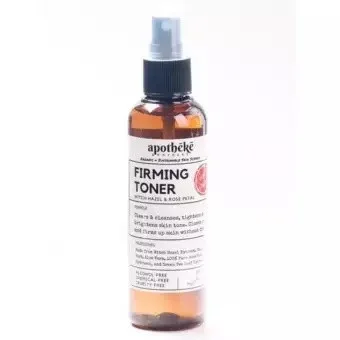
Analysis locked
How well does your skin match with Apothēkē Firming Toner for women?
Login to see detailsOr continue via
Quick 1-minute survey • Completely free
Ingredients
Analysis results of Ingredients


Ingredient List
| EWG | CIR | Ingredient Name & Cosmetic Function | Notes |
|---|---|---|---|
| 1 | - | | |
| - | - | *St. John’S Wort | |
| 1 3 | - | (Skin Conditioning) | |
| 1 | - | |
Apothēkē Firming Toner for women - Ingredient Explanation
Witch Hazel
1. Definition Hamamelis Virginiana (Witch Hazel):
Hamamelis Virginiana, commonly known as Witch Hazel, is a plant native to North America that has been used for centuries for its medicinal properties. Witch Hazel extract is derived from the leaves and bark of the plant and is known for its astringent, anti-inflammatory, and antioxidant properties.2. Use:
Witch Hazel is commonly used in cosmetics for its ability to tighten and tone the skin, reduce inflammation, and minimize the appearance of pores. It is often found in toners, cleansers, and moisturizers for its soothing and clarifying effects on the skin. Witch Hazel is also used in hair care products to help balance oil production and promote a healthy scalp.3. Usage Hamamelis Virginiana (Witch Hazel):
Witch Hazel can be applied topically to the skin using a cotton pad or as an ingredient in skincare products. It is generally safe for most skin types, but it is recommended to do a patch test before using it on the face or body to check for any allergic reactions. Witch Hazel should not be ingested and should be kept out of reach of children.4. References:
- Chevallier, Andrew. Encyclopedia of Herbal Medicine: The Definitive Home Reference Guide to 550 Key Herbs with all their Uses as Remedies for Common Ailments. DK Publishing, 2016.
- Duke, James A., and Mary Jo Bogenschutz-Godwin. Handbook of Medicinal Herbs, Second Edition. CRC Press, 2002.
- Reuter, J., et al. "Investigations on the anti-inflammatory activity of a herbal drug combination of stinging nettle herb, couch grass root and witch hazel leaves." Phytomedicine 10.8 (2003): 700-708.
*St. John’S Wort
Ingredient data is being updated. Please check back later.
Aloe Barbadensis (Aloe Vera) Extract
1. Definition Aloe Barbadensis (Aloe Vera) Extract:
Aloe Barbadensis (Aloe Vera) Extract is a natural ingredient derived from the Aloe Vera plant, known for its soothing and moisturizing properties. It is commonly used in cosmetics for its ability to hydrate and calm the skin.2. Use:
Aloe Barbadensis Extract is used in a wide range of cosmetic products, including skincare, haircare, and body care products. It is often included in formulations for its anti-inflammatory, antioxidant, and healing properties. Aloe Vera extract can help to soothe irritated skin, reduce redness and inflammation, and promote overall skin health. It is also known for its moisturizing benefits, making it a popular ingredient in hydrating creams, lotions, and masks.3. Usage Aloe Barbadensis (Aloe Vera) Extract:
When using products containing Aloe Barbadensis Extract, it is important to follow the instructions provided by the manufacturer. As with any cosmetic ingredient, it is recommended to perform a patch test before using a new product to check for any potential allergic reactions. Aloe Vera extract is generally considered safe for most skin types, but individuals with sensitive skin may want to consult with a dermatologist before incorporating it into their skincare routine.4. References:
- Surjushe, Amar, et al. "Aloe Vera: A Short Review." Indian Journal of Dermatology 53.4 (2008): 163-166.
- Radha, Maharjan, et al. "Aloe Vera: A Review of Its Clinical Effectiveness." Dermatology Practical & Conceptual 10.4 (2020): e2020093.
- Foster, Mary, et al. "Aloe Vera: A Systematic Review of Its Clinical Effectiveness." British Journal of Dermatology 179.2 (2018): 387-395.
Rose Petal
1. Definition Rose Petals:
Rose petals are the fragrant, colorful leaves of the rose flower that are commonly used in cosmetics for their soothing and nourishing properties.2. Use:
Rose petals are often used in cosmetics for their natural fragrance and skin benefits. They are rich in antioxidants, vitamins, and minerals that help to hydrate, soothe, and rejuvenate the skin. Rose petals are commonly found in skincare products such as facial toners, serums, masks, and bath products.3. Usage Rose Petals:
Rose petals can be used in various ways in cosmetics. They can be infused into oils, distilled into rose water, or ground into a fine powder to be added to skincare formulations. Rose petals can also be used as a natural exfoliant in scrubs or bath soaks. It is important to note that some individuals may be allergic to roses, so it is recommended to perform a patch test before using products containing rose petals.4. References:
- Gülçin, İ., & Topal, F. (2018). Rose petals and rose hips have potential health benefits. Current Pharmaceutical Biotechnology, 19(1), 13-20.
- Nanda, S., & Dey, A. (2016). A review on rose petals. International Journal of Pharmaceutical Sciences and Research, 7(5), 1769-1773.
- Chaudhuri, R. K., & Marchio, F. (2016). Cosmeceuticals and active cosmetics. CRC Press.
Review

Didn't find
the information you need?




Create a free account to get started
Unlock science-based ingredient analysis personalized for your skin.
Already have an account? Log in
We protect your privacy. We never send spam.