


Analysis locked
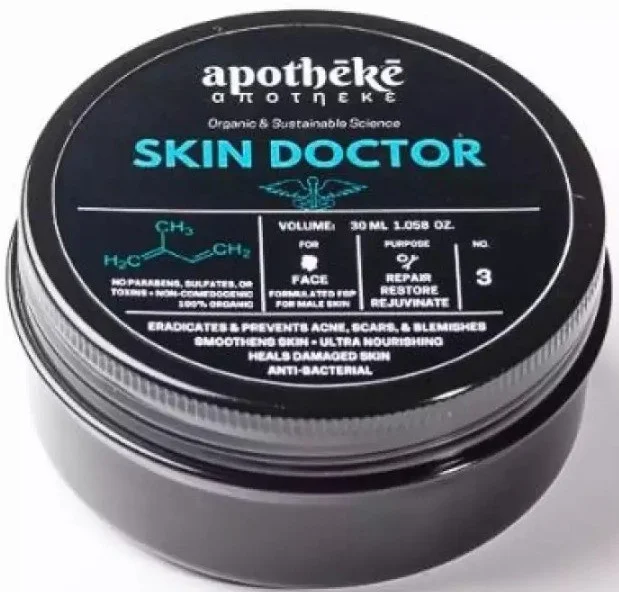
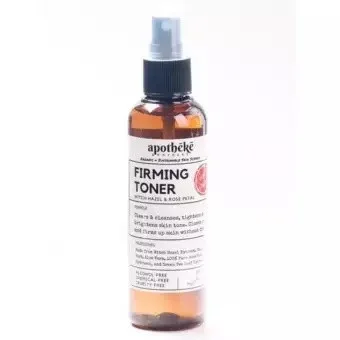
How well does your skin match with Apothēkē Skin Doctor for Men?
Login to see detailsOr continue via
Quick 1-minute survey • Completely free
Ingredients
Analysis results of Ingredients


Ingredient List
| EWG | CIR | Ingredient Name & Cosmetic Function | Notes |
|---|---|---|---|
| 1 | - | (Skin Conditioning) | |
| 1 | - | | |
| - | - | Cymbopogon Flexuosus | |
| 1 | - | (Skin Conditioning) |  |


Apothēkē Skin Doctor for Men - Ingredient Explanation
Santalum Album (Sandalwood)
1. Definition Santalum Album (Sandalwood):
Santalum Album, commonly known as Sandalwood, is a fragrant tropical tree native to South Asia, particularly India, that is highly valued for its aromatic wood and essential oil.2. Use:
Sandalwood has been used for centuries in cosmetics and skincare products due to its soothing and anti-inflammatory properties. It is often used in perfumes, lotions, soaps, and face masks to help calm irritated skin, reduce redness, and promote a sense of relaxation.3. Usage Santalum Album (Sandalwood):
When using Sandalwood in cosmetics, it is important to dilute the essential oil properly as it can be potent and may cause skin irritation in some individuals. It is recommended to perform a patch test before applying products containing Sandalwood to the skin, especially for those with sensitive skin. Additionally, pregnant women should consult with a healthcare provider before using products with Sandalwood as it may have potential effects on hormone levels.4. References:
- Singh, B., & Singh, V. (2016). Essential oil composition and antioxidant activity of Indian sandalwood (Santalum album) leaves. Journal of Essential Oil Research, 28(1), 23-30.
- Prashar, A., & Locke, I. C. (2004). Sandalwood: Basic biology, tissue culture, and genetic transformation. Planta Medica, 70(12), 1123-1132.
- Kulkarni, R. R., & Rao, L. J. M. (2013). Chemical composition and antioxidant activity of essential oil of Indian sandalwood (Santalum album) heartwood. Journal of Agricultural and Food Chemistry, 61(4), 921-927.
Pogostemon Cablin (Patchouli)
1. Definition Pogostemon Cablin (Patchouli):
Pogostemon Cablin, commonly known as Patchouli, is a perennial herb native to tropical regions of Asia. The plant produces small pinkish-white flowers and is known for its strong, musky, and earthy scent.2. Use:
Patchouli essential oil is widely used in cosmetics for its fragrant properties. It is commonly found in perfumes, soaps, lotions, and other skincare products. Patchouli is also known for its skin-healing properties and is often used to help treat acne, eczema, and other skin conditions.3. Usage Pogostemon Cablin (Patchouli):
When using Patchouli essential oil in cosmetics, it is important to dilute it properly as it can be irritating to the skin in its concentrated form. It is recommended to do a patch test before using products containing Patchouli to ensure there are no adverse reactions. Patchouli essential oil should be stored in a cool, dark place to maintain its potency.4. References:
- Tisserand, R., & Young, R. (2013). Essential Oil Safety: A Guide for Health Care Professionals (2nd ed.). Churchill Livingstone.
- Lawless, J. (2013). The Encyclopedia of Essential Oils: The Complete Guide to the Use of Aromatic Oils in Aromatherapy, Herbalism, Health, and Well Being. Conari Press.
- Worwood, V. A. (2016). The Complete Book of Essential Oils and Aromatherapy: Over 800 Natural, Nontoxic, and Fragrant Recipes to Create Health, Beauty, and Safe Home and Work Environments. New World Library.
Cymbopogon Flexuosus
Ingredient data is being updated. Please check back later.
Melaleuca Alternifolia (Tea Tree)
1. Definition Melaleuca Alternifolia (Tea Tree):
Melaleuca Alternifolia, commonly known as Tea Tree, is a small tree native to Australia. The essential oil extracted from its leaves is well-known for its antiseptic, antimicrobial, and anti-inflammatory properties.2. Use:
Tea Tree oil is widely used in cosmetics for its ability to treat various skin conditions such as acne, eczema, and psoriasis. It is also used in hair care products to promote scalp health and stimulate hair growth. Additionally, Tea Tree oil is added to skincare products for its purifying and cleansing properties.3. Usage Melaleuca Alternifolia (Tea Tree):
When using Tea Tree oil in cosmetics, it is important to dilute it with a carrier oil as it can be irritating to the skin when used in its concentrated form. It is recommended to perform a patch test before applying it to a larger area of the skin to check for any allergic reactions. Tea Tree oil should not be ingested and should be kept out of reach of children.4. References:
- Carson, C. F., Hammer, K. A., & Riley, T. V. (2006). Melaleuca alternifolia (Tea Tree) oil: a review of antimicrobial and other medicinal properties. Clinical Microbiology Reviews, 19(1), 50-62.
- Pazyar, N., Yaghoobi, R., Bagherani, N., & Kazerouni, A. (2013). A review of applications of tea tree oil in dermatology. International Journal of Dermatology, 52(7), 784-790.
- Hammer, K. A. (2015). Treatment of acne with tea tree oil (melaleuca) products: a review of efficacy, tolerability and potential modes of action. International Journal of Antimicrobial Agents, 45(2), 106-110.
Review








Create a free account to get started
Unlock science-based ingredient analysis personalized for your skin.
Already have an account? Log in
We protect your privacy. We never send spam.