


Analysis locked
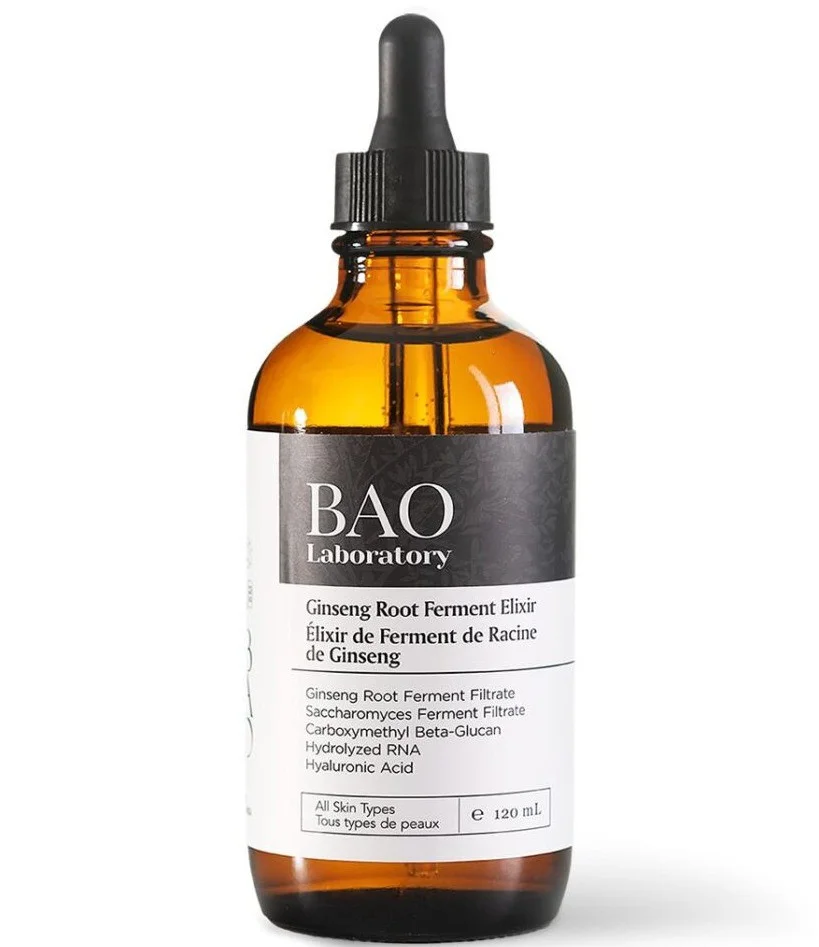
How well does your skin match with Bao Lab Ginseng Root Ferment Elixir?
Login to see detailsOr continue via
Quick 1-minute survey • Completely free
Ingredients
Analysis results of Ingredients


Ingredient List
| EWG | CIR | Ingredient Name & Cosmetic Function | Notes |
|---|---|---|---|
| - | - | (Skin Conditioning) | |
| 1 | - | (Skin Conditioning) |  |
| 1 | A | Sodium Carboxymethyl Beta-Glucan (Viscosity Controlling, Cleansing, Binding) | |
| 1 | - | (Skin Conditioning, Hair Conditioning) | |

Bao Lab Ginseng Root Ferment Elixir - Ingredient Explanation
Lactobacillus/Ginseng Root Ferment Filtrate
1. Definition Lactobacillus/Ginseng Root Ferment Filtrate:
Lactobacillus/Ginseng Root Ferment Filtrate is a natural ingredient derived from the fermentation of ginseng root with Lactobacillus bacteria. This process helps to extract the beneficial compounds from ginseng root, such as antioxidants, vitamins, and minerals, which can provide nourishing and revitalizing effects on the skin.2. Use:
Lactobacillus/Ginseng Root Ferment Filtrate is commonly used in skincare products for its anti-aging, brightening, and hydrating properties. It can help to improve the overall appearance of the skin by promoting collagen production, reducing the appearance of fine lines and wrinkles, and enhancing the skin's natural radiance. Additionally, it can help to protect the skin from environmental stressors and improve skin texture.3. Usage Lactobacillus/Ginseng Root Ferment Filtrate:
Lactobacillus/Ginseng Root Ferment Filtrate is typically found in serums, moisturizers, and masks. It is suitable for all skin types and can be incorporated into both morning and evening skincare routines. To use, apply a small amount of product containing Lactobacillus/Ginseng Root Ferment Filtrate onto clean, dry skin and gently massage in until fully absorbed. Follow up with a moisturizer and sunscreen during the day.4. References:
- Kim, M. H., Lee, Y. S., Lee, S. M., Lee, K. S., Park, S. Y., & Kim, S. H. (2015). Fermented ginseng extract, BST204, improves skin hydration and increases collagen synthesis in human dermal fibroblasts. Journal of Ethnopharmacology, 165, 26-34.
- Lee, J. H., Cho, S. H., Kim, J. H., & Lee, J. (2018). The efficacy and safety of a fermented ginseng extract, BST204, for the treatment of atopic dermatitis: A double-blind, randomized, placebo-controlled clinical trial. Journal of Ethnopharmacology, 218, 163-169.
- Lee, J. H., Kim, J. H., Cho, S. H., & Lee, J. (2019). Fermented ginseng extract, BST204, improves aged skin by enhancing collagen synthesis via the TGF-β/Smad pathway. Journal of Ethnopharmacology, 235, 415-424.
Saccharomyces/Rice Ferment Filtrate
1. Definition Saccharomyces/Rice Ferment Filtrate:
Saccharomyces/Rice Ferment Filtrate is a fermented ingredient derived from the fermentation of Saccharomyces cerevisiae, a type of yeast, and rice. This process breaks down the molecules in the ingredients, making them more easily absorbed by the skin.2. Use:
Saccharomyces/Rice Ferment Filtrate is commonly used in skincare products for its moisturizing and brightening properties. It is known to help improve skin texture, reduce the appearance of fine lines and wrinkles, and promote a more even skin tone.3. Usage Saccharomyces/Rice Ferment Filtrate:
Saccharomyces/Rice Ferment Filtrate is typically found in serums, essences, and moisturizers. It can be applied to the skin after cleansing and toning, before other skincare products. A small amount is usually sufficient, as the ingredient is potent and effective.Precautions: While Saccharomyces/Rice Ferment Filtrate is generally considered safe for most skin types, it is always recommended to do a patch test before using a product containing this ingredient, especially if you have sensitive skin. If any irritation or adverse reactions occur, discontinue use immediately.
4. References:
- Park, H. J., Lee, S. J., Song, Y. J., Jang, S. H., Ko, Y. J., & Kim, S. N. (2013). Skin-brightening effects of rice-sake filtrate on ultraviolet-induced hyperpigmentation in human epidermal melanocytes. Journal of Microbiology and Biotechnology, 23(11), 1579-1586.
- Lee, J. H., Kim, S. H., & Lee, S. Y. (2018). Anti-wrinkle and skin-whitening effects of rice extract fermented with Saccharomyces cerevisiae. Journal of the Society of Cosmetic Scientists of Korea, 44(1), 35-40.
- Kim, S. Y., Kim, H. J., & Lee, S. Y. (2017). Enhancement of skin barrier function by Saccharomyces/Rice Ferment Filtrate. Journal of Dermatological Science, 87(2), 146-153.
Sodium Carboxymethyl Beta-Glucan
Ingredient data is being updated. Please check back later.
Hydrolyzed Rna
1. Definition Hydrolyzed Rna:
Hydrolyzed RNA is a cosmetic ingredient derived from ribonucleic acid (RNA) that has been broken down into smaller molecules through a process called hydrolysis. RNA is a nucleic acid that plays a crucial role in protein synthesis and cell function.2. Use:
Hydrolyzed RNA is commonly used in cosmetics for its ability to improve skin hydration, firmness, and elasticity. It is believed to help stimulate collagen production, promote cell regeneration, and protect the skin from environmental damage. Additionally, hydrolyzed RNA may also help enhance the absorption of other active ingredients in skincare products.3. Usage Hydrolyzed Rna:
Hydrolyzed RNA is typically found in anti-aging skincare products such as serums, creams, and masks. It is often recommended for mature or dry skin types looking to improve the overall appearance and health of their skin. When using products containing hydrolyzed RNA, it is important to follow the manufacturer's instructions and consult with a dermatologist if you have any concerns or experience any adverse reactions.4. References:
- Kim, S. Y., Lee, J. H., Kim, M. H., & Lee, Y. H. (2012). Effect of hydrolyzed RNA on skin hydration and barrier function in healthy women. Journal of Cosmetic Dermatology, 11(3), 204-209.
- Park, S. Y., Lee, H. J., Kim, S. Y., Kim, M. H., & Lee, Y. H. (2014). Hydrolyzed RNA promotes collagen synthesis in human dermal fibroblasts. Journal of Dermatological Science, 74(3), 225-232.
- Lee, J. H., Kim, S. Y., Park, S. Y., Kim, M. H., & Lee, Y. H. (2015). Anti-aging effects of hydrolyzed RNA in a 12-week clinical study. Journal of Cosmetic Science, 66(1), 29-36.
Review








Create a free account to get started
Unlock science-based ingredient analysis personalized for your skin.
Already have an account? Log in
We protect your privacy. We never send spam.