


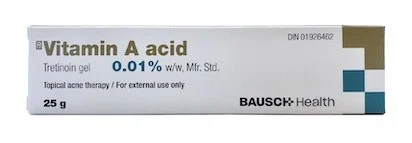
Analysis locked
How well does your skin match with Bausch Health Vitamin A Acid Gel (0.05%)?
Login to see detailsOr continue via
Quick 1-minute survey • Completely free
Ingredients
Analysis results of Ingredients


Ingredient List
| EWG | CIR | Ingredient Name & Cosmetic Function | Notes |
|---|---|---|---|
| - | - | (Antioxidant, Exfoliant) | |
| 2 | - | (Solvent, Masking, Antifoaming Agent, Viscosity Controlling, Antimicrobial, Astringent) |    |
| - | - | Carboxyvinyl Polymer | |
| 1 | A | (Viscosity Controlling, Viscosity Increasing Agent, Emulsion Stabilising, Gel Forming) | |

Bausch Health Vitamin A Acid Gel (0.05%) - Ingredient Explanation
Tretinoin (0.05%)
1. Definition Tretinoin:
Tretinoin is a derivative of vitamin A that is commonly used in skincare products for its anti-aging and acne-fighting properties. It works by increasing cell turnover and promoting collagen production, resulting in smoother, clearer, and more youthful-looking skin.
2. Use:
Tretinoin is primarily used in cosmetics to treat acne, reduce the appearance of fine lines and wrinkles, and improve overall skin texture and tone. It is often found in prescription-strength products, such as tretinoin creams or gels, that are applied topically to the skin.
3. Usage Tretinoin:
When using tretinoin in cosmetics, it is important to follow the instructions provided by a healthcare professional or dermatologist. It is typically applied once daily in the evening, after cleansing the skin. It is important to start with a lower concentration and gradually increase the frequency of use to minimize irritation and side effects, such as redness, peeling, and sensitivity to sunlight. It is also recommended to use sunscreen during the day to protect the skin from sun damage.
4. References:
- Mukherjee, S., Date, A., Patravale, V., Korting, H. C., Roeder, A., & Weindl, G. (2006). Retinoids in the treatment of skin aging: an overview of clinical efficacy and safety. Clinical interventions in aging, 1(4), 327–348. https://doi.org/10.2147/ciia.2006.1.4.327
- Fisher, G. J., Talwar, H. S., Lin, J., Lin, P., McPhillips, F., Wang, Z., Li, X., Datta, S., Kang, S., & Voorhees, J. J. (1996). Retinoic acid inhibits induction of c-Jun protein in ultraviolet-irradiated human skin in vivo. Journal of the American Academy of Dermatology, 35(6), 1018–1024. https://doi.org/10.1016/S0190-9622(96)90029-5
- Kang, S., Duell, E. A., Fisher, G. J., Datta, S. C., Wang, Z. Q., Reddy, A. P., Tavakkol, A., Yi, J. Y., Griffiths, C. E., & Elder, J. T. (1995). Application of retinol to human skin in vivo induces epidermal hyperplasia and cellular retinoid binding proteins characteristic of retinoic acid but without measurable retinoic acid levels or irritation. Journal of Investigative Dermatology, 105(4), 549–556. https://doi.org/10.1111/1523-1747.ep12323560
Alcohol (95%)
1. Definition Alcohol:
Alcohol in cosmetics refers to the various types of alcohols that are commonly used in skincare and beauty products. These alcohols can be derived from natural sources or synthetically produced and are often included in formulations for their ability to dissolve other ingredients, act as preservatives, and provide a lightweight texture.2. Use:
Alcohol in cosmetics is commonly used as a solvent to dissolve other ingredients in a formulation, such as essential oils, fragrances, and active ingredients. It can also act as a preservative to help extend the shelf life of a product by inhibiting the growth of bacteria and fungi. Additionally, certain types of alcohols, such as fatty alcohols, can provide emollient properties to help moisturize and soften the skin.3. Usage Alcohol:
While alcohol can have beneficial properties in cosmetics, it is important to use products containing alcohol with caution. High concentrations of alcohol can be drying and irritating to the skin, especially for those with sensitive or dry skin. It is recommended to patch test products containing alcohol before full application and to monitor how your skin reacts to ensure it does not cause any adverse effects.4. References:
- Draelos, Z. D. (2010). Cosmetic Formulation of Skin Care Products. CRC Press.
- Baumann, L. (2009). Cosmetic Dermatology: Principles and Practice. McGraw-Hill Professional.
- Loden, M., & Maibach, H. I. (2005). Dry Skin and Moisturizers: Chemistry and Function. CRC Press.
Carboxyvinyl Polymer
Ingredient data is being updated. Please check back later.
Carbopol 980
1. Definition Carbopol 980:
Carbopol 980 is a synthetic polymer used in cosmetics as a thickening agent and stabilizer. It is a cross-linked acrylic resin that forms a gel-like consistency when dispersed in water.2. Use:
Carbopol 980 is commonly used in cosmetic formulations such as creams, lotions, gels, and serums to improve the texture and viscosity of the product. It helps to create a smooth and stable emulsion, as well as enhance the spreadability and feel of the product on the skin.3. Usage Carbopol 980:
When using Carbopol 980 in cosmetic formulations, it is important to carefully disperse the polymer in water or another solvent to prevent clumping. It is also recommended to neutralize the Carbopol with a base such as triethanolamine to achieve the desired viscosity and pH level of the final product. Additionally, it is advisable to conduct compatibility tests with other ingredients to ensure the stability and efficacy of the formulation.4. References:
- "Carbomer." Personal Care Council, www.personalcarecouncil.org/cosmetic-ingredient/carbomer/.
- "Carbopol Polymers." Lubrizol Life Science - Beauty, www.lubrizol.com/Beauty/Products/Carbopol-Polymers.
- "Carbopol 980 Polymer." Ashland, www.ashland.com/products/carbopol-980-polymer.
Review









Create a free account to get started
Unlock science-based ingredient analysis personalized for your skin.
Already have an account? Log in
We protect your privacy. We never send spam.