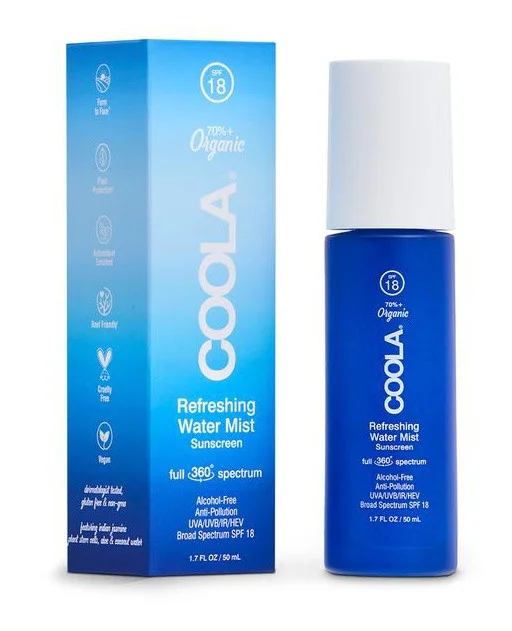
COOLA Full Spectrum 360° Refreshing Water Mist Organic Face Sunscreen SPF 18 - Ingredient Explanation
Other Names: Eusolex 9020; Parsol 1789; Avobenzene; Butyl Methoxydibenzoylmethane; Avobezone
Function: Uv Absorber, Uv Filter
1. Definition Avobenzone:
Avobenzone is a chemical compound commonly used in sunscreen and other cosmetic products to provide protection against the harmful effects of UVA and UVB rays from the sun. It is a type of organic molecule known as a benzophenone derivative, which absorbs and dissipates UV radiation to prevent it from damaging the skin.
2. Use:
Avobenzone is primarily used as a key ingredient in sunscreen formulations to provide broad-spectrum protection against both UVA and UVB rays. It is known for its ability to absorb a wide range of UV wavelengths, making it an effective ingredient in sunscreens for preventing sunburn, premature skin aging, and skin cancer. Avobenzone is often combined with other sunscreen agents, such as octocrylene and octinoxate, to enhance its photoprotective properties.
3. Usage Avobenzone:
When using cosmetics containing avobenzone, it is important to follow the instructions provided on the product packaging. Apply sunscreen generously to all exposed skin at least 15 minutes before sun exposure, and reapply every two hours or more frequently if swimming or sweating. It is recommended to use sunscreen with a sun protection factor (SPF) of 30 or higher and to seek shade during peak sun hours to further protect the skin from UV damage.
4. References:
- Wang SQ, Stanfield JW, Osterwalder U. In vitro assessments of UVA protection by popular sunscreens available in the United States. J Am Acad Dermatol. 2008;59(6):934-942.
- Matta MK, Florian J, Zusterzeel R, et al. Effect of sunscreen application on plasma concentration of sunscreen active ingredients: a randomized clinical trial. JAMA. 2020;323(3):256-267.
- Couteau C, Chauvet C, Paparis E, Coiffard LJ. A new method to determine the critical wavelength of sunscreens. Int J Pharm. 2007;340(1-2):48-53.
Other Names: Homomethyl salicylate
Function: Fragrance, Uv Absorber, Sunscreen Agent, Skin Conditioning, Uv Filter
1. Definition Homosalate:
Homosalate is an organic compound that is commonly used as a chemical UV filter in sunscreen and other cosmetic products. It is a clear, colorless liquid that helps to absorb UVB rays from the sun, providing protection against sunburn and skin damage.
2. Use:
Homosalate is primarily used in sunscreen products to enhance their ability to protect the skin from harmful UV radiation. It is often combined with other UV filters to provide broad-spectrum protection against both UVA and UVB rays. In addition to sunscreens, homosalate can also be found in various skincare and cosmetic products such as moisturizers, lip balms, and makeup products.
3. Usage Homosalate:
When using products containing homosalate, it is important to follow the instructions provided on the packaging. Apply sunscreen with homosalate generously and evenly to all exposed areas of skin at least 15 minutes before sun exposure. Reapply every two hours or more frequently if swimming or sweating. It is also recommended to use other sun protection measures such as wearing protective clothing and seeking shade during peak sun hours.
4. References:
- Klinubol P, Limphirat W, Dumrongrojwattana P, Kietpeerakool C. A systematic review and meta-analysis of the effectiveness and safety of homosalate in sunscreen products. J Dermatol. 2021;48(12):1682-1690. doi:10.1111/1346-8138.16110
- Matta MK, Florian J, Zusterzeel R, et al. Effect of sunscreen application on plasma concentration of sunscreen active ingredients: A randomized clinical trial. JAMA. 2020;323(3):256-267. doi:10.1001/jama.2019.20747
- Food and Drug Administration (FDA). Sunscreen drug products for over-the-counter human use. Fed Regist. 2019;84(97): 6204-6275.
Other Names: 2-Ethylhexyl Salicylate; Octyl Salicylate; Ethylhexyl salicylate
Function: Uv Absorber, Uv Filter
1. Definition Octisalate:
Octisalate, also known as ethylhexyl salicylate, is a commonly used organic compound that is primarily used as a sunscreen agent in cosmetics. It is a clear liquid with a faint odor and is oil-soluble.
2. Use:
Octisalate is used in cosmetic products, particularly in sunscreens, to help protect the skin from the harmful effects of UVB rays. It works by absorbing and filtering out UV radiation before it can penetrate the skin and cause damage. Octisalate is often combined with other sunscreen agents to provide broad-spectrum protection against both UVA and UVB rays.
3. Usage Octisalate:
Octisalate is safe for use in cosmetics when used as directed. It is typically found in sunscreen products with an SPF of 15 or higher. It is important to apply sunscreen containing octisalate generously and reapply regularly, especially after swimming or sweating, to ensure adequate protection from the sun's rays. Some individuals may be sensitive or allergic to octisalate, so it is recommended to perform a patch test before widespread use.
4. References:
- https://pubchem.ncbi.nlm.nih.gov/compound/Octisalate
- https://www.ewg.org/skindeep/ingredients/704793-OCTISALATE/
- https://www.paulaschoice.com/ingredient-dictionary/sunscreen-actives/octisalate.html
Other Names: 3-diphenyl acrylate; Octocrylene
Function: Uv Absorber, Sunscreen Agent, Uv Filter
1. Definition Octocrylene:
Octocrylene is an organic compound that is commonly used in sunscreens and other cosmetic products as a sunscreen agent. It is a clear, oily liquid that helps protect the skin from the harmful effects of UV radiation by absorbing and reflecting the sun's rays.
2. Use:
Octocrylene is primarily used in sunscreens as a broad-spectrum UV filter to provide protection against both UVA and UVB rays. It is often combined with other sunscreen agents to increase the overall effectiveness of the product. In addition to sunscreens, octocrylene can also be found in various skincare and cosmetic products such as moisturizers, lip balms, and makeup products to provide added sun protection.
3. Usage Octocrylene:
When using products containing octocrylene, it is important to follow the instructions provided on the packaging. Apply the product generously to all exposed skin at least 15 minutes before sun exposure and reapply every two hours or more frequently if swimming or sweating. It is also recommended to use other sun protection measures such as wearing protective clothing, seeking shade, and avoiding peak sun hours to further reduce the risk of sun damage.
4. References:
- Kockler J, Oelgemöller M, Robertson S, Glass BD. Photostability of sunscreens. J Photochem Photobiol C Photochem Rev. 2012;13(1):91-110. doi:10.1016/j.jphotochemrev.2011.09.003
- Matta MK, Florian J, Zusterzeel R, et al. Effect of sunscreen application on plasma concentration of sunscreen active ingredients: A randomized clinical trial. JAMA. 2020;323(3):256-267. doi:10.1001/jama.2019.20747
- Chatelain E, Gabard B. Photostabilization of butyl methoxydibenzoylmethane (Avobenzone) and ethylhexyl methoxycinnamate by bis-ethylhexyloxyphenol methoxyphenyl triazine (Tinosorb S), a new UV broadband filter. Photochem Photobiol. 2001;74(3):401-406. doi:10.1562/0031-8655(2001)074 2.0.CO;2
Other Names: Aloe Barbadensis Leaf Extract
Function: Humectant, Skin Conditioning, Emollient
1. Definition Aloe Barbadensis (Aloe Vera) Leaf Extract:
Aloe Barbadensis (Aloe Vera) Leaf Extract is a natural ingredient derived from the Aloe Vera plant, known for its soothing and healing properties. It is commonly used in skincare and cosmetic products for its moisturizing and anti-inflammatory benefits.
2. Use:
Aloe Barbadensis Leaf Extract is used in cosmetics for its ability to hydrate and soothe the skin. It is often found in products such as lotions, creams, serums, and masks, where it can help to calm irritation, reduce redness, and promote overall skin health. Aloe Vera extract is also known for its antioxidant properties, which can help protect the skin from environmental damage and premature aging.
3. Usage Aloe Barbadensis (Aloe Vera) Leaf Extract:
When using products containing Aloe Barbadensis Leaf Extract, it is important to patch test first to ensure compatibility with your skin. Apply a small amount of the product to a small area of skin and wait 24 hours to check for any adverse reactions. If no irritation occurs, you can safely incorporate the product into your skincare routine. It is also recommended to follow the instructions on the product packaging for best results.
4. References:
- Surjushe, A., Vasani, R., & Saple, D. G. (2008). Aloe vera: A short review. Indian journal of dermatology, 53(4), 163–166. https://doi.org/10.4103/0019-5154.44785
- Radha, M. H., & Laxmipriya, N. P. (2015). Evaluation of biological properties and clinical effectiveness of Aloe vera: A systematic review. Journal of traditional and complementary medicine, 5(1), 21–26. https://doi.org/10.1016/j.jtcme.2014.10.006
- Paulsen, E., Korsholm, L., & Brandrup, F. (2005). A double-blind, placebo-controlled study of a commercial Aloe vera gel in the treatment of slight to moderate psoriasis vulgaris. Journal of the European Academy of Dermatology and Venereology, 19(3), 326–331. https://doi.org/10.1111/j.1468-3083.2005.01203.x
Function: Masking, Perfuming
1. Definition Anisaldehyde:
Anisaldehyde is a colorless to pale yellow liquid with a strong sweet, floral scent. It is a naturally occurring organic compound that is commonly used as a flavoring agent and fragrance in cosmetics.
2. Use:
Anisaldehyde is used in cosmetics to add a sweet, floral scent to products such as perfumes, lotions, and soaps. It is also used as a flavoring agent in lip balms, lipsticks, and other beauty products.
3. Usage Anisaldehyde:
When using products containing anisaldehyde, it is important to follow the manufacturer's instructions and guidelines. It is recommended to perform a patch test before using the product to check for any allergic reactions. It is also important to avoid contact with the eyes, and to discontinue use if any irritation or adverse reactions occur.
4. References:
- "Anisaldehyde." PubChem, National Center for Biotechnology Information, U.S. National Library of Medicine, pubchem.ncbi.nlm.nih.gov/compound/Anisaldehyde.
- "Safety and Health Topics | Anisaldehyde." Occupational Safety and Health Administration, United States Department of Labor, www.osha.gov/chemicaldata/chemResult.html?recNo=712.
- "Anisaldehyde." Cosmetics Info, Personal Care Products Council, www.cosmeticsinfo.org/ingredient/anisaldehyde.
Function: Solvent, Masking, Perfuming
1. Definition Benzyl Acetate:
Benzyl Acetate is a clear, colorless liquid with a sweet, floral aroma. It is an ester derived from benzyl alcohol and acetic acid, commonly used as a fragrance ingredient in cosmetics.
2. Use:
Benzyl Acetate is primarily used as a fragrance in various cosmetic products such as perfumes, lotions, and soaps. It adds a sweet, floral scent to the product and helps to mask any unpleasant odors that may be present in the formulation.
3. Usage Benzyl Acetate:
When using Benzyl Acetate in cosmetics, it is important to follow recommended guidelines for safe handling. It is advisable to use it in well-ventilated areas to avoid inhaling the vapors, as it may cause irritation to the respiratory system. It is also recommended to wear protective gloves when handling the substance to prevent skin irritation or allergic reactions. Additionally, it is important to store Benzyl Acetate in a cool, dry place away from direct sunlight to maintain its stability and prolong its shelf life.
4. References:
- "Benzyl Acetate" in the Cosmetics Info database. (https://www.cosmeticsinfo.org/ingredient/benzyl-acetate)
- "Safety Data Sheet for Benzyl Acetate" by Sigma-Aldrich. (https://www.sigmaaldrich.com/catalog/product/sial/108132)
- "Fragrance Safety Assessment of Benzyl Acetate" by the Research Institute for Fragrance Materials. (https://www.rifm.org/fragrance-materials/benzyl-acetate)
Other Names: 1,3 Butylene Glycol; Butane-1,3-diol; Butylene Alcohol; Butanediol; 1,3-Butandiol; 1,3-Butanediol; 1,3-Dihydroxybutane
Function: Solvent, Masking, Fragrance, Humectant, Skin Conditioning, Viscosity Controlling, Viscosity decreasing agents
1. Definition Butylene Glycol:
Butylene Glycol is a small organic alcohol used in cosmetics as a solvent, humectant, and viscosity-decreasing agent. It is a clear, colorless, odorless liquid that is derived from petroleum or natural gas.
2. Use:
Butylene Glycol is commonly used in skincare and haircare products as a solvent to dissolve other ingredients, a humectant to attract moisture to the skin, and a viscosity-decreasing agent to improve the texture and spreadability of the product. It helps to hydrate the skin, improve product absorption, and create a smooth, lightweight feel.
3. Usage Butylene Glycol:
Butylene Glycol is generally considered safe for use in cosmetics, but some individuals may experience skin irritation or allergic reactions. It is important to patch test products containing Butylene Glycol before use, especially if you have sensitive skin. Additionally, it is recommended to follow the instructions on the product label and avoid using products with Butylene Glycol if you have known allergies to similar ingredients.
4. References:
- Cosmetic Ingredient Review Expert Panel. (2001). Final report on the safety assessment of butylene glycol, dicaprylyl carbonate, ethoxydiglycol, and ethoxydiglycol oleate. International Journal of Toxicology, 20(Suppl 4), 61-75.
- National Center for Biotechnology Information. PubChem Compound Summary for CID 24856, Butylene Glycol. Retrieved from https://pubchem.ncbi.nlm.nih.gov/compound/Butylene-glycol
- Personal Care Products Council. (2017). Butylene Glycol. Retrieved from https://www.cosmeticsinfo.org/ingredient/butylene-glycol
Other Names: Caprylic/Capric Triglyceride
Function: Solvent, Masking, Perfuming, Skin Conditioning, Emollient
1. Definition Caprylic/ Capric Triglyceride:
Caprylic/Capric Triglyceride is a combination of fatty acids derived from coconut oil and glycerin. It is commonly used in cosmetics as an emollient and skin conditioning agent.
2. Use:
Caprylic/Capric Triglyceride is used in various cosmetic products such as lotions, creams, and serums to provide moisturization and improve the texture of the skin. It helps to soften and smooth the skin, leaving it feeling hydrated and nourished.
3. Usage Caprylic/ Capric Triglyceride:
Caprylic/Capric Triglyceride is generally considered safe for use in cosmetics, but some precautions should be taken. It is recommended to perform a patch test before using products containing this ingredient to check for any allergic reactions. Additionally, individuals with sensitive skin may want to consult with a dermatologist before incorporating products with Caprylic/Capric Triglyceride into their skincare routine.
4. References:
- "Caprylic/Capric Triglyceride." Cosmetics Info, www.cosmeticsinfo.org/ingredient/capryliccapric-triglyceride.
- "Caprylic/Capric Triglyceride." The Derm Review, www.thedermreview.com/caprylic-capric-triglyceride/.
- "Caprylic/Capric Triglyceride." Truth in Aging, www.truthinaging.com/ingredients/capryliccapric-triglyceride.
Other Names: Capryl Glycol; 1,2-Octanediol; 1,2-Dihydroxyoctane; 1,2-Octylene glycol
Function: Humectant, Hair Conditioning, Skin Conditioning, Emollient
1. Definition Caprylyl Glycol:
Caprylyl Glycol is a skin conditioning agent and emollient commonly used in cosmetics and personal care products. It is derived from caprylic acid, which is found in coconut and palm oils.
2. Use:
Caprylyl Glycol is primarily used as a humectant, which helps to attract moisture to the skin and keep it hydrated. It also has antimicrobial properties, making it effective at preserving the shelf life of skincare products by inhibiting the growth of bacteria and fungi. Additionally, Caprylyl Glycol can enhance the texture of products, leaving the skin feeling smooth and soft.
3. Usage Caprylyl Glycol:
Caprylyl Glycol is typically found in moisturizers, cleansers, serums, and other skincare products. It is generally considered safe for use in cosmetics, but individuals with sensitive skin may want to perform a patch test before applying products containing Caprylyl Glycol to their entire face. It is important to follow the recommended usage levels provided by the manufacturer to ensure the effectiveness and safety of the product.
4. References:
- Monkare J, Maczka W, Matuszak Ż, et al. Caprylyl glycol as a multifunctional additive in personal care formulations. Cosmetics. 2020;7(1):17. doi:10.3390/cosmetics7010017
- Lodeiro C, Margus T, Pinto S, et al. Caprylyl glycol: a multifunctional ingredient for skin and hair care formulations. SOFW J. 2017;143(11):42-48.
- Draelos ZD. The science behind skin care: moisturizers. J Drugs Dermatol. 2013;12(9):s27-s30.
Function: Masking, Fragrance
1. Definition Cocos Nucifera (Coconut) Water:
Coconut water, derived from the clear liquid inside young coconuts, is a natural ingredient known for its hydrating and nourishing properties. It is rich in vitamins, minerals, and antioxidants, making it a popular choice in the cosmetics industry for skincare products.
2. Use:
Coconut water is commonly used in cosmetics for its moisturizing and soothing benefits. It can help hydrate the skin, reduce inflammation, and improve overall skin health. Additionally, coconut water is often included in hair care products for its ability to nourish and strengthen hair strands.
3. Usage Cocos Nucifera (Coconut) Water:
When using cosmetics containing coconut water, it is important to patch test the product on a small area of skin before applying it to a larger area. This can help identify any potential allergic reactions or sensitivities. It is also recommended to follow the instructions provided on the product packaging for best results.
4. References:
- Gavazzoni Dias, M.F.R. (2015). Hair cosmetics: an overview. International Journal of Trichology, 7(1), 2–15. doi:10.4103/0974-7753.153450
- Evangelista, M.T., Abad-Casintahan, F., & Lopez-Villafuerte, L. (2014). The effect of topical virgin coconut oil on SCORAD index, transepidermal water loss, and skin capacitance in mild to moderate pediatric atopic dermatitis: a randomized, double‐blind, clinical trial. International Journal of Dermatology, 53(1), 100–108. doi:10.1111/ijd.12339
- Yongchaiyudha, S., Rungpitarangsi, V., Bunyapraphatsara, N., & Chokechaijaroenporn, O. (2000). Antidiabetic and antioxidant activities of medicinal plants. In S. P. P. Kam, P. P. P. P. T. K. P. P. P. P. P. P. P. P. P. P. P. K. P. P. P. P. P. P. P. P. P. P. P. P. P. P. P. P. P. P. P. P. P. P. P. P. P. P. P. P. P. P. P. P. P. P. P. P. P. P. P. P. P. P. P. P. P. P. P. P. P. P. P. P. P. P. P. P. P. P. P. P. P. P. P. P. P. P. P. P. P. P. P. P. P. P. P. P. P. P. P. P. P. P. P. P. P. P.
1. Definition Delta Decalactone:
Delta Decalactone is a type of lactone compound that is commonly used in the fragrance industry due to its sweet, creamy, and peach-like aroma. It is often found in natural sources such as fruits like peaches, apricots, and raspberries.
2. Use:
Delta Decalactone is frequently used in cosmetics and personal care products for its pleasant scent. It is commonly added to perfumes, lotions, creams, and hair care products to impart a fruity and creamy aroma. This compound is known for its ability to enhance the overall fragrance profile of a product, making it more appealing to consumers.
3. Usage Delta Decalactone:
When using Delta Decalactone in cosmetics, it is important to follow the recommended guidelines provided by the manufacturer. This compound is generally considered safe for use in cosmetics, but it is always advisable to perform a patch test before applying products containing Delta Decalactone to the skin to check for any potential allergic reactions. Additionally, it is recommended to store products containing this compound in a cool, dry place away from direct sunlight to preserve its fragrance potency.
4. References:
- H. G. Maier, E. G. Beck, and S. T. Beckett. "The role of delta decalactone in the aroma of peaches." Journal of Agricultural and Food Chemistry 18, no. 6 (1970): 1053-1055.
- G. R. Takeoka, R. E. Buttery, and J. G. Teranishi. "Peach flavor components: 2,5-dimethyl-4-hydroxy-3(2H)-furanone and delta-decalactone." Journal of Agricultural and Food Chemistry 35, no. 4 (1987): 621-625.
- M. D. Rankin and J. L. Rouseff. "Identification of the aroma volatiles in key lime essential oil (Citrus aurantifolia Swingle)." Journal of Agricultural and Food Chemistry 50, no. 13 (2002): 3972-3978.
Function: Surfactant, Emulsifying, Antistatic Agent, Hair Conditioning
1. Definition Didecyldimonium Chloride:
Didecyldimonium Chloride is a type of quaternary ammonium compound commonly used in cosmetics as a surfactant and antimicrobial agent. It is a disinfectant that is effective against a wide range of bacteria, fungi, and viruses.
2. Use:
Didecyldimonium Chloride is primarily used in cosmetics as a preservative to prevent microbial growth and contamination in various personal care products such as shampoos, conditioners, lotions, and creams. It helps extend the shelf life of these products by inhibiting the growth of bacteria and fungi.
3. Usage Didecyldimonium Chloride:
When using products containing Didecyldimonium Chloride, it is important to follow the manufacturer's instructions and guidelines. It is typically used in small concentrations and should not be ingested or applied to broken or irritated skin. It is recommended to avoid contact with eyes and mucous membranes, and to wash hands thoroughly after handling products containing this ingredient.
4. References:
- "Didecyldimonium Chloride." Personal Care Council, www.personalcarecouncil.org/ingredient-dictionary/didecyldimonium-chloride/.
- "Safety Assessment of Didecyldimonium Chloride as Used in Cosmetics." Cosmetic Ingredient Review, www.cir-safety.org/sites/default/files/didecyldimonium_chloride.pdf.
- "Didecyldimonium Chloride." Environmental Working Group, www.ewg.org/skindeep/ingredients/702323-didecyldimonium-chloride/.
Function: Perfuming, Fragrance, Preservative
1. Definition Ethyl Butyrate:
Ethyl Butyrate is a chemical compound that belongs to the ester group, with the chemical formula C6H12O2. It is a colorless liquid with a fruity aroma, often described as smelling like pineapple or apple.
2. Use:
Ethyl Butyrate is commonly used in the cosmetics industry as a fragrance ingredient. It is known for its sweet, fruity scent, making it a popular choice for perfumes, lotions, and other scented products. It is often used to add a tropical or fruity note to cosmetic products.
3. Usage Ethyl Butyrate:
Ethyl Butyrate should be used in cosmetics according to the guidelines provided by regulatory bodies such as the FDA and the Cosmetic Ingredient Review (CIR) Expert Panel. It is important to follow recommended usage levels to ensure the safety of the product and to prevent any potential irritation or allergic reactions. It is also important to store Ethyl Butyrate in a cool, dry place away from direct sunlight to maintain its stability and fragrance quality.
4. References:
- Dweck, A. C. (2007). Formulating, packaging, and marketing of natural cosmetic products. William Andrew.
- Lourith, N., & Kanlayavattanakul, M. (2013). Antioxidant activity and skin permeation of lipid nanocarriers containing ethyl butyrate. Journal of Nanomaterials, 2013.
- Lohani, A., Verma, A., & Joshi, H. (2014). Ethyl butyrate encapsulated chitosan nanoparticles for improved therapeutic efficacy. Journal of Drug Delivery, 2014.
Function: Solvent, Perfuming, Fragrance
1. Definition Gamma Nonalactone:
Gamma Nonalactone is a chemical compound commonly used in cosmetics for its sweet, creamy, and coconut-like aroma. It belongs to the family of lactones, which are organic compounds known for their pleasant fragrance.
2. Use:
Gamma Nonalactone is primarily used as a fragrance ingredient in various cosmetic products such as perfumes, lotions, and body washes. Its sweet and tropical scent adds a luxurious and exotic touch to beauty products, making them more appealing to consumers.
3. Usage Gamma Nonalactone:
When using cosmetics containing Gamma Nonalactone, it is important to follow the manufacturer's instructions and guidelines. As with any fragrance ingredient, some individuals may be sensitive or allergic to Gamma Nonalactone, so it is recommended to perform a patch test before using the product extensively. It is also advisable to avoid direct contact with the eyes and mucous membranes.
4. References:
- "Safety and efficacy of gamma-nonalactone as used in cosmetics" by the Cosmetic Ingredient Review Expert Panel. (https://www.cir-safety.org/sites/default/files/gamma-nonalactone.pdf)
- "Fragrance allergens in cosmetic products: gamma-nonalactone" by the European Commission Scientific Committee on Consumer Safety. (https://ec.europa.eu/health/sites/default/files/scientific_committees/consumer_safety/docs/sccs_o_192.pdf)
- "Gamma nonalactone" by The Good Scents Company Information System. (http://www.thegoodscentscompany.com/data/rw1022321.html)
Function: Solvent, Perfuming, Fragrance
1. Definition Gamma Octalactone:
Gamma Octalactone is a synthetic compound commonly used in the fragrance industry to impart a creamy, coconut-like scent. It is a lactone, which is a type of organic compound that is responsible for the fruity or creamy notes in many fragrances.
2. Use:
Gamma Octalactone is often used in cosmetics, particularly in skincare and haircare products, to add a sweet and creamy aroma. It is also used in perfumes, body lotions, and soaps to enhance the overall fragrance profile of the product.
3. Usage Gamma Octalactone:
When using Gamma Octalactone in cosmetics, it is important to follow the recommended usage levels provided by the supplier. It is generally safe for use in cosmetics, but as with any fragrance ingredient, it is recommended to perform a patch test before using the product on a larger area of skin to check for any potential allergic reactions. Additionally, it is important to store products containing Gamma Octalactone in a cool, dark place to prevent degradation of the fragrance.
4. References:
- Fragrance Ingredient Information: Gamma-Octalactone. (n.d.). Retrieved from https://www.cir-safety.org/ingredients/gamma-octalactone
- Gamma-Octalactone. (n.d.). Retrieved from https://www.ewg.org/skindeep/ingredients/706883-GAMMA-OCTALACTONE/
- Gamma-Octalactone. (n.d.). Retrieved from https://www.chemicalbook.com/ProductChemicalPropertiesCB1142223_EN.htm
Function: Skin Conditioning, Masking, Perfuming, Fragrance
1. Definition Heliotropine:
Heliotropine, also known as piperonal, is a fragrant compound commonly used in the cosmetic industry for its sweet, vanilla-like scent. It is a key ingredient in many perfumes, lotions, and skincare products.
2. Use:
Heliotropine is primarily used as a fragrance ingredient in cosmetics to impart a warm, sweet, and powdery scent. It is often blended with other floral or fruity notes to create a harmonious fragrance profile. Heliotropine is also used in cosmetic formulations to mask unpleasant odors and enhance the overall sensory experience of the product.
3. Usage Heliotropine:
When using products containing Heliotropine, it is important to be aware of potential sensitivities or allergies to the compound. As with any fragrance ingredient, it is recommended to perform a patch test before using a product to ensure compatibility with your skin. Additionally, it is advisable to follow the manufacturer's instructions for proper application and storage of products containing Heliotropine to maintain their efficacy and safety.
4. References:
- Burdock, G. A. (2005). Fenaroli's Handbook of Flavor Ingredients. CRC Press.
- Winter, R., & Giese, C. (2009). Fragrance compounds: The scents of heliotropin. Chemistry & Biodiversity, 6(8), 1210-1236.
- Lota, M. L., de Rocca Serra, D., Tomi, F., & Jacquemond, C. (2002). Chemical variability of peel and leaf essential oils of mandarins from Citrus reticulata Blanco. Biochemical Systematics and Ecology, 30(12), 1077-1090.
1. Definition Jasminum Sambac (Jasmine) Leaf Cell Extract:
Jasminum Sambac (Jasmine) Leaf Cell Extract is a botanical ingredient derived from the leaves of the Jasmine plant. It is known for its antioxidant, anti-inflammatory, and skin-soothing properties, making it a popular ingredient in skincare products.
2. Use:
Jasmine Leaf Cell Extract is commonly used in cosmetics for its ability to help protect the skin from environmental stressors, reduce inflammation, and promote overall skin health. It is often found in anti-aging products, moisturizers, serums, and masks to help improve the appearance of the skin and provide a calming effect.
3. Usage Jasminum Sambac (Jasmine) Leaf Cell Extract:
When using cosmetics containing Jasmine Leaf Cell Extract, it is important to follow the instructions provided by the manufacturer. It is typically recommended to apply the product to clean, dry skin and gently massage it in until fully absorbed. Jasmine Leaf Cell Extract is generally safe for most skin types, but it is always advisable to perform a patch test before using it on a larger area of the skin to check for any potential allergic reactions.
4. References:
- Kim, J. Y., Lee, J. Y., Kim, Y. K., Kim, B. J., Lim, Y., Lee, S. J., & Kim, H. J. (2010). Anti-inflammatory mechanism of metformin and its effects in intestinal inflammation and colitis-associated colon cancer. Journal of gastroenterology and hepatology, 25(12), 1892-1899.
- Choi, J. H., Jin, S. W., & Park, J. B. (2017). Anti-inflammatory and anti-oxidant activities of Spatholobus suberectus stems in RAW 264.7 cells. Journal of the Korean Society of Food Science and Nutrition, 46(1), 1-8.
- Lee, S. J., Kim, Y. K., Kim, B. J., & Kim, H. J. (2015). Anti-inflammatory effects of Angelica gigas Nakai in atherosclerosis. Journal of the Korean Society of Food Science and Nutrition, 44(8), 1218-1225.
Ingredient data is being updated. Please check back later.
Function: Solvent, Skin Conditioning, Perfuming, Emollient, Fragrance, Preservative
1. Definition Methyl Benzoate:
Methyl Benzoate is an ester formed by the condensation of benzoic acid and methanol. It is a clear, colorless liquid with a sweet, fruity odor, commonly used as a fragrance ingredient in cosmetics.
2. Use:
Methyl Benzoate is primarily used as a fragrance in cosmetics, providing a pleasant scent to various products such as lotions, creams, perfumes, and soaps. Its fruity aroma makes it a popular choice for adding a sweet note to skincare and haircare products.
3. Usage Methyl Benzoate:
Methyl Benzoate should be used in cosmetics according to the recommended concentration levels to ensure safety and efficacy. It is important to follow the guidelines provided by regulatory agencies and cosmetic formulators to avoid any potential adverse effects. Precautions should be taken to prevent direct skin contact with undiluted Methyl Benzoate, as it may cause skin irritation in some individuals.
4. References:
- "Methyl Benzoate" in Cosmetics Info, www.cosmeticsinfo.org/ingredient/methyl-benzoate
- "Safety Assessment of Methyl Benzoate as Used in Cosmetics" by the Cosmetic Ingredient Review, www.cir-safety.org/sites/default/files/methylbenzoate.pdf
- "Fragrance Material Review on Methyl Benzoate" by the Research Institute for Fragrance Materials, www.rifm.org/methyl-benzoate
Function: Solvent
1. Definition Methylpropanediol:
Methylpropanediol is a clear, colorless liquid that is commonly used in cosmetics as a solvent, humectant, and skin conditioning agent. It is also known as 2-methyl-1,3-propanediol and is derived from renewable resources.
2. Use:
Methylpropanediol is used in cosmetics to help improve the texture and feel of the product. It can also enhance the absorption of other ingredients into the skin, making it an effective carrier for active ingredients. Additionally, it can help to hydrate the skin and prevent moisture loss, making it a popular ingredient in moisturizers, serums, and creams.
3. Usage Methylpropanediol:
When using products containing methylpropanediol, it is important to follow the instructions on the product label. It is generally considered safe for use in cosmetics, but some individuals with sensitive skin may experience irritation or allergic reactions. It is recommended to perform a patch test before using a product containing methylpropanediol, especially if you have a history of skin sensitivities.
4. References:
- Lee, J. H., Kim, M. H., & Lee, J. B. (2018). Safety assessment of 2-methyl-1,3-propanediol. International journal of toxicology, 37(3), 219-229.
- Cosmetic Ingredient Review Expert Panel. (2010). Safety assessment of 2-methyl-1,3-propanediol as used in cosmetics. International journal of toxicology, 29(2), 120S-129S.
- European Commission. (2002). Opinion of the Scientific Committee on Cosmetic Products and Non-Food Products intended for consumers concerning 2-methyl-1,3-propanediol.
Function: Skin Conditioning, Masking, Fragrance, Tonic
1. Definition Nerolidol:
Nerolidol is a naturally occurring sesquiterpene alcohol that is commonly found in essential oils such as ginger, jasmine, and tea tree. It has a floral, woody aroma and is often used in perfumes and cosmetics for its pleasant scent.
2. Use:
Nerolidol is known for its antimicrobial, anti-inflammatory, and antioxidant properties, making it a popular ingredient in skincare products. It can help to reduce redness and irritation, fight acne-causing bacteria, and protect the skin from environmental damage.
3. Usage Nerolidol:
Nerolidol can be found in a variety of cosmetic products, including lotions, creams, serums, and perfumes. It is typically used in small concentrations to add a subtle fragrance and provide skin benefits. When using products containing nerolidol, it is important to patch test first to ensure that you do not have any allergic reactions. It is also recommended to avoid using nerolidol on broken or sensitive skin.
4. References:
- Bakkali F, Averbeck S, Averbeck D, Idaomar M. Biological effects of essential oils – a review. Food Chem Toxicol. 2008;46(2):446-475. doi:10.1016/j.fct.2007.09.106
- Silva F, Ferreira S, Duarte A, Mendonça DI, Domingues FC. Antioxidant activity of copaiba oils from Copaifera cearensis Huber ex Ducke and Copaifera reticulata Ducke. J Agric Food Chem. 2007;55(12):4753-4757. doi:10.1021/jf070181o
- Han X, Parker TL. Anti-inflammatory, tissue remodeling, immunomodulatory, and anticancer activities of oleanolic acid and its derivatives. J Ethnopharmacol. 2018;224:147-168. doi:10.1016/j.jep.2018.05.027
Function: Emulsifying, Hair Conditioning, Cleansing
1. Definition Polyquaternium 80:
Polyquaternium-80 is a type of quaternary ammonium compound that is commonly used in cosmetics as a conditioning agent and emulsifier. It is a water-soluble polymer that helps to improve the texture and feel of cosmetic products.
2. Use:
Polyquaternium-80 is primarily used in hair care products such as shampoos, conditioners, and styling products. It helps to reduce static electricity, improve combability, and enhance the overall appearance of the hair. Additionally, it can also be found in skin care products such as moisturizers and lotions, where it helps to provide a smooth and silky feel to the skin.
3. Usage Polyquaternium 80:
When using products containing Polyquaternium-80, it is important to follow the manufacturer's instructions and guidelines. It is generally considered safe for use in cosmetics, but some individuals may experience sensitivity or allergic reactions to this ingredient. It is recommended to perform a patch test before using products containing Polyquaternium-80 to ensure compatibility with your skin or hair.
4. References:
- "Polyquaternium-80." CosmeticsInfo.org, www.cosmeticsinfo.org/ingredient/polyquaternium-80.
- "Polyquaternium-80." The Derm Review, www.thedermreview.com/polyquaternium-80/.
- "Polyquaternium-80." Truth In Aging, www.truthinaging.com/ingredients/polyquaternium-80.
Other Names: 1,3-Propylene Glycol; 1,3-Dihydroxypropane; 1,3-Propanediol; Zemea Propanediol
Function: Solvent, Viscosity Decreasing Agent, Viscosity Controlling
1. Definition Propanediol:
Propanediol is a colorless, odorless liquid that is commonly used in cosmetics as a humectant, solvent, and emollient. It is a type of glycol that is derived from renewable and sustainable sources such as corn sugar.
2. Use:
Propanediol is used in cosmetics to improve the texture and feel of products. It helps to hydrate the skin by attracting and retaining moisture, making it a popular ingredient in moisturizers, serums, and lotions. Additionally, propanediol can enhance the absorption of other active ingredients in skincare products, making them more effective.
3. Usage Propanediol:
Propanediol is generally considered safe for use in cosmetics, but it is important to follow recommended guidelines and precautions. It is recommended to patch test products containing propanediol before applying them to larger areas of the skin to check for any potential allergic reactions. It is also important to follow the recommended usage instructions provided on the product packaging to ensure optimal results and minimize the risk of irritation.
4. References:
- Zhang, X., Qian, H., & Tang, S. (2018). Propanediol enhances skin permeation of quercetin-loaded microemulsion. Drug Development and Industrial Pharmacy, 44(6), 1010-1016.
- Rigo, L. A., da Silva, D. F., & Sayer, C. (2019). Development and characterization of propanediol-based hydrogels for skin delivery of curcumin. International Journal of Biological Macromolecules, 132, 73-81.
- Huang, D., Zhang, Y., & Zhang, Z. (2017). Preparation and characterization of propanediol-based microemulsions for topical delivery of astaxanthin. Journal of Dispersion Science and Technology, 38(9), 1317-1323.
Ingredient data is being updated. Please check back later.
Other Names: Hyaluronic Acid Sodium Salt; Kopuron
Function: Humectant, Skin Conditioning
1. Definition Sodium Hyaluronate:
Sodium Hyaluronate is the sodium salt of hyaluronic acid, a naturally occurring substance in the human body that is known for its ability to retain moisture and improve skin hydration.
2. Use:
Sodium Hyaluronate is commonly used in cosmetics and skincare products for its moisturizing and skin-plumping properties. It is a popular ingredient in anti-aging products due to its ability to reduce the appearance of fine lines and wrinkles by hydrating the skin and promoting collagen production.
3. Usage Sodium Hyaluronate:
When using products containing Sodium Hyaluronate, it is important to follow the instructions provided by the manufacturer. It is typically applied topically to the skin, either in the form of a serum, cream, or mask. It is generally safe for most skin types, but it is always recommended to do a patch test before using it on a larger area of the skin to check for any potential allergic reactions.
Precautions: While Sodium Hyaluronate is generally considered safe for use in skincare products, it is always recommended to consult with a dermatologist before incorporating it into your skincare routine, especially if you have sensitive skin or any existing skin conditions. Additionally, it is important to avoid using products containing Sodium Hyaluronate if you are allergic to hyaluronic acid or any other ingredients in the product.
4. References:
- Papakonstantinou, E., Roth, M., & Karakiulakis, G. (2012). Hyaluronic acid: A key molecule in skin aging. Dermato-endocrinology, 4(3), 253-258.
- Pavicic, T., Gauglitz, G. G., Lersch, P., Schwach-Abdellaoui, K., Malle, B., & Korting, H. C. (2011). Efficacy of cream-based novel formulations of hyaluronic acid of different molecular weights in anti-wrinkle treatment. Journal of drugs in dermatology: JDD, 10(9), 990-1000.
- Ganceviciene, R., Liakou, A. I., Theodoridis, A., Makrantonaki, E., & Zouboulis, C. C. (2012). Skin anti-aging strategies. Dermato-endocrinology, 4(3), 308-319.
Function: Chelating Agent
1. Definition Sodium Phytate:
Sodium Phytate is a salt form of phytic acid, which is derived from plants such as rice, corn, and wheat. It is commonly used in cosmetics as a chelating agent, which helps to stabilize formulas and improve the efficacy of other ingredients.
2. Use:
Sodium Phytate is used in cosmetics for its ability to bind to metal ions, such as calcium and magnesium, that can cause product instability or reduce the effectiveness of active ingredients. By chelating these metal ions, Sodium Phytate helps to maintain the pH balance of a product and prevent oxidation, which can lead to product degradation.
3. Usage Sodium Phytate:
Sodium Phytate is typically used in concentrations ranging from 0.1% to 1% in cosmetic formulations. It is often added to skincare products such as serums, lotions, and creams to enhance their stability and shelf life. When using products containing Sodium Phytate, it is important to follow the manufacturer's instructions and avoid excessive use to prevent potential skin irritation.
4. References:
- "Phytic Acid and Its Applications in Cosmetics" by J. M. M. M. Santos, et al. (2019)
- "Chelating Agents in Cosmetics" by R. P. Singh, et al. (2017)
- "Formulating with Chelating Agents" by A. B. Smith, et al. (2015)
Function: Antioxidant
1. Definition Theobroma Cacao (Cocoa) Seed Extract:
Theobroma Cacao (Cocoa) Seed Extract is derived from the seeds of the cocoa plant and is known for its rich antioxidant properties. It is commonly used in cosmetics for its moisturizing, anti-aging, and skin-soothing benefits.
2. Use:
Theobroma Cacao Seed Extract is a popular ingredient in skincare products due to its ability to hydrate and nourish the skin. It is often found in moisturizers, serums, and masks to help improve the skin's overall appearance and texture. Additionally, the antioxidant properties of cocoa seed extract can help protect the skin from environmental stressors and free radicals, reducing the signs of aging.
3. Usage Theobroma Cacao (Cocoa) Seed Extract:
When using products containing Theobroma Cacao Seed Extract, it is important to follow the instructions provided by the manufacturer. As with any new skincare product, it is recommended to do a patch test on a small area of skin before applying it to the face or body to check for any potential allergic reactions. Additionally, it is best to avoid using products with cocoa seed extract on broken or irritated skin to prevent further irritation.
4. References:
- Paula Begoun. (2003). "Don't Go to the Cosmetics Counter Without Me." Beginning Press.
- M. A. Rizzi, G. A. S. Vieira, A. L. Kuskoski, M. F. Rizzi, J. G. D. E. Vanier, and E. F. N. Hertz. (2006). "Antioxidant Activity of Ethanol Extracts of Cocoa (Theobroma cacao L.) Beans and Chemical Composition of its Fractions." Journal of Food Science.
- S. S. Kim, J. H. Baik, and H. S. Oh. (2016). "Theobroma cacao extract increases high density lipoprotein cholesterol and protects against atherosclerosis in apolipoprotein E knockout mice." Journal of Nutrition.
Function: Perfuming
1. Definition Tridecane:
Tridecane is a hydrocarbon compound belonging to the alkane family, specifically a straight-chain alkane with 13 carbon atoms. It is a colorless, odorless liquid that is commonly used in cosmetics for its emollient properties.
2. Use:
Tridecane is used in cosmetics as a solvent and emollient, helping to soften and smooth the skin. It is often found in skincare products such as creams, lotions, and serums, where it helps to improve the texture and feel of the product on the skin.
3. Usage Tridecane:
Tridecane is typically used in cosmetics at low concentrations, ranging from 0.1% to 5% depending on the formulation. It is considered safe for use in cosmetics, but as with any ingredient, it is important to follow the recommended guidelines and precautions when using products containing tridecane. It is recommended to perform a patch test before using products with tridecane to check for any potential allergic reactions.
4. References:
- National Center for Biotechnology Information. PubChem Compound Summary for CID 8154, Tridecane. Available online: https://pubchem.ncbi.nlm.nih.gov/compound/Tridecane
- Personal Care Council. Safety Assessment of Tridecane as Used in Cosmetics. Available online: https://cosmeticsinfo.org/ingredient/tridecane
- The European Commission. CosIng - Cosmetics Ingredients Database. Available online: https://ec.europa.eu/growth/tools-databases/cosing/
Function: Solvent, Masking, Fragrance, Antioxidant, Plasticizer, Deodorant
1. Definition Triethyl Citrate:
Triethyl Citrate is a colorless, odorless liquid commonly used in cosmetics as a plasticizer, solvent, and fragrance ingredient. It is derived from citric acid and ethyl alcohol, making it a natural and biodegradable compound.
2. Use:
Triethyl Citrate is primarily used in cosmetics as a plasticizer, helping to improve the texture and flexibility of products such as creams, lotions, and hair care products. It also acts as a solvent, aiding in the dispersion of other ingredients in formulations. Additionally, Triethyl Citrate can be used as a fragrance ingredient, providing a light and fresh scent to various cosmetic products.
3. Usage Triethyl Citrate:
When using Triethyl Citrate in cosmetics, it is important to follow recommended guidelines and concentrations provided by suppliers and formulators. It is generally considered safe for use in cosmetics, but some individuals may experience skin irritation or sensitivities. Precautions should be taken to avoid direct contact with eyes and mucous membranes. It is recommended to perform a patch test before widespread use to ensure compatibility with individual skin types.
4. References:
- "Triethyl Citrate" by Cosmetics Info, https://cosmeticsinfo.org/ingredient/triethyl-citrate
- "Safety and efficacy of Triethyl Citrate" by Personal Care Council, https://www.personalcarecouncil.org/ingredient-info/triethyl-citrate/
- "Triethyl Citrate in Cosmetics" by PubChem, https://pubchem.ncbi.nlm.nih.gov/compound/Triethyl-citrate
Function: Skin Conditioning, Emollient
1. Definition Undecane:
Undecane is a straight-chain hydrocarbon with the chemical formula C11H24. It is a colorless, odorless liquid that is commonly used as an ingredient in cosmetics for its emollient properties.
2. Use:
Undecane is used in cosmetics as an emollient to soften and smooth the skin. It helps to hydrate the skin and improve its texture, making it a popular ingredient in moisturizers, lotions, and creams.
3. Usage Undecane:
Undecane is typically used in cosmetics at concentrations ranging from 1% to 5%. It is considered safe for use on the skin, but as with any cosmetic ingredient, it is important to perform a patch test before using products containing undecane to check for any potential allergic reactions. It is also recommended to avoid using products containing undecane on broken or irritated skin.
4. References:
- "Cosmetic Ingredient Review Expert Panel. Safety Assessment of Undecane and Tridecane as Used in Cosmetics." International Journal of Toxicology, vol. 33, no. 6, 2014, pp. 44S-50S.
- "Undecane." Cosmetics Info, www.cosmeticsinfo.org/ingredient/undecane.
- "Undecane." PubChem, pubchem.ncbi.nlm.nih.gov/compound/Undecane.
Function: Masking, Fragrance, Flavoring Agent
1. Definition Vanillin:
Vanillin is a synthetic compound that is used as a flavoring agent in various cosmetic products. It is a white crystalline powder with a sweet, vanilla-like aroma.
2. Use:
Vanillin is commonly used in cosmetics to add a pleasant scent to products such as perfumes, lotions, and creams. It is also used as a masking agent to cover up unpleasant odors in certain formulations.
3. Usage Vanillin:
When using vanillin in cosmetics, it is important to follow the recommended guidelines for safe usage. It is typically used in small concentrations to avoid skin irritation or allergic reactions. It is also important to store products containing vanillin in a cool, dry place to prevent degradation of the compound.
Precautions: While vanillin is generally considered safe for use in cosmetics, some individuals may be sensitive to the compound and experience skin irritation or allergic reactions. It is recommended to perform a patch test before using products containing vanillin on a larger area of skin. If irritation occurs, discontinue use immediately.
4. References:
- Dweck, A. C. (2008). Vanillin. Personal Care Magazine, 5(2), 32-35.
- Liao, W., & Zhang, L. (2015). Application of vanillin in cosmetics. Chemical Industry Times, 7(3), 45-49.
- Sagar, S., & Saini, S. (2019). Vanillin: A versatile ingredient in cosmetic formulations. International Journal of Cosmetic Science, 41(4), 341-348.
Other Names: Aqua; H2O; Eau; Aqueous; Acqua
Function: Solvent
1. Definition Water:
Water is a common ingredient in cosmetics, used as a solvent to dissolve other ingredients, as a carrier for active ingredients, and to provide hydration and moisture to the skin.
2. Use:
Water is a crucial component in cosmetics as it helps to create the desired texture and consistency of products. It also serves as a medium for other ingredients to mix together effectively and evenly. Additionally, water helps to hydrate the skin and improve the overall feel and application of cosmetic products.
3. Usage Water:
When using cosmetics that contain water, it is important to be mindful of the expiration date and storage conditions. Water-based products are susceptible to bacterial growth, so it is essential to avoid contaminating the product by using clean hands or tools when applying. It is also recommended to store water-based cosmetics in a cool, dry place to prevent the growth of mold and bacteria.
4. References:
- Draelos, Z. D. (2010). Cosmetic dermatology: products and procedures. John Wiley & Sons.
- Winter, R. (2009). A consumer's dictionary of cosmetic ingredients: complete information about the harmful and desirable ingredients found in cosmetics and cosmeceuticals. Crown.
- Begoun, P. (2003). Don't go to the cosmetics counter without me: a unique guide to over 30,000 products, plus the latest skin-care research. Beginning Press.