


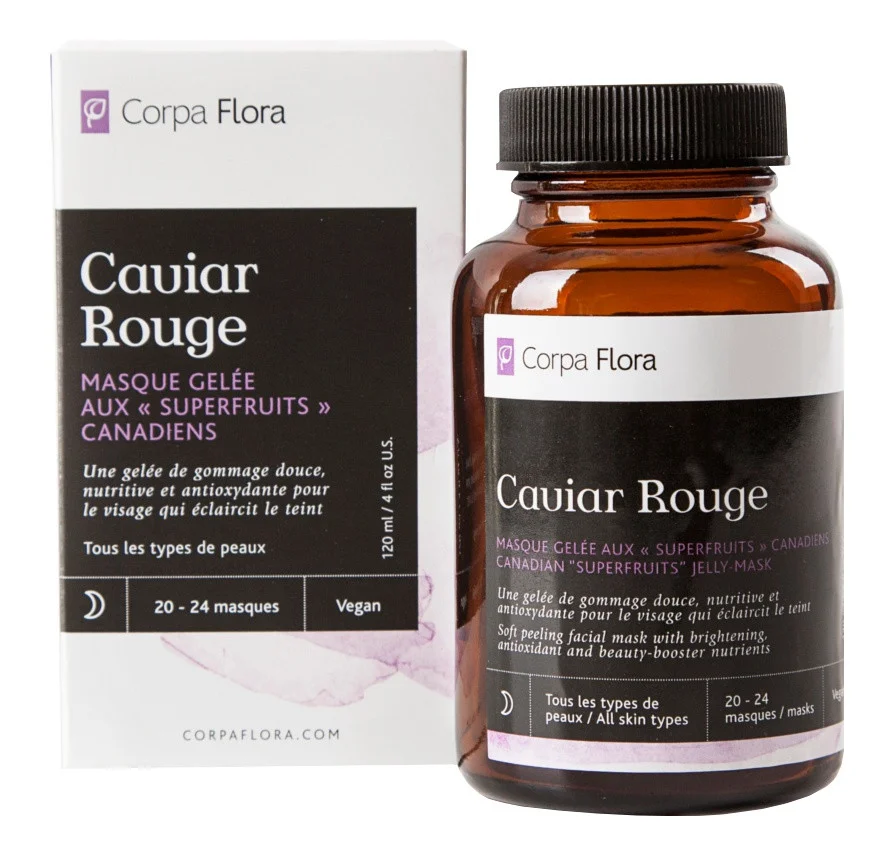
Analysis locked
How well does your skin match with Corpa Flora Caviar Rouge?
Login to see detailsOr continue via
Quick 1-minute survey • Completely free
Ingredients
Analysis results of Ingredients


Ingredient List
| EWG | CIR | Ingredient Name & Cosmetic Function | Notes |
|---|---|---|---|
| - | - | | |
| - | - | Vaccinium Macrocarpon (Cranberry) Fruit Powder* | |
| - | - | Vaccinium Myrtillus (Blueberry) Fruit Powder* | |
| 1 | A | (Skin Conditioning, Viscosity Controlling, Viscosity Increasing Agent, Emulsion Stabilising, Binding Agent, Binding, Surfactant - Emulsifying Agent, Gel Forming) | |
Corpa Flora Caviar Rouge - Ingredient Explanation
Vitis Vinifera (Grape) Skin Powder
1. Definition Vitis Vinifera (Grape) Skin Powder:
Vitis Vinifera (Grape) Skin Powder is a natural ingredient derived from the skin of grapes, which is rich in antioxidants, vitamins, and minerals. It is commonly used in cosmetics for its anti-aging, skin brightening, and protective properties.2. Use:
Grape skin powder is often used in skincare products such as serums, creams, and masks due to its ability to fight free radicals, reduce inflammation, and promote collagen production. It can help improve the overall appearance of the skin, making it look more youthful and radiant.3. Usage Vitis Vinifera (Grape) Skin Powder:
When using products containing Vitis Vinifera (Grape) Skin Powder, it is important to follow the instructions provided by the manufacturer. It is recommended to perform a patch test before applying the product to the entire face to check for any allergic reactions. Additionally, it is advisable to use sunscreen during the day when using products with grape skin powder to protect the skin from UV damage.4. References:
- Goyal, A., Sharma, V., Upadhyay, N., Gill, S., & Sihag, M. (2017). Flavonoids from the Grape Skin Powder. Journal of Food Science and Technology, 54(3), 1005-1015.
- Sivakumar, G., & Balamurugan, S. (2016). Grape Skin Powder: A Potential Ingredient in Cosmetic Formulations. International Journal of Cosmetic Science, 38(5), 469-476.
- Almeida, I. F., Fernandes, E., Lima, J. L. F. C., & Costa, P. C. (2012). Grape Skin Powder: Antioxidant Properties and Their Potential Use in Cosmetic Industry. International Journal of Cosmetic Science, 34(5), 459-463.
Vaccinium Macrocarpon (Cranberry) Fruit Powder*
Ingredient data is being updated. Please check back later.
Vaccinium Myrtillus (Blueberry) Fruit Powder*
Ingredient data is being updated. Please check back later.
Xanthan Gum
1. Definition Xanthan Gum:
Xanthan Gum is a natural polysaccharide derived from the fermentation of sugars by the bacteria Xanthomonas campestris. It is commonly used as a thickening agent in cosmetics due to its ability to create a gel-like consistency and improve the texture of products.2. Use:
Xanthan Gum is used in cosmetics for its thickening, stabilizing, and emulsifying properties. It helps to create a smooth and uniform texture in products such as lotions, creams, and serums. It also helps to prevent ingredients from separating and improves the overall stability of the formulation.3. Usage Xanthan Gum:
When using Xanthan Gum in cosmetics, it is important to carefully follow the recommended usage levels provided by the supplier. Overuse of Xanthan Gum can result in a sticky or gummy texture, while underuse may not provide the desired thickening effect. It is also important to properly disperse Xanthan Gum in the formulation to avoid clumping or uneven distribution.4. References:
- Silva, E. O., et al. (2018). Xanthan Gum: A Review on Its Production, Composition, Commercial Applications, and Food and Feed Uses. Food and Bioprocess Technology, 11(1), 195-229.
- Kaur, A., et al. (2020). Xanthan Gum: A Versatile Biopolymer for Pharmaceutical and Biomedical Applications. Journal of Polymers and the Environment, 28(7), 1541-1555.
- Li, Z., et al. (2019). Xanthan Gum and Its Applications in Drug Delivery: A Review. Carbohydrate Polymers, 217, 1-8.
Review








Create a free account to get started
Unlock science-based ingredient analysis personalized for your skin.
Already have an account? Log in
We protect your privacy. We never send spam.