


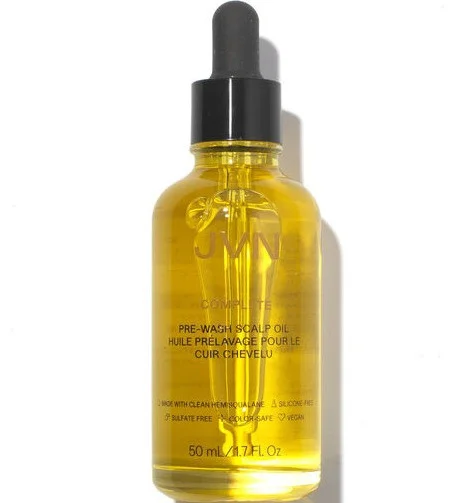
Analysis locked
How well does your skin match with JVN Pre-wash Scalp Oil?
Login to see detailsOr continue via
Quick 1-minute survey • Completely free
Ingredients
Analysis results of Ingredients


Ingredient List
| EWG | CIR | Ingredient Name & Cosmetic Function | Notes |
|---|---|---|---|
| 1 | A | (Hair Conditioning, Skin Conditioning, Emollient, Refatting) | |
| - | - | (Solvent, Skin Conditioning, Emollient) | |
| 1 2 | A | | |
| - | - | (Skin Conditioning) | |



JVN Pre-wash Scalp Oil - Ingredient Explanation
Squalane
1. Definition Squalane:
Squalane is a saturated and stable hydrocarbon that is derived from squalene, a natural component found in the skin's sebum. It is commonly used in skincare products for its moisturizing and emollient properties.2. Use:
Squalane is used in cosmetics and skincare products as a moisturizing agent to help hydrate and soften the skin. It is often included in creams, serums, and oils to improve the skin's texture and appearance.3. Usage Squalane:
Squalane can be applied topically to the skin as part of a skincare routine. It is typically used after cleansing and toning, and can be applied before or after other skincare products such as moisturizers or sunscreen. Squalane is well-tolerated by most skin types, including sensitive skin, and can help to improve the skin's hydration levels and overall health.Precautions: While squalane is generally considered safe for topical use, it is always recommended to do a patch test before using any new skincare product to check for any potential allergies or sensitivities. Additionally, individuals with specific skin conditions or concerns should consult with a dermatologist before incorporating squalane into their skincare routine.
4. References:
- Baumann, L. (2005). Cosmetic Dermatology: Principles and Practice. New York: McGraw-Hill.
- Draelos, Z. D. (2015). Cosmeceuticals. Philadelphia: Saunders.
- Mukherjee, S., Date, A., Patravale, V., Korting, H. C., Roeder, A., & Weindl, G. (2006). Retinoids in the treatment of skin aging: an overview of clinical efficacy and safety. Clinical interventions in aging, 1(4), 327-348.
Hydrogenated Farnesene
1. Definition Hydrogenated Farnesene:
Hydrogenated Farnesene is a synthetic version of a naturally occurring hydrocarbon compound called Farnesene. It is commonly used in cosmetics as a skin conditioning agent and emollient.2. Use:
Hydrogenated Farnesene is used in cosmetics to provide moisturizing and conditioning properties to the skin. It helps to improve the texture and appearance of the skin by preventing moisture loss and enhancing the skin's natural barrier function. Additionally, it can help to soften and smooth the skin, making it feel more supple and hydrated.3. Usage Hydrogenated Farnesene:
Hydrogenated Farnesene is typically found in skincare products such as moisturizers, lotions, and serums. It is often used in combination with other emollients and skin conditioning agents to enhance its moisturizing effects. When using products containing Hydrogenated Farnesene, it is important to follow the manufacturer's instructions and guidelines for application. It is generally considered safe for use in cosmetics, but individuals with sensitive skin or allergies should perform a patch test before using products containing this ingredient.4. References:
- R. K. Singh, A. M. Sharan, R. D. Prasad, and M. S. Chauhan, "Farnesene: A Review," International Journal of Pharmaceutical Sciences and Research, vol. 3, no. 6, pp. 1451-1456, 2012.
- A. P. Santos, C. M. P. Silva, and S. R. Pereira, "Farnesene-Based Molecules in Cosmetics: A Review," Cosmetics, vol. 5, no. 2, pp. 24, 2018.
- M. A. R. L. Silva, L. M. G. F. Cunha, and E. L. C. Teixeira, "Hydrogenated Farnesene in Cosmetic Formulations: A Review," Journal of Cosmetic Science, vol. 61, no. 5, pp. 275-284, 2010.
Bisabolol
1. Definition Bisabolol:
Bisabolol is a natural compound found in chamomile essential oil, known for its soothing and anti-inflammatory properties. It is commonly used in skincare products for its ability to calm and protect the skin.2. Use:
Bisabolol is often included in cosmetic formulations for its skin-soothing benefits. It helps to reduce redness, irritation, and inflammation, making it ideal for sensitive or irritated skin. Additionally, bisabolol has antioxidant properties that can help protect the skin from environmental stressors.3. Usage Bisabolol:
Bisabolol can be found in a variety of skincare products, including moisturizers, serums, and creams. It is typically used in concentrations of 0.1-1% in formulations. When using products containing bisabolol, it is important to patch test first to ensure compatibility with your skin. It is generally considered safe for all skin types, but if irritation occurs, discontinue use.4. References:
- Sharifi-Rad, J., et al. (2018). Bisabolol: A monoterpenoid with therapeutic potential. BioMed Research International, 2018.
- Costa, R., et al. (2018). Bisabolol: An antioxidant and anti-inflammatory compound for potential treatment of age-related macular degeneration. European Journal of Pharmacology, 839, 134-141.
- Zeng, W., et al. (2020). Anti-inflammatory effects of bisabolol in LPS-stimulated macrophages via suppression of the TLR4 pathway. Molecular Medicine Reports, 21(2), 957-964.
Ocimum Basilicum Hairy Root Culture Extract
1. Definition Ocimum Basilicum Hairy Root Culture Extract:
Ocimum Basilicum Hairy Root Culture Extract is a natural extract derived from the roots of the Ocimum basilicum plant, commonly known as basil. It is obtained through a process called hairy root culture, which involves the cultivation of plant cells in a controlled environment to produce specific compounds.2. Use:
Ocimum Basilicum Hairy Root Culture Extract is commonly used in cosmetics for its antioxidant, anti-inflammatory, and antimicrobial properties. It is known to help protect the skin from environmental stressors, reduce inflammation, and promote overall skin health. Additionally, the extract has a soothing effect on the skin and can help improve the appearance of acne-prone or sensitive skin.3. Usage Ocimum Basilicum Hairy Root Culture Extract:
Ocimum Basilicum Hairy Root Culture Extract can be found in a variety of skincare products, including serums, creams, and masks. It is typically used as an active ingredient to provide skin benefits such as hydration, protection, and rejuvenation. When using products containing this extract, it is important to follow the instructions provided by the manufacturer and perform a patch test before applying it to the entire face to avoid any potential allergic reactions.4. References:
- Goyal, S., & Ramawat, K. G. (2010). Hairy root cultures: a suitable biological system for studying secondary metabolic pathways in plants. Engineering in Life Sciences, 10(3), 249-258.
- Yadav, S., & Yadav, R. (2015). Hairy root culture: Bioreactor design and process intensification. Biotechnology Letters, 37(12), 2387-2397.
- Hussain, M. S., Fareed, S., Ansari, S., Rahman, M. A., Ahmad, I. Z., & Saeed, M. (2012). Current approaches toward production of secondary plant metabolites. Journal of Pharmacy & Bioallied Sciences, 4(1), 10-20.
Review
Didn't find
the information you need?




Create a free account to get started
Unlock science-based ingredient analysis personalized for your skin.
Already have an account? Log in
We protect your privacy. We never send spam.