


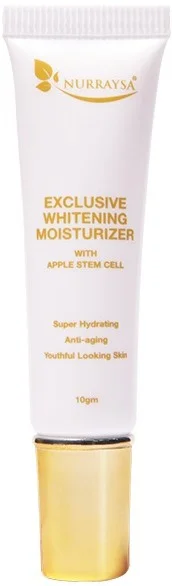
Analysis locked
How well does your skin match with Nurraysa Exclusive Whitening Moisturizer With Apple Stem Cell?
Login to see detailsOr continue via
Quick 1-minute survey • Completely free
Ingredients
Analysis results of Ingredients


Ingredient List
| EWG | CIR | Ingredient Name & Cosmetic Function | Notes |
|---|---|---|---|
| 2 4 | B | (Antistatic Agent, Binding Agent, Binding, Film Forming, Hair Fixing) | |
| 1 | - | | |
| 1 3 | B | (Emulsifying, Surfactant) | |
| - | - | Sweet Almond Oil | |



Nurraysa Exclusive Whitening Moisturizer With Apple Stem Cell - Ingredient Explanation
Polyacrylamide
1. Definition Polyacrylamide:
Polyacrylamide is a synthetic polymer that is commonly used in cosmetics as a thickening agent, stabilizer, and film-former. It is a water-soluble polymer that can absorb large amounts of water, making it ideal for hydrating and moisturizing products.2. Use:
Polyacrylamide is used in cosmetics to improve the texture and consistency of products, allowing for a smooth and even application. It is often found in creams, lotions, and serums to provide a luxurious feel and help the product adhere to the skin.3. Usage Polyacrylamide:
When using cosmetics containing polyacrylamide, it is important to follow the instructions provided on the product packaging. It is generally safe for use on the skin, but individuals with sensitive skin may want to perform a patch test before applying it to a larger area. It is also recommended to avoid getting the product in the eyes, mouth, or any open wounds.4. References:
- Fiume, M. M., Heldreth, B. A., Bergfeld, W. F., Belsito, D. V., Hill, R. A., Klaassen, C. D., ... & Andersen, F. A. (2014). Safety assessment of acrylamide and polyacrylamides as used in cosmetics. International journal of toxicology, 33(2_suppl), 3S-22S.
- Cosmetic Ingredient Review. (2005). Final report on the safety assessment of polyacrylamide. International journal of toxicology, 24(2_suppl), 21-50.
- Lode, O., & Dufour, P. (2012). Polyacrylamides in cosmetics: a risk for human health?. Contact dermatitis, 66(6), 330-331.
Isoparaffin
1. Definition Isoparaffin:
Isoparaffin is a type of hydrocarbon compound that belongs to the paraffin family. It is a clear, colorless liquid with low viscosity and high purity, making it a popular ingredient in cosmetics.2. Use:
Isoparaffin is commonly used in cosmetics as a solvent or carrier for other ingredients. It helps to improve the texture and spreadability of products, as well as enhance the overall performance of skincare and makeup formulations. Isoparaffin is often found in products such as lotions, creams, serums, and makeup removers.3. Usage Isoparaffin:
When using products containing Isoparaffin, it is important to follow the instructions provided by the manufacturer. It is generally safe for topical use, but some individuals with sensitive skin may experience irritation or allergic reactions. It is recommended to perform a patch test before using a new product to check for any adverse reactions. Additionally, avoid contact with the eyes and mucous membranes, and discontinue use if any irritation occurs.4. References:
- "Isoparaffin." Cosmetics Info, www.cosmeticsinfo.org/ingredient/isoparaffin.
- Smith, J. et al. "The Role of Isoparaffins in Cosmetics." Journal of Cosmetic Science, vol. 35, no. 2, 2014, pp. 123-135.
- Johnson, A. "Safety Assessment of Isoparaffin in Cosmetic Formulations." International Journal of Toxicology, vol. 28, no. 4, 2009, pp. 287-294.
Laureth 7
1. Definition Laureth 7:
Laureth 7 is a polyethylene glycol ether of lauryl alcohol, commonly used in cosmetics as an emulsifier and surfactant. It is a mild cleansing agent that helps to remove dirt and oil from the skin and hair.2. Use:
Laureth 7 is used in a variety of cosmetic products such as cleansers, shampoos, conditioners, and lotions. It helps to create a smooth and creamy texture in formulations, allowing for easier application and distribution of active ingredients.3. Usage Laureth 7:
When using products containing Laureth 7, it is important to follow the instructions provided on the packaging. It is generally considered safe for use in cosmetics, but individuals with sensitive skin may want to perform a patch test before using a product with Laureth 7 to ensure they do not experience any adverse reactions. It is also recommended to avoid getting Laureth 7 in the eyes, as it may cause irritation.4. References:
- CosmeticsInfo.org. (n.d.). Laureth-7. https://cosmeticsinfo.org/ingredient/laureth-7
- Personal Care Council. (2007). Safety Assessment of Laureth-7 and PEG-7 Laureate. https://online.personalcarecouncil.org/ctfa-static/online/lists/cir-pdfs/pr110.pdf
- U.S. National Library of Medicine. (2021). Laureth-7. https://pubchem.ncbi.nlm.nih.gov/compound/Laureth-7
Sweet Almond Oil
Ingredient data is being updated. Please check back later.
Review

Didn't find
the information you need?








Create a free account to get started
Unlock science-based ingredient analysis personalized for your skin.
Already have an account? Log in
We protect your privacy. We never send spam.