


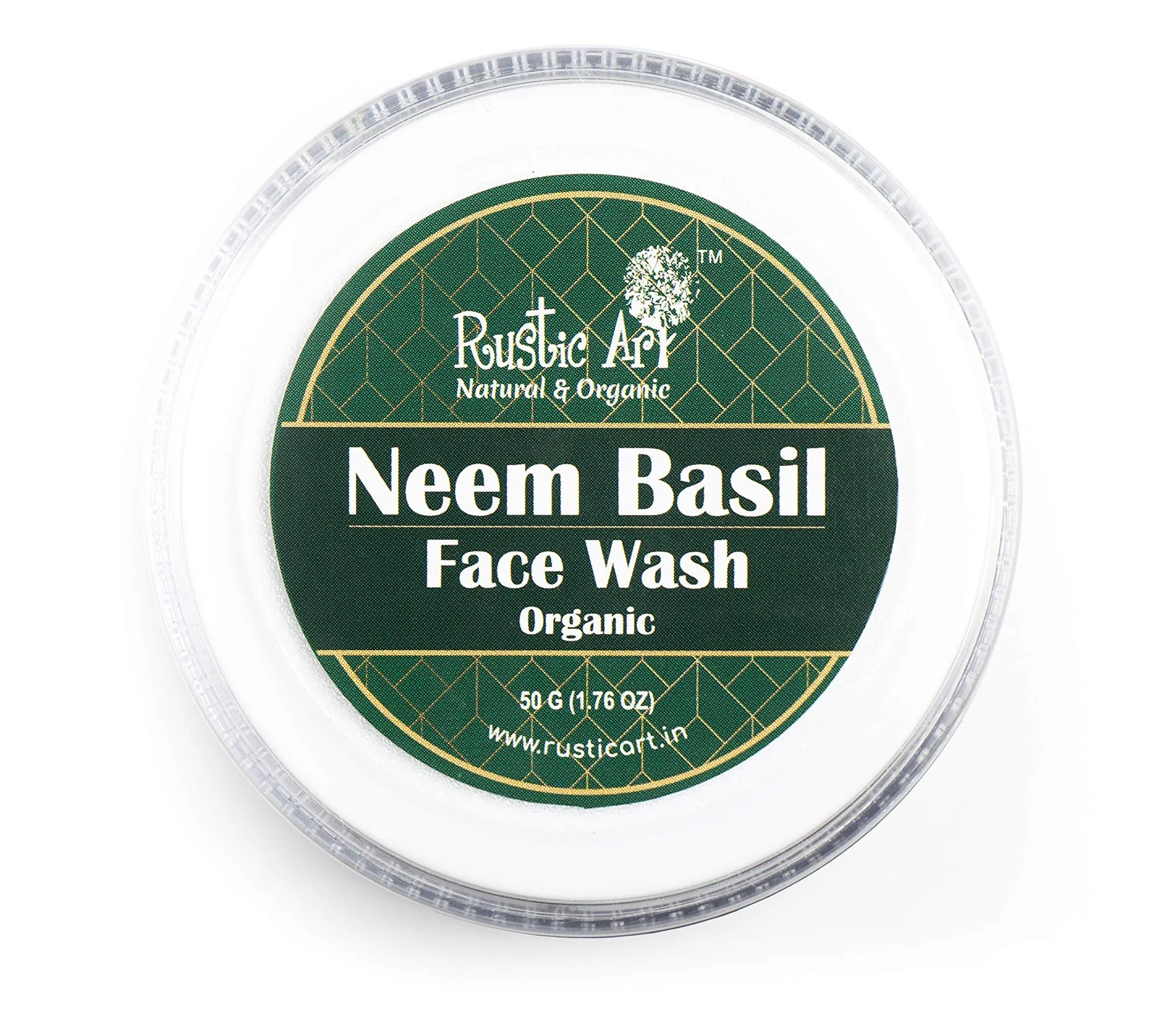
Analysis locked
How well does your skin match with Rustic art Organic Neem Basil Face Wash?
Login to see detailsOr continue via
Quick 1-minute survey • Completely free
Ingredients
Analysis results of Ingredients


Ingredient List
| EWG | CIR | Ingredient Name & Cosmetic Function | Notes |
|---|---|---|---|
| 1 | A | (Surfactant, Emulsifying, Sufactant) | |
| - | - | Potassium Pangamate (Karanja Oil) | |
| - | - | Potassium Sesamate (Sesame Oil) | |
| 1 | - | (Viscosity Controlling, Viscosity Increasing Agent) | |

Rustic art Organic Neem Basil Face Wash - Ingredient Explanation
Potassium Cocoate
1. Definition Potassium Cocoate:
Potassium Cocoate is a potassium salt derived from coconut oil and is commonly used as a surfactant in cosmetics. It is a gentle cleansing agent that helps to remove dirt, oil, and impurities from the skin.2. Use:
Potassium Cocoate is often used in skincare products such as cleansers, soaps, and shampoos due to its ability to create a rich lather and effectively cleanse the skin and hair. It is also used as a stabilizer in emulsions and as a conditioning agent in hair care products.3. Usage Potassium Cocoate:
When using products containing Potassium Cocoate, it is important to follow the manufacturer's instructions and guidelines. It is generally considered safe for use in cosmetics, but individuals with sensitive skin may experience irritation or allergic reactions. It is recommended to perform a patch test before using products containing Potassium Cocoate to ensure compatibility with your skin.4. References:
- "Coconut Oil and Derivatives" by Peter J. Wan, Wiley-VCH, 2019.
- "Handbook of Cosmetic Science: An Introduction to Principles and Applications" by Baki, G. and Alexander, K., CRC Press, 2014.
- "Surfactants in Cosmetics" by Martin M. Rieger and Linda D. Rhein, CRC Press, 2006.
Potassium Pangamate (Karanja Oil)
Ingredient data is being updated. Please check back later.
Potassium Sesamate (Sesame Oil)
Ingredient data is being updated. Please check back later.
Potassium Sunflowerate
1. Definition Potassium Sunflowerate:
Potassium Sunflowerate is a potassium salt derived from sunflower oil. It is commonly used in cosmetics as an emollient and surfactant.2. Use:
Potassium Sunflowerate is primarily used in cosmetic formulations as a natural alternative to traditional emollients and surfactants. It helps to improve the texture and feel of the product, making it smoother and more spreadable. Additionally, it has moisturizing properties that help to hydrate and soften the skin.3. Usage Potassium Sunflowerate:
Potassium Sunflowerate is typically found in a variety of cosmetic products such as lotions, creams, and soaps. It is used in small concentrations, usually between 1-5%, depending on the desired texture and properties of the final product. It is important to follow the recommended guidelines for usage to ensure the safety and efficacy of the product.Precautions: While Potassium Sunflowerate is generally considered safe for use in cosmetics, it is always recommended to perform a patch test before using it on a larger area of the skin, especially for those with sensitive skin. It is also important to store products containing Potassium Sunflowerate in a cool, dry place to prevent degradation.
4. References:
- Pazyar, N., Yaghoobi, R., & Rafiee, E. (2014). Sunflower in dermatology: a comprehensive review. International journal of dermatology, 53(5), 588-594.
- Kaur, N., & Choudhary, S. (2019). Sunflower oil: A boon to skin health. Journal of essential oil research, 31(6), 511-518.
- Balakrishnan, P., Lee, H., & Yoon, S. (2011). Sunflower oil-based emulsions as potential topical anti-inflammatory agents. International journal of pharmaceutics, 403(1-2), 46-53.
Review

Didn't find
the information you need?





Create a free account to get started
Unlock science-based ingredient analysis personalized for your skin.
Already have an account? Log in
We protect your privacy. We never send spam.