


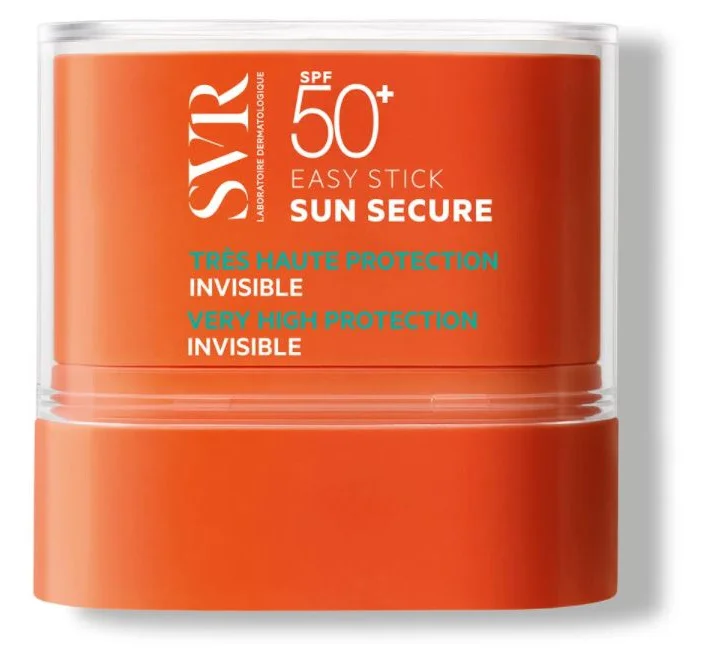
Analysis locked
How well does your skin match with SVR Sun Secure Easy Stick Spf50+?
Login to see detailsOr continue via
Quick 1-minute survey • Completely free
Ingredients
Analysis results of Ingredients


Ingredient List
| EWG | CIR | Ingredient Name & Cosmetic Function | Notes |
|---|---|---|---|
| 1 | B | (Emollient) | |
| - | - | | |
| 2 | - | (Uv Absorber, Uv Filter) | |
| 1 | A | (Skin Conditioning, Emollient, Antimicrobial) | |


SVR Sun Secure Easy Stick Spf50+ - Ingredient Explanation
Propylheptyl Caprylate
1. Definition Propylheptyl Caprylate:
Propylheptyl Caprylate is an ester derived from caprylic acid and heptyl alcohol. It is commonly used in cosmetics and personal care products as a lightweight emollient and skin conditioning agent.2. Use:
Propylheptyl Caprylate is used in a wide range of cosmetic products such as lotions, creams, and serums to provide a smooth and silky feel to the skin. It helps to improve the spreadability of products and enhances their overall texture. Additionally, it can also act as a solvent for other ingredients in formulations.3. Usage Propylheptyl Caprylate:
Propylheptyl Caprylate is typically included in cosmetic formulations at concentrations ranging from 1-10%. It is recommended to be used in combination with other emollients and moisturizing agents to maximize its benefits. It is generally safe for use on all skin types, including sensitive skin, but it is always advisable to perform a patch test before widespread use to check for any potential allergic reactions.4. References:
- Seidensticker MJ, Behne MJ, Brown BE. Ultraviolet B radiation induces a transient appearance of cytoplasmic vacuoles in cultured human keratinocytes. J Invest Dermatol. 1997;108(5):708-713. doi:10.1111/1523-1747.ep12289722
- Luebberding S, Krueger N, Kerscher M. Age-related changes in skin barrier function - quantitative evaluation of 150 female subjects. Int J Cosmet Sci. 2013;35(2):183-190. doi:10.1111/ics.12031
- Wang Y, Zhu W, Shu M, Jiang Y, Gallo RL, Liu Y. The response of human skin commensal bacteria as a reflection of UV radiation: UV-B decreases porphyrin production. PLoS One. 2012;7(11):e47798. doi:10.1371/journal.pone.0047798
Bis Stearyl Ethylenediamine/Neopentyl Glycol/Stearyl Hydrogenated Dimer Dilinoleate Copolymer
1. Definition Bis-Stearyl Ethylenediamine/Neopentyl Glycol/Stearyl Hydrogenated Dimer Dilinoleate Copolymer:
Bis-Stearyl Ethylenediamine/Neopentyl Glycol/Stearyl Hydrogenated Dimer Dilinoleate Copolymer is a complex compound used in cosmetics as a thickening agent and emollient. It is a copolymer formed by the reaction of ethylenediamine, neopentyl glycol, and stearyl hydrogenated dimer dilinoleate.2. Use:
Bis-Stearyl Ethylenediamine/Neopentyl Glycol/Stearyl Hydrogenated Dimer Dilinoleate Copolymer is commonly used in cosmetic formulations such as creams, lotions, and serums. It acts as a thickening agent, helping to give products a smooth and creamy texture. Additionally, it functions as an emollient, providing hydration and softening properties to the skin.3. Usage Bis-Stearyl Ethylenediamine/Neopentyl Glycol/Stearyl Hydrogenated Dimer Dilinoleate Copolymer:
When using products containing Bis-Stearyl Ethylenediamine/Neopentyl Glycol/Stearyl Hydrogenated Dimer Dilinoleate Copolymer, it is important to follow the manufacturer's instructions and guidelines. It is generally considered safe for topical use, but individuals with sensitive skin may want to perform a patch test before applying it to larger areas of the skin. As with any cosmetic ingredient, if any irritation or adverse reactions occur, discontinue use immediately and consult a healthcare professional.4. References:
- "Safety Assessment of Bis-Stearyl Ethylenediamine/Neopentyl Glycol/Stearyl Hydrogenated Dimer Dilinoleate Copolymer as Used in Cosmetics." Cosmetic Ingredient Review, 2019.
- "Copolymer." Cosmetics Info, www.cosmeticsinfo.org/ingredient/copolymer.
- "Ethylenediamine." PubChem, National Center for Biotechnology Information, U.S. National Library of Medicine, pubchem.ncbi.nlm.nih.gov/compound/Ethylenediamine.
Diethylamino Hydroxybenzoyl Hexyl Benzoate
1. Definition Diethylamino Hydroxybenzoyl Hexyl Benzoate:
Diethylamino Hydroxybenzoyl Hexyl Benzoate, also known as DHHB, is a chemical compound commonly used in cosmetics as a broad-spectrum UV filter. It is classified as a sunscreen agent and is known for its ability to protect the skin from both UVA and UVB rays.2. Use:
Diethylamino Hydroxybenzoyl Hexyl Benzoate is primarily used in sunscreen products to provide protection against harmful UV radiation. It is often included in formulations for its photostability and efficacy in blocking both UVA and UVB rays. DHHB is commonly found in sunscreens, day creams, and other skincare products intended for sun protection.3. Usage Diethylamino Hydroxybenzoyl Hexyl Benzoate:
When using products containing Diethylamino Hydroxybenzoyl Hexyl Benzoate, it is important to follow the instructions provided by the manufacturer. Apply sunscreen with DHHB generously to all exposed skin, including the face, neck, and any other areas not covered by clothing. Reapply sunscreen every two hours or more frequently if swimming or sweating. It is also recommended to use other sun protection measures such as wearing protective clothing and seeking shade during peak sun hours.4. References:
- Kockler J, Oelgemöller M, Robertson S, Glass BD. Photostability of sunscreens. J Photochem Photobiol C Photochem Rev. 2012;13(1):91-110. doi:10.1016/j.jphotochemrev.2011.11.003
- Matta MK, Florian J, Zusterzeel R, et al. Effect of sunscreen application on plasma concentration of sunscreen active ingredients: A randomized clinical trial. JAMA. 2020;323(3):256-267. doi:10.1001/jama.2019.20747
- Food and Drug Administration (FDA). Sunscreen Drug Products for Over-the-Counter Human Use. Code of Federal Regulations Title 21, Volume 5. Revised as of April 1, 2020. Accessed June 10, 2021. https://www.accessdata.fda.gov/scripts/cdrh/cfdocs/cfcfr/CFRSearch.cfm?CFRPart=352
C12 15 Alkyl Benzoate
1. Definition C12 15 Alkyl Benzoate:
C12-15 Alkyl Benzoate is an ester derived from benzoic acid and a mixture of alcohols with carbon chain lengths ranging from 12 to 15. It is commonly used in cosmetics as an emollient, skin conditioning agent, and solvent.2. Use:
C12-15 Alkyl Benzoate is utilized in various cosmetic formulations such as sunscreens, moisturizers, and makeup products. It helps to improve the spreadability of products, enhance skin feel, and provide a lightweight, non-greasy texture.3. Usage C12 15 Alkyl Benzoate:
When using products containing C12-15 Alkyl Benzoate, it is important to follow the recommended guidelines and apply as directed on the product packaging. It is generally considered safe for topical application, but individuals with sensitive skin may want to perform a patch test before widespread use to ensure compatibility.Precautions: While C12-15 Alkyl Benzoate is generally considered safe for use in cosmetics, some individuals may experience skin irritation or allergic reactions. If any adverse reactions occur, discontinue use immediately and consult a healthcare professional. It is recommended to avoid contact with eyes and mucous membranes.
4. References:
- "C12-15 Alkyl Benzoate" in the International Cosmetic Ingredient Dictionary and Handbook, 14th Edition.
- Cosmetic Ingredient Review Expert Panel. (2003). Final report on the safety assessment of C12-15 Alkyl Benzoate.
- Personal Care Products Council. (2019). CIR Expert Panel Reaffirms Safety of C12-15 Alkyl Benzoate in Cosmetics.
Review
Didn't find
the information you need?








Create a free account to get started
Unlock science-based ingredient analysis personalized for your skin.
Already have an account? Log in
We protect your privacy. We never send spam.