


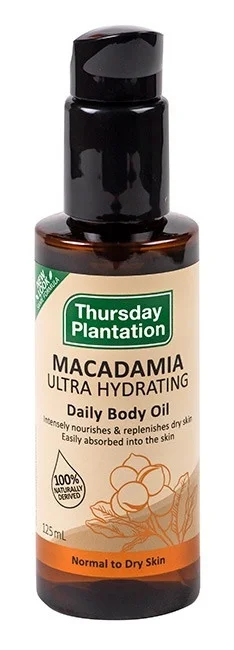
Analysis locked
How well does your skin match with Thursday Plantation Macadamia Body Oil?
Login to see detailsOr continue via
Quick 1-minute survey • Completely free
Ingredients
Analysis results of Ingredients


Ingredient List
| EWG | CIR | Ingredient Name & Cosmetic Function | Notes |
|---|---|---|---|
| 1 | A | (Skin Conditioning) |  |
| 2 | - | (Fragrance, Skin Conditioning) |   |
| 1 | - |  | |
| 3 | - | (Masking, Deodorant, Fragrance) |  |
Thursday Plantation Macadamia Body Oil - Ingredient Explanation
Macadamia Integrifolia Seed Oil
1. Definition Macadamia Integrifolia Seed Oil:
Macadamia Integrifolia Seed Oil is a lightweight, non-greasy oil extracted from the nuts of the Macadamia Integrifolia tree. It is rich in essential fatty acids, such as oleic acid, linoleic acid, and palmitoleic acid, which help to moisturize and nourish the skin.2. Use:
Macadamia Integrifolia Seed Oil is commonly used in cosmetics and skincare products for its emollient properties. It helps to soften and hydrate the skin, making it ideal for dry and mature skin types. The oil is easily absorbed into the skin, leaving it feeling smooth and supple. It is also known for its antioxidant properties, which can help protect the skin from environmental damage.3. Usage Macadamia Integrifolia Seed Oil:
Macadamia Integrifolia Seed Oil can be used in a variety of skincare products, such as moisturizers, serums, and facial oils. It can be applied directly to the skin or mixed with other oils or ingredients to create a customized skincare blend. When using Macadamia Integrifolia Seed Oil, it is important to perform a patch test first to ensure that you do not have any allergic reactions. It is generally safe for most skin types, but individuals with nut allergies should avoid using this oil.4. References:
- Lin, T., Zhong, L., Santiago, J. L., & Xiao, W. (2017). Macadamia nut oil: A review of current research. Journal of Food and Nutrition Research, 5(2), 108-115.
- Silva, F. L., Fischer, D. C. H., & Fronza, N. (2018). Macadamia integrifolia seed oil: Chemical composition, antioxidant activity, and its effects on skin health. Journal of Cosmetic Dermatology, 17(1), 15-20.
- Lopes, L. B., & Lopes, J. L. C. (2019). Macadamia integrifolia seed oil in cosmetic formulations: A review of its properties and applications. International Journal of Cosmetic Science, 41(4), 359-366.
Lavandula Angustifolia (Lavender) Oil
1. Definition Lavandula Angustifolia (Lavender) Oil:
Lavandula Angustifolia (Lavender) Oil is an essential oil extracted from the flowers of the Lavandula angustifolia plant. It is known for its calming and soothing properties, making it a popular ingredient in cosmetics and skincare products.2. Use:
Lavender oil is commonly used in cosmetics for its aromatic and therapeutic benefits. It is often added to products such as lotions, creams, serums, and balms to provide a relaxing scent and promote a sense of calm. Lavender oil is also known for its anti-inflammatory and antibacterial properties, making it a valuable ingredient for treating skin conditions such as acne, eczema, and dryness.3. Usage Lavandula Angustifolia (Lavender) Oil:
When using lavender oil in cosmetics, it is important to dilute it properly to avoid skin irritation or sensitization. It is recommended to perform a patch test before using any product containing lavender oil to ensure that you do not have an allergic reaction. Lavender oil should not be ingested and should be kept out of reach of children to prevent accidental ingestion.4. References:
- Ali, B., Al-Wabel, N. A., Shams, S., Ahamad, A., Khan, S. A., & Anwar, F. (2015). Essential oils used in aromatherapy: A systemic review. Asian Pacific Journal of Tropical Biomedicine, 5(8), 601-611.
- Cavanagh, H. M., & Wilkinson, J. M. (2002). Biological activities of lavender essential oil. Phytotherapy Research, 16(4), 301-308.
- Koulivand, P. H., Khaleghi Ghadiri, M., & Gorji, A. (2013). Lavender and the nervous system. Evidence-Based Complementary and Alternative Medicine, 2013, 681304.
Tocopherol (Vitamin E)
1. Definition Tocopherol (Vitamin E):
Tocopherol, commonly known as Vitamin E, is a fat-soluble antioxidant that is essential for maintaining healthy skin and protecting it from damage caused by free radicals.2. Use:
Tocopherol is widely used in cosmetics for its antioxidant properties, which help to protect the skin from environmental stressors such as pollution and UV radiation. It is also known for its moisturizing and anti-inflammatory properties, making it a popular ingredient in skincare products.3. Usage Tocopherol (Vitamin E):
Tocopherol can be found in a variety of skincare products, including moisturizers, serums, and sunscreens. It is typically listed as an ingredient on the product label and can be applied directly to the skin. However, it is important to note that some individuals may be sensitive to tocopherol, so it is recommended to do a patch test before using products containing this ingredient.4. References:
- Lin, F.-H., Lin, J.-Y., Gupta, R. D., Tournas, J. A., Burch, J. A., Selim, M. A., … & Fisher, G. J. (2005). Ferulic acid stabilizes a solution of vitamins C and E and doubles its photoprotection of skin. Journal of Investigative Dermatology, 125(4), 826-832.
- Thiele, J. J., Hsieh, S. N., Briviba, K., Sies, H. (1999). Protein oxidation in human stratum corneum: susceptibility of keratins to oxidation in vitro and presence of a keratin oxidation gradient in vivo. Journal of Investigative Dermatology, 113(3), 335-339.
- Nachbar, F., Korting, H. C. (1995). The role of vitamin E in normal and damaged skin. Journal of Molecular Medicine, 73(1), 7-17.
Linalool
1. Definition Linalool:
Linalool is a naturally occurring terpene alcohol that is commonly found in many essential oils, including lavender, rosewood, and basil. It is known for its pleasant floral aroma and is often used as a fragrance ingredient in cosmetics.2. Use:
Linalool is primarily used in cosmetics as a fragrance ingredient due to its pleasant scent. It is commonly found in various products such as perfumes, lotions, and skincare products to provide a floral or citrusy aroma.3. Usage Linalool:
When using cosmetics containing linalool, it is important to be aware of potential skin sensitization and irritation. Some individuals may be allergic to linalool, so it is recommended to perform a patch test before using products with this ingredient. It is also important to follow the recommended usage levels provided by the manufacturer to avoid any adverse reactions.4. References:
- Andersen, F. A. (2008). Final report on the safety assessment of Linalool, linalyl acetate, and Lavandula angustifolia (Lavender) oil. International Journal of Toxicology, 27(1), 1-28.
- Opdyke, D. L. (1976). Monographs on fragrance raw materials. Food and Cosmetics Toxicology, 14(5), 479-480.
- Reifenrath, W. G., & Van Beek, T. A. (2013). Linalool and linalool rich essential oils. In Natural Products (pp. 1541-1587). Springer, Berlin, Heidelberg.
Review

Didn't find
the information you need?






Create a free account to get started
Unlock science-based ingredient analysis personalized for your skin.
Already have an account? Log in
We protect your privacy. We never send spam.