


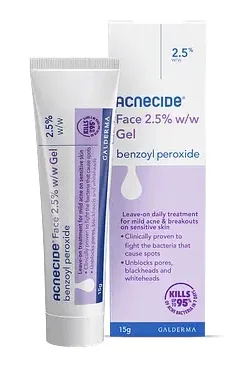
Analysis locked
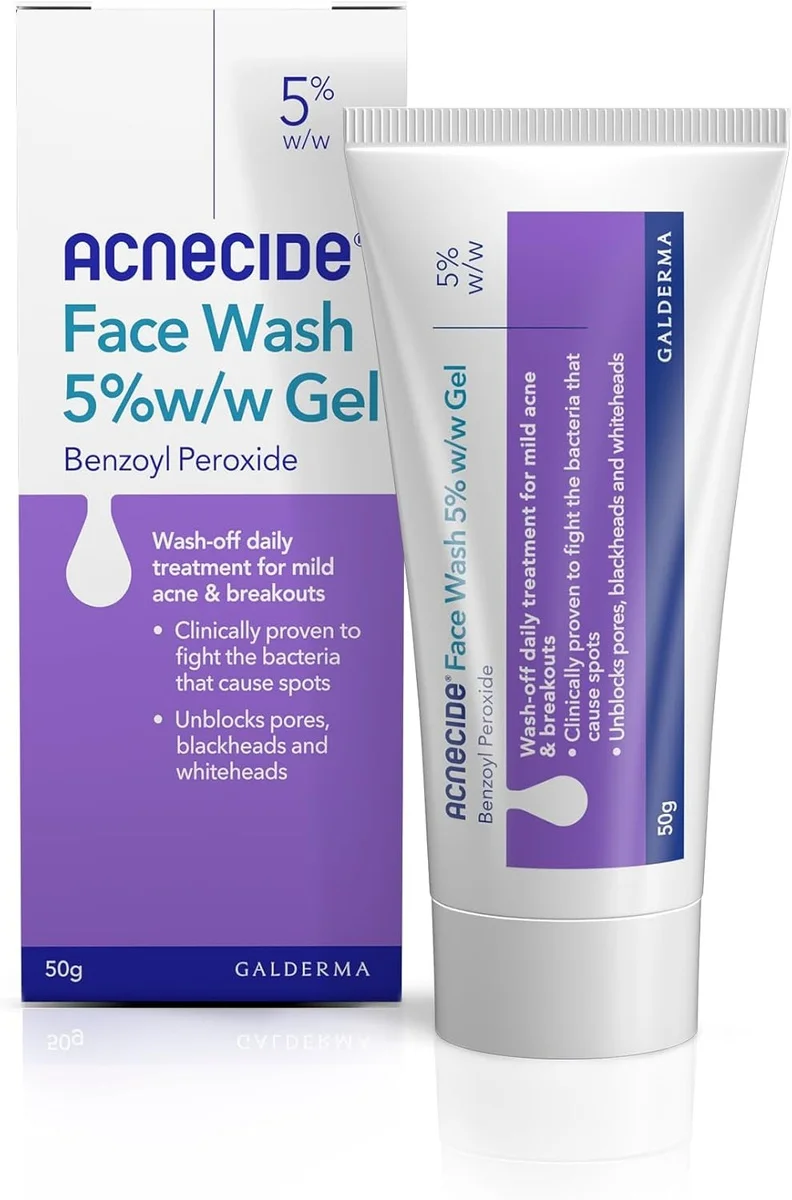
How well does your skin match with Acnecide Face Gel Spot Treatment With 2.5% Benzoyl Peroxide?
Login to see detailsOr continue via
Quick 1-minute survey • Completely free
Ingredients
Analysis results of Ingredients


Ingredient List
| EWG | CIR | Ingredient Name & Cosmetic Function | Notes |
|---|---|---|---|
| 3 | - | (Antiacne Agent, Oxidising Agent) |  |
| - | - | Docusate Sodium | |
| - | - | Disodium Edetate | |
| 1 | A | (Emulsifying, Surfactant) |  |


Acnecide Face Gel Spot Treatment With 2.5% Benzoyl Peroxide - Ingredient Explanation
Benzoyl Peroxide (2.5%)
1. Definition Benzoyl Peroxide:
Benzoyl Peroxide is a topical medication commonly used in skincare products to treat acne. It works by reducing the amount of acne-causing bacteria on the skin and helping to unclog pores.2. Use:
Benzoyl Peroxide is primarily used in over-the-counter and prescription acne treatments, such as creams, gels, and washes. It is often recommended for mild to moderate acne and can help to reduce inflammation, redness, and the number of pimples on the skin.3. Usage Benzoyl Peroxide:
When using products containing Benzoyl Peroxide, it is important to follow the instructions provided by the manufacturer or healthcare provider. Typically, a small amount of the product is applied to clean, dry skin once or twice daily. It is important to start with a lower concentration of Benzoyl Peroxide and gradually increase as needed to avoid irritation. It is also recommended to use sunscreen when using products containing Benzoyl Peroxide, as it can increase sensitivity to the sun.4. References:
- Draelos, Z. D. (2016). Over-the-counter acne treatments. Dermatologic clinics, 34(2), 175-184.
- Zaenglein, A. L., Pathy, A. L., Schlosser, B. J., Alikhan, A., Baldwin, H. E., Berson, D. S., ... & Bhushan, R. (2016). Guidelines of care for the management of acne vulgaris. Journal of the American Academy of Dermatology, 74(5), 945-973.
- Thiboutot, D., Dréno, B., Abanmi, A., Alexis, A., Araviiskaia, E., Barona Cabal, M. I., ... & Layton, A. M. (2019). Practical management of acne for clinicians: An international consensus from the Global Alliance to Improve Outcomes in Acne. Journal of the American Academy of Dermatology, 81(3), 775-789.
Docusate Sodium
Ingredient data is being updated. Please check back later.
Disodium Edetate
Ingredient data is being updated. Please check back later.
Poloxamer
1. Definition Poloxamers:
Poloxamers are nonionic surfactants that are commonly used in cosmetics for their emulsifying, solubilizing, and stabilizing properties. They are copolymers of polyoxyethylene and polyoxypropylene, which give them unique amphiphilic properties.2. Use:
Poloxamers are widely used in cosmetics as emulsifiers to help blend water and oil-based ingredients together. They also act as solubilizers, helping to dissolve ingredients that are not easily soluble in water. Additionally, Poloxamers are used as stabilizers to prevent the separation of ingredients in cosmetic formulations.3. Usage Poloxamers:
When using Poloxamers in cosmetics, it is important to follow the recommended usage levels provided by the manufacturer. Overuse of Poloxamers can lead to skin irritation or sensitization in some individuals. It is also important to conduct a patch test before using a product containing Poloxamers to ensure that you do not have an allergic reaction.4. References:
- Almeida, A. J., & Souto, E. B. (2007). Solid lipid nanoparticles as a drug delivery system for peptides and proteins. Advanced drug delivery reviews, 59(6), 478-490.
- Zloh, M., & Gibbons, S. (2008). Molecular modeling of the interactions of surfactants with skin penetration enhancers. Journal of Molecular Graphics and Modelling, 26(3), 497-506.
- Ribeiro, L. N. M., Breitkreitz, M. C., Guilherme, V. A., Da Silva, C. B., & De Araujo, D. R. (2015). Poloxamer: A versatile pharmaceutical excipient with great promise. Journal of Pharmacy & Pharmaceutical Sciences, 18(4), 683-705.
Review

Didn't find
the information you need?




Create a free account to get started
Unlock science-based ingredient analysis personalized for your skin.
Already have an account? Log in
We protect your privacy. We never send spam.