


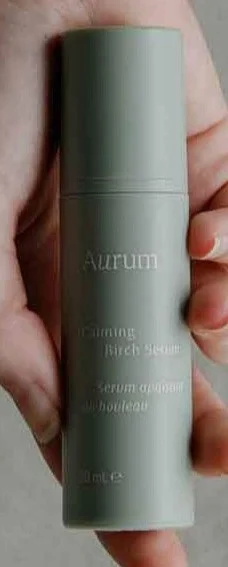
Analysis locked
How well does your skin match with Aurum Calming Birch Serum?
Login to see detailsOr continue via
Quick 1-minute survey • Completely free
Ingredients
Analysis results of Ingredients


Ingredient List
| EWG | CIR | Ingredient Name & Cosmetic Function | Notes |
|---|---|---|---|
| - | - | Betula Neoalaskana (Birch) Extract | |
| 1 | A | (Hair Conditioning, Skin Conditioning, Emollient, Refatting) | |
| 1 | - | (Skin Conditioning) | |
| 1 | B | (Skin Conditioning, Emollient, Emulsifying) |  |

Aurum Calming Birch Serum - Ingredient Explanation
Betula Neoalaskana (Birch) Extract
Ingredient data is being updated. Please check back later.
Squalane
1. Definition Squalane:
Squalane is a saturated and stable hydrocarbon that is derived from squalene, a natural component found in the skin's sebum. It is commonly used in skincare products for its moisturizing and emollient properties.2. Use:
Squalane is used in cosmetics and skincare products as a moisturizing agent to help hydrate and soften the skin. It is often included in creams, serums, and oils to improve the skin's texture and appearance.3. Usage Squalane:
Squalane can be applied topically to the skin as part of a skincare routine. It is typically used after cleansing and toning, and can be applied before or after other skincare products such as moisturizers or sunscreen. Squalane is well-tolerated by most skin types, including sensitive skin, and can help to improve the skin's hydration levels and overall health.Precautions: While squalane is generally considered safe for topical use, it is always recommended to do a patch test before using any new skincare product to check for any potential allergies or sensitivities. Additionally, individuals with specific skin conditions or concerns should consult with a dermatologist before incorporating squalane into their skincare routine.
4. References:
- Baumann, L. (2005). Cosmetic Dermatology: Principles and Practice. New York: McGraw-Hill.
- Draelos, Z. D. (2015). Cosmeceuticals. Philadelphia: Saunders.
- Mukherjee, S., Date, A., Patravale, V., Korting, H. C., Roeder, A., & Weindl, G. (2006). Retinoids in the treatment of skin aging: an overview of clinical efficacy and safety. Clinical interventions in aging, 1(4), 327-348.
Epilobium Angustifolium (Canadian Willowherb) Flower/ Leaf/ Stem Extract
1. Definition Epilobium Angustifolium Flower/Leaf/Stem (Canadian Willowherb) Extract:
Epilobium Angustifolium Flower/Leaf/Stem (Canadian Willowherb) Extract is a natural extract derived from the flowering plant Epilobium Angustifolium, commonly known as Canadian Willowherb. This extract is known for its anti-inflammatory, antioxidant, and soothing properties, making it a popular ingredient in skincare products.2. Use:
Epilobium Angustifolium Flower/Leaf/Stem Extract is commonly used in cosmetics for its ability to help calm and soothe irritated skin, reduce redness, and protect the skin from environmental stressors. It is often found in products targeted towards sensitive or reactive skin types, as well as in formulations designed to address concerns such as acne or rosacea.3. Usage Epilobium Angustifolium Flower/Leaf/Stem (Canadian Willowherb) Extract:
When using products containing Epilobium Angustifolium Flower/Leaf/Stem Extract, it is important to follow the instructions provided by the manufacturer. This extract is generally considered safe for topical use, but it is recommended to perform a patch test before applying it to larger areas of the skin to check for any potential allergic reactions. As with any new skincare ingredient, it is best to start with a lower concentration to assess how your skin responds before incorporating it into your regular routine.4. References:
- Sarkic A, Stappen I. Essential oils and their single compounds in cosmetics—a critical review. Cosmetics. 2018;5(1):11. doi:10.3390/cosmetics5010011
- Barel AO, Paye M, Maibach HI. Handbook of Cosmetic Science and Technology. 4th ed. CRC Press; 2014.
- Park K, Lee JH. Anti-inflammatory effects of Epilobium angustifolium on human gingival fibroblasts. J Periodontal Implant Sci. 2019;49(4):230-239. doi:10.5051/jpis.2019.49.4.230
Glyceryl Stearate Citrate
1. Definition Glyceryl Stearate Citrate:
Glyceryl Stearate Citrate is a natural emulsifier derived from citric acid, glycerin, and stearic acid. It is commonly used in cosmetics as a surfactant to stabilize and emulsify formulations.2. Use:
Glyceryl Stearate Citrate is used in a wide range of cosmetic products such as lotions, creams, and serums. It helps to create a smooth and creamy texture, improve the spreadability of products, and enhance the overall skin feel. Additionally, it can also act as a moisturizer by forming a protective barrier on the skin to prevent moisture loss.3. Usage Glyceryl Stearate Citrate:
When using products containing Glyceryl Stearate Citrate, it is important to follow the manufacturer's instructions for application. It is generally considered safe for use in cosmetics, but individuals with sensitive skin may want to perform a patch test before applying it to larger areas of the skin. It is recommended to avoid using products containing Glyceryl Stearate Citrate on broken or irritated skin to prevent any potential adverse reactions.4. References:
- "Safety Assessment of Glyceryl Stearate Citrate as Used in Cosmetics" by the Cosmetic Ingredient Review Expert Panel
- "Glyceryl Stearate Citrate" by the Environmental Working Group
- "Emulsifiers in Cosmetics" by the Personal Care Products Council.
Review
Didn't find
the information you need?





Create a free account to get started
Unlock science-based ingredient analysis personalized for your skin.
Already have an account? Log in
We protect your privacy. We never send spam.