


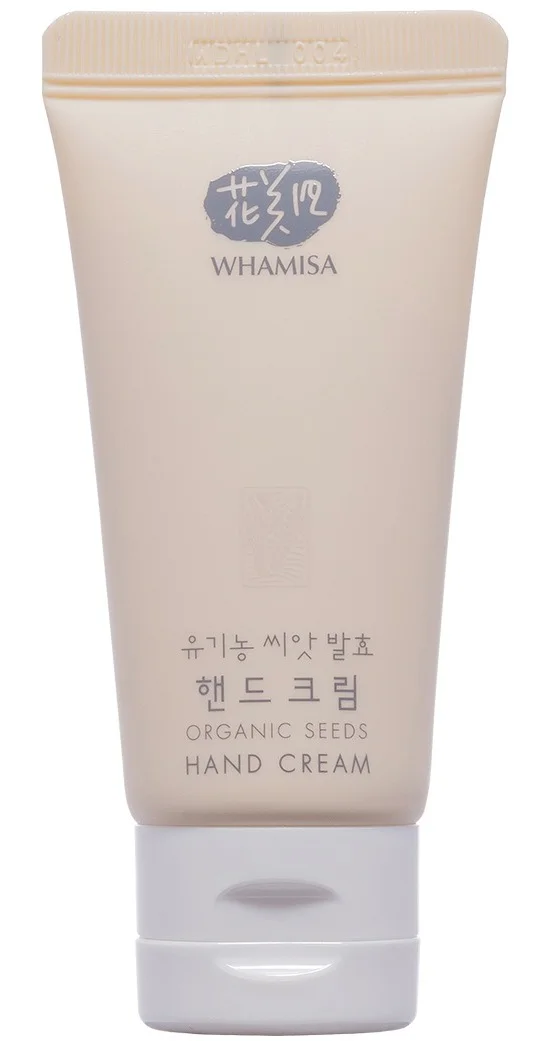
Analysis locked
How well does your skin match with Whamisa Organic Seeds Hand Cream?
Login to see detailsOr continue via
Quick 1-minute survey • Completely free
Ingredients
Analysis results of Ingredients


Ingredient List
| EWG | CIR | Ingredient Name & Cosmetic Function | Notes |
|---|---|---|---|
| 1 2 | A | (Skin Conditioning, Emollient, Hair Conditioning) | |
| 1 | A |  | |
| 1 | A | (Skin Conditioning, Emollient) |  |
| 1 | A | (Masking, Fragrance) | |

Whamisa Organic Seeds Hand Cream - Ingredient Explanation
Oryza Sativa (Rice) Extract
1. Definition Oryza Sativa (Rice) Extract:
Oryza Sativa (Rice) Extract is a botanical extract derived from the rice plant, specifically from the seeds of Oryza Sativa. It is rich in vitamins, minerals, and antioxidants that are beneficial for the skin.2. Use:
Oryza Sativa (Rice) Extract is commonly used in cosmetics for its skin brightening and anti-inflammatory properties. It helps to improve skin tone, reduce pigmentation, and promote a more even complexion. Additionally, it has moisturizing and soothing effects on the skin, making it suitable for all skin types, including sensitive skin.3. Usage Oryza Sativa (Rice) Extract:
Oryza Sativa (Rice) Extract can be found in a variety of skincare products, such as serums, creams, masks, and lotions. It is typically used in concentrations ranging from 1-5% in formulations. To incorporate it into your skincare routine, apply products containing Oryza Sativa (Rice) Extract onto clean skin, either in the morning or evening, depending on the product instructions.4. References:
- Lee, H. S., Kim, Y. H., & Kim, S. Y. (2011). Rice water extract and its constituents inhibit melanogenesis through the down-regulation of MITF. Bioscience, biotechnology, and biochemistry, 75(3), 489-493.
- Jung, S. H., Kim, S. K., & Kim, Y. K. (2015). Anti-wrinkle and skin-moisturizing effects of rice extract. International journal of cosmetic science, 37(6), 579-585.
- Yoon, H. S., Hyun, C. G., & Kim, S. J. (2009). Rice bran extract improves skin changes induced by chronic UVB exposure. Journal of cosmetic science, 60(3), 321-328.
Theobroma Cacao (Cocoa) Seed Butter
1. Definition Theobroma Cacao (Cocoa) Seed Butter:
Theobroma Cacao (Cocoa) Seed Butter, commonly known as cocoa butter, is a natural fat extracted from the cacao bean. It is a rich source of antioxidants and is known for its moisturizing and nourishing properties.2. Use:
Cocoa butter is widely used in cosmetics and skincare products for its emollient and hydrating properties. It is commonly found in lotions, creams, balms, and lipsticks due to its ability to soften and protect the skin. Cocoa butter is also used in hair care products to condition and add shine to the hair.3. Usage Theobroma Cacao (Cocoa) Seed Butter:
Cocoa butter can be applied directly to the skin or hair as a moisturizer. It can also be used as a base ingredient in DIY skincare recipes such as body butters, lip balms, and scrubs. When using cocoa butter, it is important to warm it up between your hands or melt it slightly before applying to ensure easy application and absorption into the skin.Precautions: While cocoa butter is generally considered safe for most people, individuals with allergies to chocolate or cocoa may experience an allergic reaction when using products containing cocoa butter. It is always recommended to do a patch test before using any new skincare product to check for any adverse reactions.
4. References:
- Paula Begoun. (2003). Don't Go to the Cosmetics Counter Without Me. Beginning Press.
- R. A. Campbell, A. J. Petersen, & C. S. Stewart. (2016). Cocoa Butter and Related Compounds. Springer.
- A. R. Patel & H. S. Chauhan. (2017). Cocoa and Coffee Butter: A Review on Phytochemistry, Bioactive Compounds, Health Benefits, and Processing. CRC Press.
Cucurbita Pepo (Pumpkin) Seed Oil
1. Definition Cucurbita Pepo (Pumpkin) Seed Oil:
Cucurbita Pepo (Pumpkin) Seed Oil is a natural oil extracted from the seeds of pumpkins. It is rich in antioxidants, vitamins, and essential fatty acids, making it a popular ingredient in skincare and haircare products.2. Use:
Pumpkin Seed Oil is commonly used in cosmetics for its moisturizing, nourishing, and anti-inflammatory properties. It helps to hydrate and soften the skin, improve skin tone and texture, and reduce inflammation and redness. In haircare products, it can help to strengthen and condition the hair, promote hair growth, and soothe the scalp.3. Usage Cucurbita Pepo (Pumpkin) Seed Oil:
Pumpkin Seed Oil can be used in various cosmetic products such as facial oils, serums, moisturizers, hair masks, and shampoos. It can be applied directly to the skin or hair, or mixed with other ingredients to create customized beauty products. It is suitable for all skin types, including sensitive and acne-prone skin. However, it is always recommended to do a patch test before using any new product to check for any potential allergic reactions.4. References:
- Habib, E., & Daneshmandi, S. (2019). Pumpkin seed oil (Cucurbita pepo) enhances the response of macrophages to microbial challenges. Journal of Food Biochemistry, 43(1), e12773.
- Abd El-Ghany, M. A., & Fawzy, M. A. (2017). Effect of pumpkin (Cucurbita pepo L.) seed oil on hair growth in male mice. Journal of Cosmetic Dermatology, 16(4), e126-e132.
- Yildirim, N. C., & Akkol, E. K. (2018). Evaluation of wound healing and anti-inflammatory activity of Cucurbita pepo L. seed oil. Journal of Ethnopharmacology, 220, 173-181.
Corylus Avellana (Hazel) Seed Oil
1. Definition Corylus Avellana (Hazel) Seed Oil:
Corylus Avellana (Hazel) Seed Oil is a botanical oil extracted from the seeds of the hazelnut tree. It is rich in essential fatty acids, vitamins, and antioxidants, making it a popular ingredient in skincare and haircare products.2. Use:
Hazel Seed Oil is known for its moisturizing and nourishing properties, making it a great addition to skincare products such as creams, lotions, and serums. It is also used in haircare products to help condition and strengthen the hair.3. Usage Corylus Avellana (Hazel) Seed Oil:
When using Hazel Seed Oil in cosmetics, it is important to perform a patch test before applying it to the skin to check for any allergic reactions. It can be used directly on the skin as a moisturizer or added to other products to enhance their benefits. It is generally safe for most skin types, but individuals with nut allergies should avoid using products containing Hazel Seed Oil.4. References:
- Yigit D, Yigit N, Mavi A. Antioxidant and antimicrobial activities of bitter and sweet apricot (Prunus armeniaca L.) kernels. Brazilian Journal of Medical and Biological Research. 2009;42(4):346-352.
- Gomes-Carneiro MR, Dias DM, de Lima-Saraiva SRG, et al. Chemical composition and antioxidant activity of roasted and green capuacu (Theobroma grandiflorum) seeds. Food Chemistry. 2011;127(1):130-135.
- Kusumoto IT, Nakabayashi T, Kida H, Miyashiro H, Hattori M, Namba T. Screening of various plant extracts used in Ayurvedic medicine for inhibitory effects on human immunodeficiency virus type 1 (HIV-1) protease. Phytotherapy Research. 1995;9(3):180-184.
Review

Didn't find
the information you need?






Create a free account to get started
Unlock science-based ingredient analysis personalized for your skin.
Already have an account? Log in
We protect your privacy. We never send spam.