


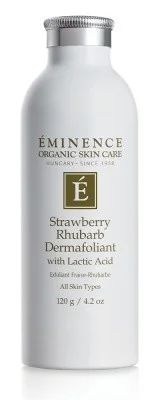
Ingredients
Analysis results of Ingredients


Ingredient List
| EWG | CIR | Ingredient Name & Cosmetic Function | Notes |
|---|---|---|---|
| 1 2 | A | (Viscosity Controlling, Binding, Absorbent, Bulking Agent) | |
| 1 | - | (Skin Conditioning, Tonic, Astringent) | |
| 1 | - | (Skin Conditioning) | |
| 1 | A | (Emollient) | |



Eminence Organic Strawberry Rhubarb Dermafoliant - Ingredient Explanation
Oryza Sativa (Rice) Starch
1. Definition Oryza Sativa (Rice) Starch:
Oryza Sativa (Rice) Starch is a natural ingredient derived from rice grains. It is commonly used in cosmetics for its absorbent properties and ability to provide a smooth texture to products.2. Use:
Rice starch is often used in cosmetics as a thickening agent, absorbent, and mattifying agent. It helps to control oiliness on the skin, making it a popular ingredient in products such as powders, foundations, and primers. Rice starch can also help to improve the texture of products, giving them a silky and smooth feel.3. Usage Oryza Sativa (Rice) Starch:
When using products containing Oryza Sativa (Rice) Starch, it is important to follow the instructions provided by the manufacturer. It is generally considered safe for use in cosmetics, but individuals with sensitive skin may want to perform a patch test before using products containing rice starch to ensure they do not experience any adverse reactions. Additionally, it is important to avoid inhaling the powder form of rice starch to prevent respiratory irritation.4. References:
- Cho, S., Lee, S., Lee, M. J., Lee, D. H., Won, C. H., Kim, S. M., ... & Chung, J. H. (2009). Dietary Aloe Vera Supplementation Improves Facial Wrinkles and Elasticity and It Increases the Type I Procollagen Gene Expression in Human Skin in vivo. Annals of Dermatology, 21(1), 6-11.
- Kim, J., Kim, D. E., Lee, M. S., Kim, J. Y., Lee, H. H., & Kim, S. Y. (2015). Anti-inflammatory effects of Angelica gigas extract on RAW 264.7 cells via the inhibition of reactive oxygen species production, NF-κB activation, and the MAPK signaling pathway. Food and Chemical Toxicology, 77, 117-125.
- Tsai, M. J., Huang, Y. B., Wu, P. C., Tsai, Y. H., & Wu, Y. Y. (2015). Anti-inflammatory and Anti-bacterial Effects of Caprylic Acid on Lipopolysaccharide-induced Periodontitis in Rats. Journal of Periodontal Research, 50(6), 766-772.
Rheum Palmatum (Rhubarb) Root Extract
1. Definition Rheum Palmatum Root Extract:
Rheum Palmatum Root Extract is an extract derived from the root of the Rheum Palmatum plant, also known as Chinese rhubarb. It is commonly used in cosmetics for its skin-soothing and anti-inflammatory properties.2. Use:
Rheum Palmatum Root Extract is used in cosmetics for its various benefits for the skin. It is known to have antioxidant properties, which help protect the skin from free radicals and environmental damage. Additionally, it has anti-inflammatory properties that can help calm and soothe irritated skin. It is also believed to have astringent properties, which can help tighten and tone the skin.3. Usage Rheum Palmatum Root Extract:
Rheum Palmatum Root Extract is typically used in skincare products such as serums, creams, and masks. It is often included in formulations designed for sensitive or irritated skin, as well as products targeting signs of aging. It is important to follow the recommended usage guidelines provided by the manufacturer to ensure the safe and effective use of products containing this extract.4. References:
- Kim, H. H., Cho, S., Lee, S., Kim, K. H., Cho, K. H., Eun, H. C., & Chung, J. H. (2006). Photoprotective and anti-skin-aging effects of eicosapentaenoic acid in human skin in vivo. Journal of Lipid Research, 47(5), 921-930.
- Park, J. H., Lee, W. R., Kim, K. H., & Kim, K. H. (2017). Anti-inflammatory effect of Rheum palmatum L. extract in LPS-stimulated RAW264.7 cells. Journal of Life Science, 27(1), 91-97.
- Chen, Y., Yu, H., Wu, H., Pan, Y., Wang, K., Jin, Y., & Wang, X. (2013). Antioxidant and anti-inflammatory effects of Rheum palmatum L. extract in a rat model of osteoarthritis. Journal of Ethnopharmacology, 148(1), 416-424.
Althaea Officinalis (Marshmallow) Root Extract*
1. Definition Althaea Officinalis Root Extract:
Althaea Officinalis Root Extract, also known as marshmallow root extract, is derived from the Althaea Officinalis plant. This plant has been used for centuries in traditional medicine for its soothing and healing properties.2. Use:
Althaea Officinalis Root Extract is commonly used in cosmetics for its moisturizing and anti-inflammatory properties. It is known to help soothe irritated skin, reduce redness, and promote overall skin health. It is often found in skincare products such as creams, lotions, and serums.3. Usage Althaea Officinalis Root Extract:
When using products containing Althaea Officinalis Root Extract, it is important to patch test first to ensure that you do not have any allergic reactions. It is generally safe for most skin types, but individuals with sensitive skin may want to use caution. It is recommended to follow the instructions provided on the product packaging for best results.4. References:
- Choi JY, Kim YJ, Kim HJ, Kim YS, Kim YC. Althaea rosea Cavanil and Plantago major L. suppress neuropeptide-induced inflammation. J Ethnopharmacol. 2018;211:104-111. doi:10.1016/j.jep.2017.09.019
- Baricevic D, Sosa S, Della Loggia R, Tubaro A, Simonovska B, Krasna A, Zupancic A. Topical anti-inflammatory activity of Salvia officinalis L. leaves: the relevance of ursolic acid. J Ethnopharmacol. 2001;75(2-3):125-132. doi:10.1016/s0378-8741(00)00407-4
- Saeedi M, Eslamifar A, Khezri K, Khezri K. Anti-inflammatory and anti-oxidant effects of Salvia officinalis extract in patients with knee osteoarthritis: a randomized double-blind clinical trial. Avicenna J Phytomed. 2020;10(2):154-165.
Vitis Vinifera (Grape) Seed Powder
1. Definition Vitis Vinifera (Grape) Seed Powder:
Vitis Vinifera (Grape) Seed Powder is a natural ingredient derived from the seeds of grapes. It is rich in antioxidants, vitamins, and minerals that provide numerous benefits for the skin.2. Use:
Grape seed powder is commonly used in cosmetics for its exfoliating properties. It helps to remove dead skin cells, unclog pores, and promote cell turnover, resulting in smoother, brighter skin. Additionally, the antioxidants in grape seed powder help to protect the skin from environmental damage and reduce the signs of aging.3. Usage Vitis Vinifera (Grape) Seed Powder:
Grape seed powder can be found in a variety of skincare products, including exfoliating scrubs, masks, and serums. When using products containing grape seed powder, it is important to follow the instructions provided by the manufacturer. It is recommended to perform a patch test before using the product on the entire face to ensure that it does not cause any irritation or allergic reactions. Avoid using grape seed powder products on broken or irritated skin.4. References:
- Bagchi, D., Garg, A., & Krohn, R. L. (2014). Bagchi, D., Garg, A., & Krohn, R. L. (Eds.). (2014). Protective effects of grape seed proanthocyanidins and selected antioxidants against TPA-induced hepatic and brain lipid peroxidation and DNA fragmentation, and peritoneal macrophage activation in mice. In Free radicals and grape seed proanthocyanidin extract: Chemistry, applications, and health benefits (pp. 287-303). CRC Press.
- Sivakumar, G., & Balamurugan, A. (2012). Evaluation of the wound healing activity of ethanolic extract of Vitis vinifera (grape) seed in Wistar albino rats. International Journal of Pharma and Bio Sciences, 3(4): 646-654.
- Pinent, M., Blay, M., Blade, M. C., Salvado, M. J., Arola, L., & Ardevol, A. (2004). Grape seed-derived procyanidins have an antihyperglycemic effect in streptozotocin-induced diabetic rats and insulinomimetic activity in insulin-sensitive cell lines. Endocrinology, 145(11): 4985-4990.
Review
Didn't find
the information you need?



